
The false economy: why the cheapest option can cost more
The lowest upfront price can hide replacement, downtime, hassle, risk, and lost utility. This framework shows when spending more is rational, when premium is waste, and where the value curve actually bends.
The cheapest option can cost more
I've repeatedly found that the lowest price is a bad shortcut for the best purchase. Sometimes buying cheap works. Other times it means replacing the item, losing a day, tolerating a worse experience, or paying to undo the decision. That's the false economy I care about: saving on the receipt while losing somewhere more important.
A $55 hostel instead of a $120 hotel saves $65. That can be a bad trade if poor sleep or a long transfer ruins one of the few days you paid to travel. I would rather protect the trip than win the cheapest-room contest.
A $35 hostel instead of a $275 hotel saves $240, which is a different decision. For someone traveling solo who enjoys hostel life and does not need the extra privacy, I would take the savings. The question is what the cheaper stay actually costs in sleep, time and enjoyment.
The correct objective is to find the point where money, time, durability, reliability, convenience, risk, performance, and quality of life produce the strongest total outcome. A false economy happens when one visible cost is minimized while larger costs elsewhere are ignored. The classic version is buying something cheap, replacing it repeatedly, and eventually spending more than a durable alternative would have cost. That definition is too narrow. False economies also include:
- saving $15 while wasting an hour;
- choosing a cheaper house that adds hundreds of commuting hours per year;
- buying inadequate equipment and upgrading twice;
- delaying maintenance until the eventual repair becomes larger;
- choosing the lowest monthly payment while increasing total financing cost;
- buying in bulk because the unit price is lower, then throwing part of it away;
- maintaining an insurance or warranty product whose exclusions make the apparent protection weak;
- keeping obsolete equipment because replacement costs money even though the old equipment wastes hours every week;
- buying an expensive flagship when a much cheaper product already delivers nearly all useful performance.
There are two expensive ways to optimize badly:
- Spend too little and pay for the compromise later.
- Spend too much after meaningful improvement has already stopped.
Buy enough quality to escape the failure and friction zone. Stop spending when incremental utility collapses.
For everyday purchases, the Sweet Spot Index shows where paying more earns its keep and where I would stop.
Price is not cost
Purchase price is simply the easiest number to see. That visibility makes it disproportionately influential. A $400 product feels cheaper than a $700 product because the transaction happens now and the difference is certain. Replacement five years from now is uncertain. Future maintenance is uncertain. Downtime is uncertain. The hour spent troubleshooting next Thursday is invisible. Resale value is delayed. Frustration has no receipt. The comparison becomes:
$400 versus $700
when the real comparison might be:
$400 + replacement + repairs + downtime + shopping again
versus:
$700 + longer service life + better daily use + residual value
Consider a deliberately simple example.
| Option | Purchase price | Expected useful life | Purchase cost per year |
|---|---|---|---|
| A | $400 | 4 years | $100 |
| B | $700 | 10 years | $70 |
Ignoring maintenance, resale, financing, and the time value of money, the more expensive product costs less per year. These are assumed service lives, not tested product results. Compare both options over the same realistic ownership period before deciding. Now reverse the situation. Suppose a $700 product delivers 95% of the utility a buyer wants, while a $2,000 version delivers 100%. These percentages are illustrative judgments, not measured product scores.
The final 5% costs another $1,300. That may be defensible for an enthusiast who notices and values that difference constantly. For everyone else, the flagship can become the false economy. The mistake was never spending more or spending less. The mistake was optimizing the wrong number.
Why false economies are so easy to create
Visible dollars are easy to compare. Everything else is messy. Cash paid today is certain. A future failure is probabilistic. A lower sticker price is measurable. An annoying user interface experienced 2,000 times is not. A cheaper house has a clear purchase price. Ten years of additional commuting arrives 45 minutes at a time.
An extended warranty has a clear monthly cost. The probability of a covered claim, deductible, exclusions, reimbursement method, and claim effort are harder to compress into one number. A larger package has a lower unit price. The food thrown away six weeks later is disconnected from the purchasing decision.
A luxury product may be objectively better. The fact that its final improvement costs three times as much as the previous improvement is less emotionally satisfying. This creates several recurring blind spots:
Delayed costs get discounted psychologically. Replacement, repair, resale loss, and accumulated inconvenience feel less real than today's price.
Probabilistic costs get treated as zero. A failure that only happens 5% of the time is still part of the economics if the consequences are large.
Time is often assigned a value of zero. People will drive, wait, troubleshoot, research, assemble, return, repair, and manage complexity to protect surprisingly small amounts of money.
Recurring friction hides inside routine. Five irritating minutes rarely feel important. Five minutes every day for ten years is more than 300 hours.
Unit economics replace household economics. A lower cost per ounce, month, mile, or feature sounds efficient even when total spending or consumption increases.
Premium pricing gets confused with premium value. Better materials, more features, and higher benchmark scores do not guarantee proportional utility.
I don't need every purchase in a perfect spreadsheet. I do need to know when the cheap price is hiding replacement, extra driving, lost time, inconvenience, risk, or a shorter usable life. If one of those dominates the decision, pretending it doesn't exist is the expensive mistake.
The Mr ROI total-value ledger
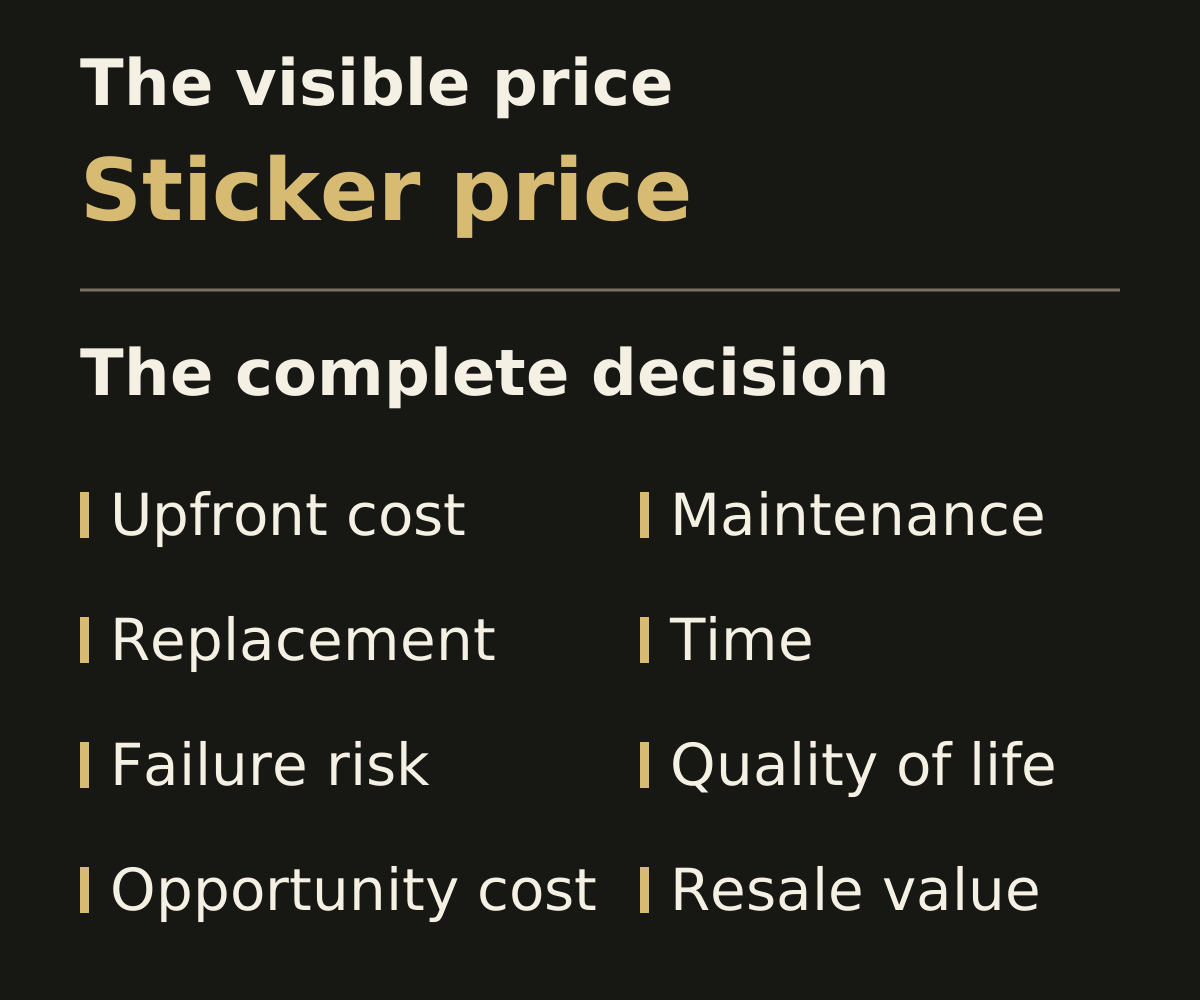
I do not try to convert every dimension of life into a fake dollar value. Some costs are naturally measured in dollars. Others are better measured in hours, probability, frequency, or a simple description of what gets better or worse. The purpose is not artificial precision. It is avoiding artificial omission.
Upfront cost
Start with what leaves the account today:
- purchase price;
- tax;
- shipping;
- installation;
- financing fees;
- accessories required to make the purchase usable.
This matters. It just does not deserve to end the analysis.
Lifetime cash cost
Then include what follows the transaction:
Lifetime cash cost ≈
Acquisition and installation + financing interest and fees + operating costs + repairs and replacements − resale value.
Operating costs include maintenance, consumables, energy, subscriptions, and insurance. Count tax, shipping, accessories, and transaction costs once. If the purchase price is already included, add loan interest and fees, not principal repayments again. The equation will not be exact. It is still much better than comparing stickers.
I treat new, open-box, refurbished, and used as different risk packages, not just different prices. Warranty support, inspection work, return friction, repair exposure, depreciation, and the amount I can recover when I sell all belong in the comparison.
Time cost
Ask how much additional time the option requires. Include:
- travel;
- waiting;
- setup;
- maintenance;
- troubleshooting;
- research;
- claims;
- repeated manual work;
- commuting;
- returns;
- selling;
- repairing.
A useful first-pass calculation is:
effective compensation = savings ÷ additional time
Save $12 after 90 extra minutes of work:
$12 ÷ 1.5 hours = $8 per hour
Save $15 by adding 40 minutes of driving:
$15 ÷ (40/60 hours) = $22.50 per hour, roughly $22
That is the gross return before fuel, vehicle wear, risk and inconvenience. Decide whether the money saved is worth giving up that time, including leisure you would rather keep.
Reliability and failure cost
Failure economics depend on consequences, not replacement price alone. A useful approximation is:
expected failure cost ≈ probability of failure × consequence of failure
Use probabilities over the same ownership period and avoid counting the same repair again in lifetime cash cost. An average expected cost is not enough when one bad outcome would be unaffordable or unsafe. A cheap component that occasionally dies may be perfectly rational when failure is harmless.
I'll gamble on an inexpensive storage bin long before I gamble on a safety-critical component. Even if two products have similar failure rates, a failed bin and a failed electrical part carry entirely different consequences. The downside determines how much reliability is worth.
Quality of life
Some returns are not financial. Count recurring changes in:
- comfort;
- noise;
- privacy;
- sleep;
- convenience;
- stress;
- usability;
- performance;
- autonomy;
- enjoyment.
The useful mental model is:
frequency × magnitude
A severe inconvenience that happens once may matter less than a mild annoyance repeated several times every day. That is why a mattress, climate-control system, phone, office chair, vehicle, commute, or home layout can deserve disproportionately careful optimization. They sit underneath thousands of hours of life.
Opportunity cost
Resources have alternative uses. The relevant resource might be:
- money;
- time;
- space;
- attention;
- borrowing capacity;
- storage;
- flexibility;
- mental bandwidth.
A $10,000 upgrade competes with investing, travel, another home project, debt reduction, business investment, or simply keeping $10,000 available. A giant piece of equipment competes with usable floor space. A complicated rewards system competes with attention. Better stuff has an ownership cost after checkout. A cheap house far from everything competes with years of time. Opportunity cost is what prevents a technically good purchase from automatically becoming a good allocation.
Diminishing returns
Finally ask:
What does the next dollar actually buy?
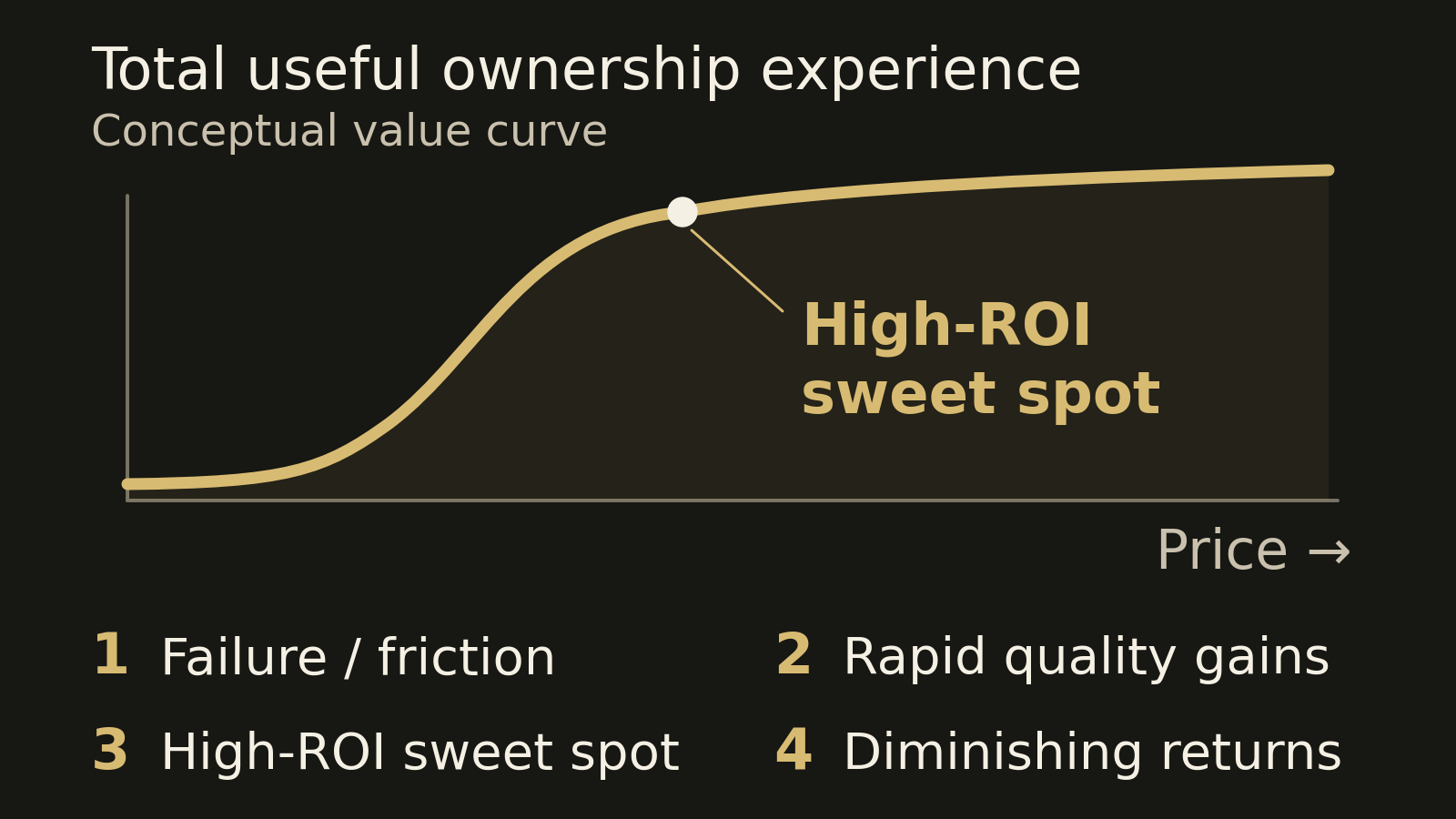
Most categories have a value curve. At the bottom, spending slightly more can create enormous improvements. Then comes a range where quality, durability, usability, reliability, and performance improve rapidly. Eventually the curve bends. Beyond that point, price can keep rising while useful improvement slows dramatically. The goal is not to spend as little as possible.
It is to stop near the point where useful improvement stops compounding. The upper-middle sweet spot applies that stopping rule to product tiers.
Travel: save the trip, not just the hotel bill
Travel makes false economies unusually visible because vacation time is scarce and the surrounding trip is already expensive. Return to the hostel example. These prices are teaching examples, not current lodging quotes.
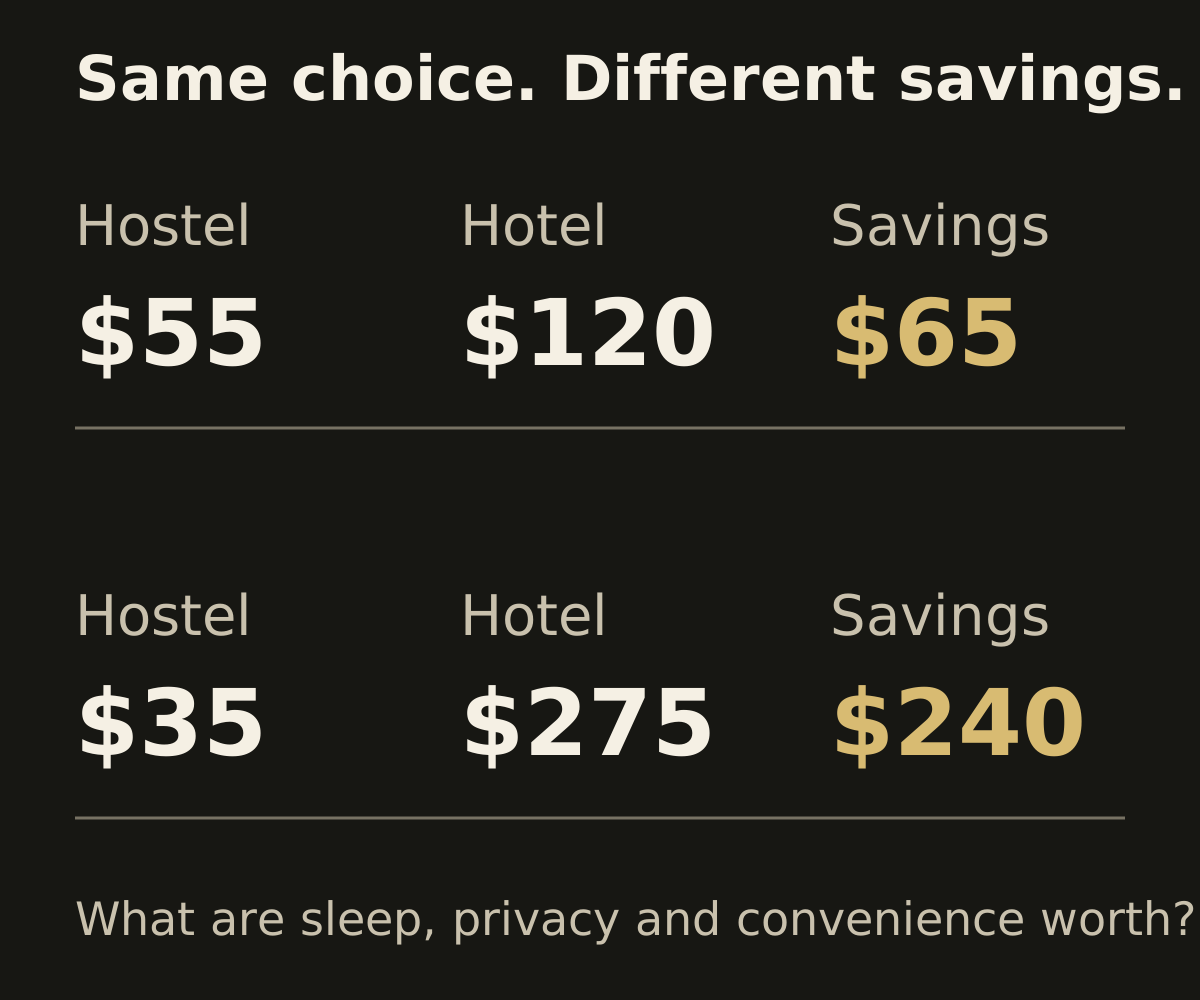
Scenario A
Hostel: $55 Hotel: $120 Visible savings: $65
The hostel may be the right answer. But suppose the sleep, privacy, location, and storage tradeoffs noticeably damage a day containing $300 worth of prepaid activities and one of only four vacation days. The decision did not really protect $65. It exchanged some portion of a scarce $300 day for $65.
A meta-analysis of experimentally restricted sleep found impaired cognitive performance, including executive function and sustained attention. When cheaper lodging disrupts your sleep, count the effect on the next day as part of its cost.
Scenario B
Hostel: $35 Hotel: $275 Visible savings: $240
Now the economics are completely different. The sacrifice may easily justify the savings, particularly for someone traveling solo who enjoys communal travel. The correct decision depends on the utility sacrificed per dollar saved. That same analysis catches other travel false economies. A flight saving $70 may be poor value if it requires waking at 3 AM, a long layover, an additional night away, or losing half a useful vacation day.
A distant airport may advertise a cheaper fare while ground transportation consumes the entire difference. Saving $20 on parking can be irrational if it adds an hour of walking, shuttles, uncertainty, or missed-event risk. Refusing every airport convenience purchase can also become silly. Paying $12 for food is not automatically waste if the alternative is arriving exhausted at the next destination or spending two hours engineering a cheaper solution.
The opposite error is just as common. First class, luxury resorts, private transfers, lounge subscriptions, premium rental cars, and expensive travel bundles can be enjoyable without being efficient. The test is not whether the upgrade feels luxurious. It is whether the incremental utility survives the incremental price. Price the complete vacation, including restricted time: lodging, transport, fees, food, restricted time, fatigue, flexibility, and the experiences the traveler actually cares about.
Home ownership: cheap decisions can become structural liabilities
Home projects magnify false economies because the labor required to redo them can dwarf the original material savings. Cheap flooring does not merely risk buying flooring twice. Premature failure can mean:
- removing furniture;
- demolition;
- disposal;
- subfloor preparation;
- labor;
- trim;
- transitions;
- disruption;
- another installation.
The material is only one line item. The same principle applies to paint. Saving modestly on paint can be irrelevant if it adds labor, extra coats, touch-ups, or earlier repainting.
HVAC provides an even clearer example of why equipment price alone is inadequate. ENERGY STAR states that improper heat-pump installation can reduce system efficiency by up to 30% and may shorten equipment life. A cheaper contractor who gets sizing, airflow, ducts, refrigerant charge, or installation wrong can make the inexpensive quote the expensive system. The broader home rule is straightforward:
Spend more attention where mistakes become embedded in the building.
That includes:
- water management;
- roofing;
- electrical work;
- HVAC design and installation;
- insulation and air sealing;
- structural work;
- shower waterproofing;
- drainage;
- buried utilities;
- networking and conduit;
- difficult-to-access infrastructure.
Cheap cosmetic finishes are relatively easy to change. A hidden mistake behind drywall or tile can be another category of problem entirely. Cheap renovations can hide expensive systems. Preventive maintenance has similar economics. Water intrusion does not become cheaper because it is ignored for another six months. But home efficiency spending also produces reverse false economies.
Geothermal, solar, batteries, premium windows, extreme insulation packages, and ultra-efficient appliances can all be technically excellent while producing poor incremental economics for a particular house. The Department of Energy describes quick payback from some caulking and weatherstripping work. More substantial envelope upgrades can have much longer payback periods. The lesson is not that one upgrade is universally superior. It is to attack the high-return leakage before spending heavily on refinement.
An upgrade claiming to save energy is not automatically a good investment. Calculate:
Installed cost − confirmed applicable incentives − credible residual value over the chosen horizon
against:
realistic energy savings + comfort improvement + durability + risk reduction
Then compare that result with everything else the money could accomplish.
Housing and location: recurring friction compounds for years
Housing prices are so large that buyers can become fixated on acquisition cost. But the house is also a location experienced every day. Imagine two otherwise acceptable homes. One costs less but adds 30 minutes each way to a five-day commute. Assuming 48 working weeks:
1 extra hour per day × 5 days × 48 weeks = 240 hours per year
Over ten years:
2,400 hours
That is 100 full 24-hour days. The cheaper house may still win. A sufficiently large purchase-price difference can absolutely justify the commute. But the commute belongs in the calculation. So do:
- tolls;
- vehicle mileage;
- fuel or electricity;
- parking;
- schedule restrictions;
- access to family;
- restaurants and entertainment;
- schools where relevant;
- airport access;
- job flexibility;
- future resale.
The same principle applies to apartments. Noise, unreliable maintenance, bad climate control, poor parking, long commutes, weak security, or constant management friction can make a cheaper apartment expensive in noncash terms. The reverse matters too. An oversized home can create years of extra:
- acquisition cost;
- interest;
- tax;
- insurance;
- utilities;
- cleaning;
- furnishing;
- landscaping;
- maintenance.
Pay for the neighborhood, amenities and HOA services you will actually use. Housing deserves close scrutiny because its costs and conveniences repeat for thousands of days.
Tools, technology, furniture, and fitness: cost per useful use
Frequency changes the economics of quality. A professional using a tool every day can rationally pay much more for:
- speed;
- ergonomics;
- reliability;
- accuracy;
- parts availability;
- battery ecosystem;
- reduced project failure.
The tool is not merely an object. It is part of the production system. An occasional homeowner drilling six holes per year may get almost no return from the professional tier. This is where inexpensive tools can be excellent ROI. If an inexpensive tool clears the required performance threshold, is used infrequently, and has a harmless failure mode, paying three times more for professional branding may accomplish nothing.
Other tools sit on the opposite side of the line. Poor tolerances, uncomfortable ergonomics, unreliable batteries, bad blades, inadequate power, or constant troubleshooting can turn a bargain into repeated friction. Technology behaves the same way. A phone or computer used several hours every day does not deserve the same purchase logic as a specialty device used twice per year. Paying several hundred dollars more for:
- adequate memory;
- sufficient storage;
- a better display;
- longer support;
- meaningful battery life;
- better ergonomics;
- materially faster workflows
can be cheap on a cost-per-use basis if the improvement is experienced thousands of times. Underbuying can also force an early replacement. But flagship technology produces some of the cleanest examples of reverse false economy. A buyer may pay heavily for:
- processing performance never used;
- storage that remains empty;
- professional video features never opened;
- premium materials hidden inside a case;
- annual upgrades with almost no perceptible benefit.
The same logic applies to mattresses, office chairs, couches, shoes, desks, cookware, bedding, and luggage. A serious home theater illustrates diminishing returns across an entire system. Suppose a $1,500 mattress is used eight hours per night for eight years. That is roughly 23,000 hours of use. The sticker price looks large. The frequency changes the frame. A $1,500 specialty object used twice a year receives no such mathematical forgiveness.
Cost per use does not make expensive products good. It forces price to compete with actual use.
Fitness equipment deserves the same treatment. A poor bench, cable system, bar, shoe, attachment, or rack used constantly can reduce the quality of hundreds of training sessions. Buying three inadequate versions while gradually learning what was needed can cost more than buying the correct one once. But "buy once, cry once" becomes dangerous when it is used to rationalize:
- supplement stacks;
- luxury machines with tiny training advantages;
- recovery gadgets without meaningful evidence;
- premium branding on commodity products;
- equipment purchased for status instead of programming need.
Frequency matters. Performance matters. Failure mode matters. The logo does not.
Cars: sticker price is one variable in a much larger machine
Cars are almost designed to create bad optimization. A buyer can obsess over fuel economy while ignoring depreciation. Someone can save pennies per gallon by driving across town while consuming time and vehicle wear. A cheap used car can be exceptional value or an unreliable bargain that repeatedly interrupts work. A more expensive car can produce real daily utility or simply burn capital through depreciation and insurance.
The useful comparison is total ownership cost:
- purchase price minus resale value, which is depreciation;
- taxes and transaction fees;
- financing interest and fees;
- insurance and registration;
- energy or fuel;
- tires, maintenance, and repairs;
- downtime.
Do not add depreciation again after subtracting resale from purchase price. Do not count loan principal twice either. Financing creates its own false economy.
A lower monthly payment feels cheaper. But CFPB explains that a longer term can increase total interest and negative-equity exposure. Its illustrative $20,000 loan at 4.75% shows the tradeoff: 36 months costs $597 monthly and $1,498 in total interest. At 72 months, the payment drops to $320, but total interest rises to $3,024. These are rounded historical examples, not current loan offers. The payment went down. The cost went up.
Maintenance works the same way. NHTSA emphasizes that proper tire pressure affects safety, durability, and fuel consumption. Correct inflation can also help tires last longer. Tires are a useful example because saving money on a component can increase several other costs simultaneously. Cheap tires, questionable brake components, ignored maintenance, and repairs performed badly can create downside much larger than the original savings. But the premium end deserves equal skepticism.
Prestige brands, exotic cars, luxury trims, giant wheels, and marginal performance upgrades may cost dramatically more without making daily transportation proportionally better. An enthusiast may still rationally buy them. Enjoyment is utility. The mistake is pretending the premium is economically efficient when the actual return is emotional. Label the indulgence accurately and decide whether it is worth the opportunity cost.
That is better analysis than inventing a functional justification after the purchase. Tesla's complete daily-driver economics show how performance and recurring convenience can change the comparison.
Career, food, insurance, and health
Career and education: underinvesting can have enormous opportunity cost
The cheapest path through education or career development is not necessarily the one with the highest lifetime ROI. Refusing to pay for a useful tool, course, certification, portfolio project, conference, relocation, interview preparation, or other career investment can save money today while protecting a much larger income constraint. The return should not be assumed. A credential does not become valuable because it is expensive. The useful questions are:
- Does the target job actually value it?
- Does it create demonstrable skills?
- Does it produce portfolio evidence?
- Does it improve access to interviews?
- Is the skill transferable?
- What income or flexibility could reasonably change?
- How much time does it require?
- What could that time have accomplished elsewhere?
Prestige education creates the opposite problem. A degree with a famous name, expensive campus experience, or elaborate credential stack may have weak ROI if a much cheaper route reaches essentially the same career destination. Career inertia is another false economy. Staying in a substantially lower-paying or lower-growth job because interviewing, networking, reskilling, or changing employers is inconvenient can preserve comfort today while costing years of income and optionality.
Sunk cost should not control the decision. The money, time, or education already invested in the current path is gone. The relevant comparison begins now.
Food: unit price is not household cost
Bulk purchasing shows how easily "value" can become waste. A warehouse package may be cheaper per ounce. That does not make it cheaper if:
- part expires;
- the household consumes more because more is available;
- storage becomes a problem;
- the product is replaced before it is finished;
- a subscription creates purchases that would not otherwise happen.
EPA's April 2025 analysis estimated consumer food waste at roughly $728 per person annually, or about $2,913 for a household of four. The exact number will vary dramatically by household, but it illustrates why cost per unit cannot be separated from the amount actually consumed. The useful metric is often:
cost per unit actually used
not:
cost per unit purchased
This does not make meal prep automatically superior to convenience food either. A prepared meal that costs a few dollars more may prevent a $25 restaurant order on a busy evening. A premium grocery item someone reliably eats can outperform a cheaper substitute repeatedly thrown away. Convenience can be economically useful when it replaces a more expensive default.
Insurance and warranties: transfer catastrophe, do not blindly prepay maintenance
Insurance is one of the easiest categories to oversimplify. The right answer is not "always insure" or "always self-insure." Insurance is most valuable when it transfers a loss that would be financially disruptive or unacceptable to absorb. Small, predictable costs are different. A financially capable household may rationally accept a higher deductible and retain more routine risk itself.
Choose the deductible using your cash reserve, premium savings and ability to absorb a loss. Apply the same discipline to extended warranties.
The FTC recommends examining cost, deductibles, exclusions, overlapping warranty coverage, and the claims process before assuming a service contract adds value. The agency specifically notes that claims friction can reduce the value of coverage and that saving the money for repairs can sometimes be preferable. That framework separates two very different products:
Risk transfer: inexpensive protection against a high-impact loss.
Maintenance prepayment: paying an intermediary to manage relatively predictable repairs while retaining exclusions, deductibles, and claim friction.
The first can be highly rational. The second needs much stronger evidence. Broad protection can still win when one reasonable price covers a large pool of expensive assets and the contract actually pays. Use the right consumer-protection layer, and check when one household plan can beat individual warranties. The contract controls. Not the marketing term "protection."
Healthcare and prevention: cheap today can move cost into tomorrow
Healthcare requires more caution because the correct choice depends on the person and the medical situation. The economic principle is still useful. Delaying appropriate care can sometimes allow a manageable issue to become more disruptive or limiting. The right preventive service depends on age, risk, and clinical evidence. USPSTF recommendations explicitly weigh benefits and harms; more testing is not automatically better. The analysis should not be:
care costs money, therefore avoid care
or:
more care is always better
It should be:
What is the credible downside of delaying this, and what does appropriate professional guidance recommend?
The same logic applies to sleep, workspace ergonomics, protective equipment, smoke and carbon-monoxide detection, and basic household safety. The important distinction is between evidence-supported prevention and expensive wellness consumption that only looks preventive. A drawer full of supplements and recovery gadgets is not automatically health investment.
Time and quality of life belong in the return
Time is the hidden currency behind many false economies
This may be the most commonly ignored cost in personal finance. People who would never work a second job for $6 per hour will effectively do exactly that to "save money." They drive 30 minutes for a tiny discount. They spend an evening searching coupon combinations. Couponing should not become a second job. They manually repeat work that software could automate. They wait in a long line to avoid a modest fee.
They perform low-value DIY work despite hating the task and having no interest in developing the skill. They repair a disposable product for the fifth time because replacing it feels like waste. They construct brutal travel itineraries to protect a small fare difference. The basic calculation is useful:
Savings ÷ additional time = implied hourly compensation
Suppose a deal saves $18 but requires:
- 20 minutes of research;
- 15 minutes of additional driving each way;
- 10 minutes in the store.
Total time: 60 minutes Effective compensation: $18 per hour Then subtract transportation cost and any meaningful hassle. That may still be worthwhile. It may also be irrational for someone with a valuable alternative use for the hour. The point is not that every free hour should be converted into income. An hour relaxing at home does not need to "earn" anything. The point is that the hour has value.
Using it intentionally for leisure can be a much better allocation than involuntarily turning it into unpaid logistics to save six dollars. This is also where automation earns its keep. If a $100 tool eliminates 10 minutes of annoying work every week for five years: 10 minutes × 52 weeks × 5 years = 2,600 minutes That is more than 43 hours.
The purchase costs about $2.30 per hour eliminated, before considering resale or other utility. This assumes the tool stays useful for five years and has no additional fees. Subtract setup and maintenance time from the hours saved. A good automation is not merely a gadget. It is purchased time.
Quality of life is a legitimate return
Financial optimization becomes self-defeating when net worth is treated as the only output that matters. Money exists partly to convert economic resources into better life outcomes. That can include:
- time;
- comfort;
- health;
- privacy;
- enjoyment;
- convenience;
- autonomy;
- reduced stress.
A quiet house does not produce a dividend. A great mattress does not appreciate. Good climate control does not increase a brokerage balance every month. A reliable car may not be the lowest-cost transportation. A short commute does not appear as income. A comfortable workspace may never pay for itself in a conventional spreadsheet. Those things can still have enormous lifetime utility because they affect hundreds or thousands of hours.
The mistake is not spending money on quality of life. The mistake is failing to compare the quality-of-life improvement with its cost and frequency. A $1,000 premium that meaningfully improves something used every day for ten years can be tiny on a per-use basis. A $1,000 premium for a feature noticed twice per year can be enormous. This is why "I could invest the difference" is incomplete analysis.
Yes, the difference has future value. The utility being given up also has value. Optimization requires comparing both. The financially intelligent life is not the life with the highest possible ending balance. It is the life where scarce resources are allocated deliberately enough that both future optionality and present utility remain strong.
Risk and the limits of paying for quality
Risk changes what "cheap" means
Expected value matters most when consequences vary dramatically. Imagine two $20 components. Component A occasionally stops working and requires five minutes to replace. Component B occasionally fails in a way that can damage $2,000 of connected equipment. The replacement price is identical. The rational quality threshold is not. This is why I treat failure modes differently across categories. Low-cost experimentation works well when:
- failure is obvious;
- failure is harmless;
- replacement is easy;
- downtime does not matter;
- the decision is reversible.
Paying for reliability becomes more attractive when:
- failure creates collateral damage;
- safety is involved;
- repair access is difficult;
- downtime affects work;
- travel is involved;
- installation is expensive;
- the product sits behind walls or under floors;
- failure compromises other expensive systems.
This is also why the cheapest contractor is not automatically the lowest bid economically. If labor must be paid twice, walls reopened, flooring removed, a trip disrupted, or another system damaged, the expected downside can dwarf the original savings. Risk should be priced by consequence. Not by how inexpensive the failing part looked at checkout.
"Buy once, cry once" is not a strategy
There is a useful idea hiding inside the cliché. Buying a durable, repairable, high-performing product once can absolutely beat buying multiple inadequate versions. But "buy once, cry once" can also become luxury marketing disguised as discipline. Sometimes:
- technology changes rapidly;
- needs change;
- the expensive product is not more durable;
- the cheaper product already clears the performance threshold;
- replacement parts disappear;
- an enthusiast does not yet know which features matter;
- three times the price buys 10% more utility;
- a low-cost starter product is the cheapest way to learn.
A beginner may rationally buy the $150 version, discover which shortcomings actually matter, and upgrade later. The first product functioned as tuition. That can be more rational than spending $1,500 based on specifications the buyer does not yet understand. A low-cost trial is rational when it buys information cheaply and failure is harmless. Pay for durability once the job and use pattern are clear.
The value curve: where the best purchase usually lives
The conceptual curve illustrates diminishing returns. Use actual prices and the improvements you would notice to find the bend for your purchase.
X-axis: price. Y-axis: total useful ownership experience.
The curve begins in the failure and friction zone. Products here technically perform the job but may impose severe compromises in reliability, durability, comfort, usability, or support. Then comes a steep section. Each additional dollar buys meaningful improvements:
- better construction;
- longer life;
- better ergonomics;
- improved performance;
- greater reliability;
- stronger support.
Eventually the curve reaches a bend. This is the high-ROI sweet spot. The product clears the job well enough that additional spending becomes harder to justify. Beyond it lies diminishing returns. Improvements remain real but become progressively more expensive. Finally comes the luxury and status zone, where much of the incremental price may purchase exclusivity, craftsmanship, aesthetics, rarity, branding, or tiny refinements. Those things can still produce utility.
They simply should not be confused with efficiency. The ideal purchase is usually near the bend in the curve. Not necessarily the cheapest. Not necessarily the middle. Not necessarily the flagship. The bend moves depending on the buyer, use frequency, failure consequences, income, preferences, and what else the resources could accomplish.
A repeatable false-economy test
When a decision matters enough to analyze, I would run it in this order. Keep the analysis proportionate: optimization itself can turn negative ROI.
Define the actual job
What must the purchase or decision accomplish? Separate:
non-negotiables
from:
nice improvements
from:
features marketing taught you to want
A product that fails a genuine requirement is not cheap. A product that exceeds every requirement by a mile is not automatically valuable.
Choose the ownership horizon
How long will this realistically be used? Do not give a product a ten-year durability advantage if technology, moving, growth, changing needs, or personal preferences make three years the realistic horizon.
Calculate lifetime cash cost
Include:
- acquisition;
- financing;
- maintenance;
- consumables;
- energy;
- subscriptions;
- repairs;
- replacement;
- transaction costs;
- resale.
Run a normal case and an ugly case when uncertainty matters.
Count the extra time and friction
Estimate the hours consumed by:
- travel;
- setup;
- upkeep;
- troubleshooting;
- claims;
- commuting;
- manual work;
- replacing;
- reselling.
Use the hourly compensation test when one option claims to save money by requiring more work.
Model failure
Ask:
What can realistically go wrong?
Then:
How likely is it?
Then:
What happens if it does?
A small probability multiplied by a catastrophic consequence may deserve more spending than a high probability multiplied by a harmless consequence.
Count recurring quality-of-life effects
Write down what changes in normal life. Then estimate:
frequency × magnitude × duration
Do not obsess over assigning dollars. "Twenty minutes saved every workday" is already useful information. "So much quieter that I sleep better every night" is useful information. "I like the stitching slightly more" is also information. They simply deserve different prices.
Price the opportunity cost
What does choosing this prevent? Could the premium:
- remain invested;
- fund another higher-return upgrade;
- eliminate debt;
- buy time elsewhere;
- preserve flexibility;
- reduce risk;
- solve a larger problem?
A good purchase can still lose to a better use of the same resources.
Test the next dollar
Once every requirement is met, ask:
What exactly does the next tier improve?
Then:
How often will I experience that improvement?
Then:
What am I paying for each additional unit of utility?
When the answer becomes difficult to explain without brand prestige, specifications, or vague claims about "quality," the curve may already have flattened.
BUY when the complete cost is justified by durable utility or meaningful risk reduction. WAIT when the use case or evidence is unclear. PASS when the premium buys little you value. KEEP WHAT YOU HAVE when it already does the job.
The same framework works almost everywhere
| Decision | False economy at the cheap end | False economy at the expensive end |
|---|---|---|
| Travel | Ruin a scarce vacation day to save a small amount on sleep, location, or scheduling | Buy luxury upgrades that barely change the trip |
| Home | Cheap materials, bad installation, deferred maintenance, undersized infrastructure | Capital-intensive efficiency upgrades with weak payback or utility |
| Tools | Constant frustration, lost time, failed projects | Professional equipment for occasional trivial use |
| Cars | Cheap tires, unreliable vehicles, skipped maintenance, payment-only financing | Prestige, luxury trims, exotic performance rarely used |
| Technology | Inadequate hardware that limits productivity or forces early replacement | Flagship capability that sits unused |
| Furniture | Daily discomfort or repeated replacement | Designer premiums with little additional utility |
| Fitness | Bad equipment that limits repeated training | Supplements and luxury equipment with marginal benefits |
| Insurance | Retaining a loss you could not absorb | Paying intermediaries to cover predictable small expenses inefficiently |
| Housing | Long commutes, noise, poor maintenance, recurring friction | Excess space and amenities that create permanent carrying costs |
| Career | Refusing high-return tools, education, or transitions | Prestige credentials without proportional career benefit |
| Food | Low quality that goes uneaten, bulk waste, travel for tiny savings | Convenience and subscriptions that increase consumption |
| Financial optimization | Ignoring valuable savings | Spending hours extracting pennies |
Frugality is resource efficiency, not minimum spending
The word frugal is often treated as a synonym for cheap. That definition is too shallow. If I spend $700 instead of $400 because the product lasts more than twice as long, I did not abandon frugality. If I pay $65 more for a hotel because it protects a rare $300 vacation day, that can be frugal. If I pay for automation that returns dozens of hours, that can be frugal.
If I choose the more reliable car because downtime would severely disrupt life, that can be frugal. And if I refuse a $2,000 flagship because the $700 product does 95% of the job, that is the same philosophy. Frugality is not spending the least money. It is refusing to waste resources. Money is one resource. So are:
- time;
- attention;
- comfort;
- reliability;
- physical space;
- flexibility;
- health;
- opportunity.
Sometimes the waste is buying too much. Sometimes the waste is buying too little. Sometimes the waste is keeping something long after it stops serving you. Sometimes the best purchase is no purchase at all. A financially optimized life should protect future optionality without making the present unnecessarily inconvenient, fragile, or miserable. The cheapest option does not win because it is cheap. The premium option does not win because it is better.
The winner is the option that produces the strongest total outcome after every meaningful cost and benefit is allowed into the calculation. That is the difference between minimizing price and maximizing lifetime ROI.
FAQ
What is a false economy?
A false economy appears to save resources, usually money, but produces a worse total outcome. Replacement, maintenance, time, inconvenience, risk, lost utility, or other downstream costs erase the apparent saving.
Does buying more expensive products prevent false economies?
No. Expensive products can be false economies too. Once a cheaper option meets every important requirement, additional spending may buy progressively smaller improvements, prestige, aesthetics, unnecessary capability, or features that are rarely used.
How do I know whether paying more is worth it?
Compare the incremental premium with the incremental utility. Give more weight to improvements that are frequent, durable, difficult to replicate, reduce meaningful risk, save substantial time, or prevent expensive failure.
How should I value my time?
You do not need to assign every hour a strict wage. For savings decisions, divide the dollars saved by the additional time required. The resulting implied hourly compensation makes it easier to see when a complicated money-saving tactic is consuming disproportionate time.
Is "buy once, cry once" good advice?
Sometimes. It works when the premium genuinely buys longer life, better reliability, lower maintenance, stronger performance, or meaningful recurring utility. It fails when expensive products add little practical value, technology changes quickly, needs are uncertain, or a lower-priced option already does the job well.
What matters more, cost per use or purchase price?
Neither metric should be used alone. Cost per use is especially useful for durable items used frequently, but reliability, performance, opportunity cost, maintenance, resale, and quality-of-life effects can still change the answer.
Sources
- ENERGY STAR: heat-pump installation quality
- U.S. Department of Energy: insulation and air sealing, October 2024
- CFPB: comparing auto loans, January 2024 illustrative terms
- NHTSA: tire maintenance and inflation
- FTC: extended warranties and service contracts
- EPA: cost of consumer food waste, April 2025 report
- Lowe, Safati and Hall: sleep restriction meta-analysis, 2017
- USPSTF: preventive-service grades balance benefits and harms
Disclosure
Some links on Mr ROI may earn a commission at no added cost to you. That does not change the recommendation.