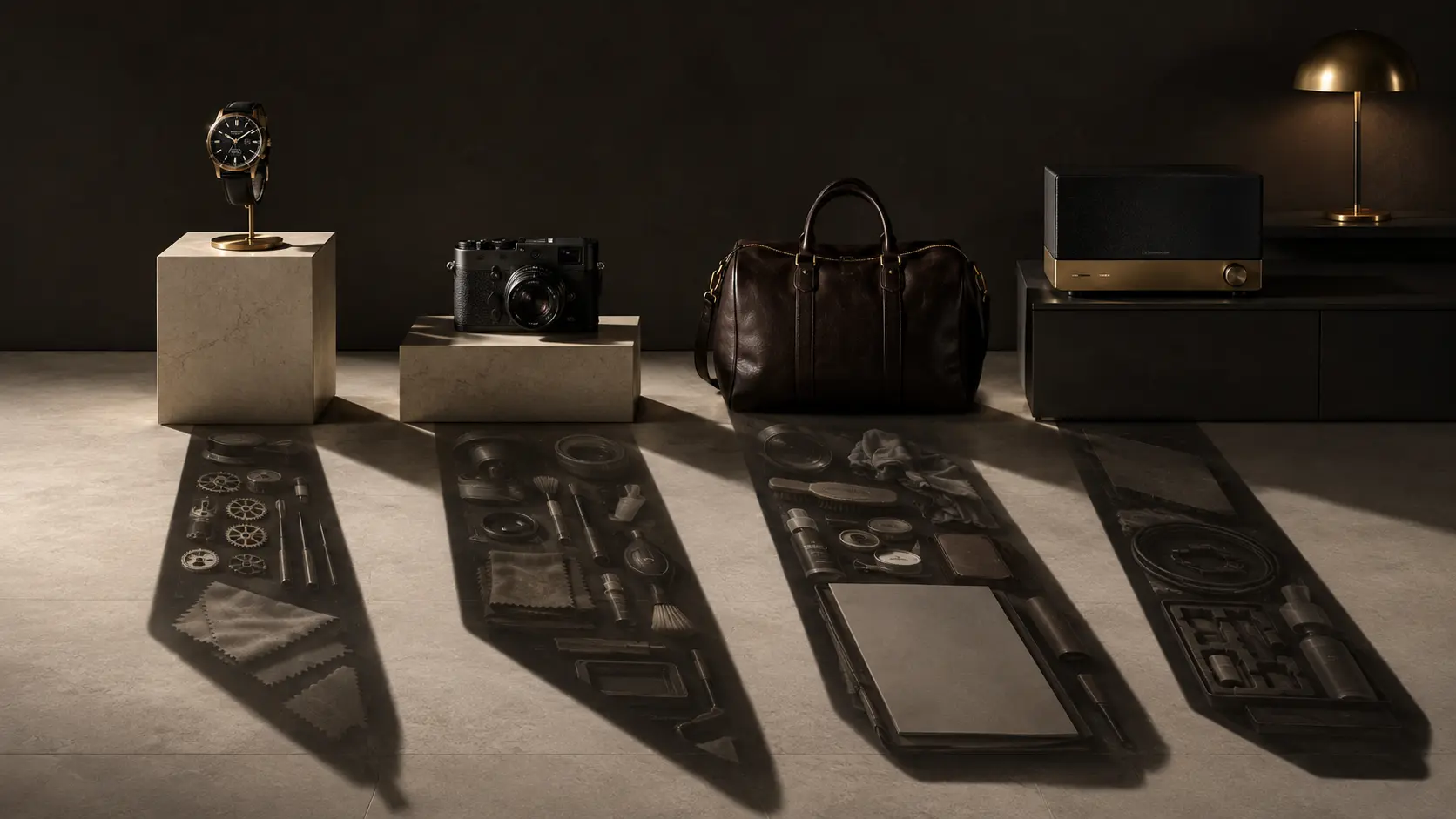
The hidden cost of owning better stuff
A purchase can outperform on paper and still reduce freedom, simplicity, contentment, and flexibility after it enters your life.

In brief
What I learned
Acquisition price misses the ongoing cost of protection, maintenance, attention, restrictions, and manufactured dissatisfaction.
Define enough before shopping so research cannot keep moving the finish line after the problem is solved.
Pay a premium when the recurring benefit exceeds the recurring burden, not merely because the product is objectively better.
The second price begins after checkout
I am not a minimalist. I own a serious home theater and home gym, drive a Model 3 Performance, care about good tools, and will spend heavily when a product improves life repeatedly. That is exactly why the cost after purchase matters.
The receipt captures acquisition. It misses protection, maintenance, storage, accessories, monitoring, worry, restrictions, upgrade pressure, and the capital committed to an object that may be difficult to sell. A better product can still be a worse decision when its recurring benefit does not repay that ownership burden.
- Decision
- Model 3 Performance with full XPEL Stealth PPF
- Value earned
- Daily performance, utility, and a car I enjoy
- Burden omitted from the price
- More attention to paint, wrap, wheels, parking, and preservation
- Decision
- Dedicated home theater
- Value earned
- Thousands of hours of entertainment
- Burden omitted from the price
- Research keeps exposing upgrades after the room already feels exceptional
- Decision
- Less-expensive 18-inch wheels
- Value earned
- Fitment, appearance, ride, and daily utility
- Burden omitted from the price
- The premium forged option offered real engineering with weak incremental value for my use
The conclusion is not that these purchases were mistakes. It is that the correct comparison includes the work of owning them.
Price the ownership tax
Before upgrading, I add five lines to the purchase price.
- Ownership cost
- Protection
- What to count
- Insurance, cases, film, storage, careful handling
- Warning sign
- Preserving the item becomes a recurring job
- Ownership cost
- Attention
- What to count
- Research, cleaning, monitoring, service, upgrade comparison
- Warning sign
- The product consumes more attention than it returns
- Ownership cost
- Restriction
- What to count
- Weather, parking, guests, travel, ordinary use
- Warning sign
- Ownership reduces the freedom the purchase was meant to create
- Ownership cost
- Standard inflation
- What to count
- The old product now feels inadequate only after exposure to the new tier
- Warning sign
- Comparison content moved the finish line
- Ownership cost
- Lost flexibility
- What to count
- Cash, space, compatibility, and resale friction
- Warning sign
- A future choice becomes materially harder
These costs do not need a fake dollar value to matter. I use dollars where the estimate is defensible, hours where time is the burden, and a written constraint where the cost is behavioral. The purpose is to expose the tradeoff, not manufacture precision.
A better product can still be a worse investment if owning it reduces freedom, simplicity, contentment, or flexibility.
Better can reduce freedom
An imperfect possession can be easy. Park it anywhere. Let guests use it. Haul something dirty. Ignore a small scratch. Replace it when it stops doing the job. A premium replacement may perform much better while adding rules to ordinary life.
My Tesla is the clearest example. It is dramatically better than an $8,000 beater at the jobs I care about. It is also harder to treat casually. Full satin PPF, pristine wheels, modifications, and the desire to keep the car right make parking damage and careless handling more expensive emotionally as well as financially.
The honest comparison is not Tesla performance versus beater performance. It is Tesla performance, comfort, technology, and enjoyment minus preservation burden versus basic transportation and freedom minus the inferior daily experience. I still choose the Tesla. Naming the burden makes the decision more accurate, not less enthusiastic.
The same screen applies to furniture, wheels, watches, collectibles, and delicate finishes: does this purchase expand what I can do, or increase the number of ordinary things I am afraid to do?
Define enough before the market defines it for you
Enthusiast markets have no natural stopping point. My theater can always gain a different processor, larger subwoofers, more capable speakers, a better display, or more room work. None of those ideas changes the sound in the room today. Research changes the reference point first, then sells the cure.
I now write the stopping rule before shopping:
- What problem must change?
- What evidence will prove that it changed?
- Which requirements are non-negotiable?
- What premium is justified by recurring use?
- What result makes keeping the current product the winner?
This is more demanding than "buy the cheapest." The correct product is the least expensive option that fully clears the actual job and does not introduce an obvious early-replacement failure. Once that line is crossed, the next tier must show an incremental benefit large enough to repay both its price and ownership burden.
Exposure can create the problem it solves
Sometimes a purchase adds utility. Sometimes it merely ends dissatisfaction created by learning that a more expensive version exists. The distinction matters most for optimizers because research makes small deficiencies easier to notice and easier to rationalize.
My wheel decision forced this test. I liked the more expensive Martian option and could name real engineering advantages. The less-expensive wheel still delivered the appearance, fitment, daily usability, and quality I required. The premium product was better. It was not better enough for the job.
I ask one blunt question: was I dissatisfied before I learned this upgrade existed? A no does not automatically kill the purchase, but it raises the burden of proof. The upgrade must create new recurring value rather than restore a baseline that marketing disturbed.
Affordability is a weak standard
"I can afford it" says nothing about value. I defend expensive purchases when the use is frequent and the improvement is material. A large, high-performing television can anchor thousands of hours of movies and games. A home gym can remove commute time and make training easier four or five days per week. Better tires affect every mile through grip, braking, noise, ride, and safety.
A prestige product can also be rational when the object itself is the hobby and the buyer understands the emotional premium. The weak move is using functional language to defend a status purchase. If the real return is design, rarity, craftsmanship, or enjoyment, say so and compare that entertainment value with the alternatives.
- Question
- What changes in normal use?
- Strong answer
- A frequent task becomes meaningfully better
- Weak answer
- The benefit appears mainly in specifications or other people's reactions
- Question
- How long should it last?
- Strong answer
- Construction, support, and repair path fit the horizon
- Weak answer
- Durability is assumed from price or branding
- Question
- What new work appears?
- Strong answer
- Maintenance is minor or worth the benefit
- Weak answer
- Protection and monitoring become hobbies I did not want
- Question
- Can I exit?
- Strong answer
- Resale, reuse, or long service life limits the downside
- Weak answer
- The premium disappears as soon as novelty fades
- Question
- What would make me keep the current item?
- Strong answer
- The stopping rule is defined before shopping
- Weak answer
- Every comparison creates a new requirement
Maintenance can be the better asset
Replacement is exciting; maintenance is often more valuable. Cleaning, calibration, lubrication, a battery, a cable, a worn part, room correction, or a small repair can restore most of the benefit without restarting depreciation and accessories.
Before replacing anything meaningful, I check:
- Is the problem a failed component or the whole product?
- Would service restore the original job?
- Is the desired upgrade solving a measured limitation?
- What installation, compatibility, protection, and resale work follows the purchase?
- What happens if I spend nothing for 30 days?
That delay is especially useful after exposure to a new tier. If the current product still performs the job after the novelty window closes, the upgrade was probably optional.
My current verdict
BUY the premium when it creates a large, repeated improvement and the maintenance, attention, restriction, and exit costs remain acceptable. WAIT when dissatisfaction began with comparison content and no failure or measurable limitation exists. PASS when the object would mainly add rules, anxiety, or another upgrade chain.
I still want excellent things. I am simply counting the part of the price that arrives after the box is opened.
Sources
Disclosure
Some links may earn Mr ROI a commission at no added cost to you. That does not change the recommendation. This is general information, not personal financial or medical advice. Read the full disclosure.