
The Durability Threshold: When Paying More Actually Costs Less
A real-world field guide to clothing, boots, cookware, vacuums, tools, cables, hoses, food storage, and the modest price step where product architecture finally changes.
In brief
Start here
- Look for the part that fails first, then check its materials, construction and repair path. That tells you more about durability than the price or logo.
- My recurring shirt problems changed what I check: dye stability, fabric composition, pilling and seams. Judge the exact garment instead of buying the brand’s promise.
- Compare the premium with the extra service life it needs to break even. Shirts, boots, cookware and vacuums reach that threshold in different ways.
I've bought cheap things that lasted and expensive things that disappointed me. The useful difference is usually construction: repairable parts, strong materials, a supported battery, or an honest warranty. Pay more when the architecture changes, not because the box promises an upgrade.
The cheapest product can fail early because the manufacturer removed material, used a consumable coating, sealed the battery, eliminated replacement parts, or built the product around a disposable assembly method. The expensive product can fail just as quickly while charging for branding, finish, exclusivity, or specifications that do not extend useful life.
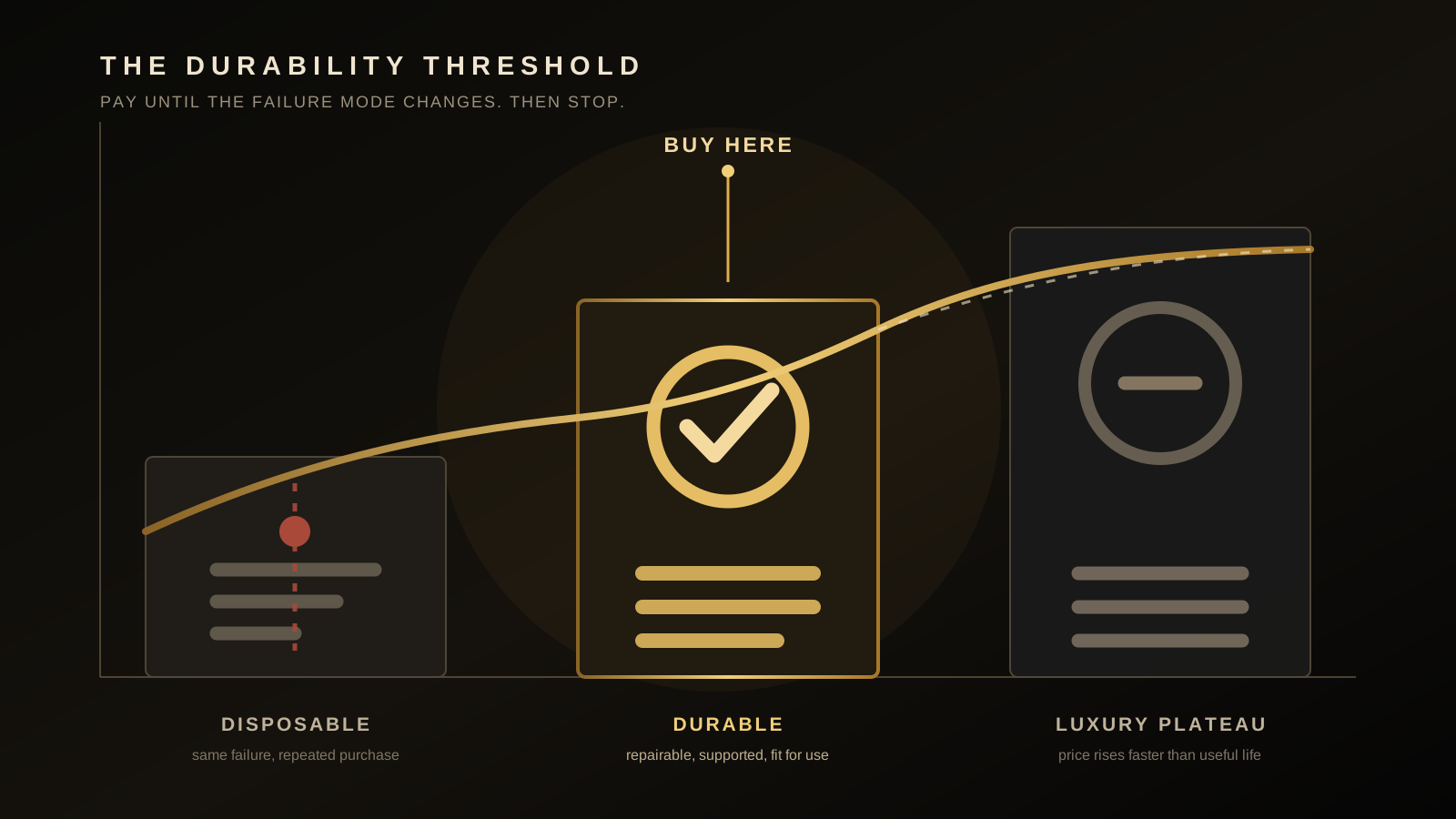
The target is neither cheap nor premium. It is the durability threshold: the lowest price at which the product architecture changes enough to survive, remain repairable, or preserve its useful performance.
This is the practical companion to my upper-middle sweet spot. That article explains where I stop paying for marginal performance. This one explains what I inspect in a store or online before I decide that paying more will actually reduce cost per use.
Price is not a durability specification
I'll pay more when the extra money buys a real change in construction: replaceable wear parts, repairability, better materials at known failure points, or support that keeps a product running. Cheap and simple can last decades. Expensive and sealed can still be disposable. I want the mechanism, not a 'professional' sticker or a lifetime-sounding promise.
The variables that matter are more specific:
- fiber length, yarn, weave, knit, fabric mass, dye fixation, and seam integrity in textiles
- replaceable outsoles, batteries, seals, lids, cables, filters, and other wear parts
- uncoated versus coated working surfaces
- fasteners and serviceable assemblies instead of permanent adhesive or sealed housings
- stable battery platforms and consumable supply chains
- parts availability after the model is discontinued
- failure consequences, including downtime, water damage, safety, and replacement labor
Paying more works only when the premium changes what fails, how it is repaired, or how long the product remains useful.
Brand is evidence only when the exact model, generation, materials, parts system, and support policy justify it. MSRP is evidence of nothing.
Why a dark shirt can turn orange under the arms
An orange or brown patch on a dark shirt is not automatically dirt deposited onto the fabric. It can be a localized color change in the dye system.
The American Association of Textile Chemists and Colorists maintains a dedicated colorfastness-to-perspiration test. A colored textile is exposed to simulated acidic perspiration, pressure, slow drying, and elevated temperature, then evaluated for color change and dye transfer. That test exists because sweat exposure can alter some dyed fabrics even when they are washed normally.
Antiperspirant adds another mechanism. University of Georgia textile-care guidance notes that acidic aluminum-chloride antiperspirants can change the color of some dyes, and that heat can make the chemical interaction worse. Repeated wear can combine:
perspiration + antiperspirant salts + body oils + friction + heat + the garment's exact dye chemistry
On a dark fabric, losing or shifting part of the original color can visually read as orange or brown. That is an inference from the location and appearance, not a laboratory diagnosis. Residue, chlorine exposure, skin products, and other oxidizing chemicals can create similar damage.
The diagnostic clues are practical:
| What I see | More likely explanation | What I would test |
|---|---|---|
| Fabric is lighter with no raised residue | Dye change or bleaching | Compare garments by color and SKU; reduce heat; check skin and laundry products |
| Stiff, waxy, white, yellow, or gray buildup | Antiperspirant, oil, detergent, or mineral residue | Pretreat promptly and avoid drying before the residue is removed |
| Failure occurs only on one garment line | That fabric, finish, or dye system may be vulnerable | Stop rebuying that SKU even if the brand normally works |
| Failure follows multiple brands and colors | Personal-care or laundry chemistry becomes more likely | Change one variable at a time and document the result |
There is no credible controlled evidence that every Old Navy shirt uses inferior dye. The useful conclusion is narrower: repeated premature damage is enough to reject the exact garment, while the label alone is not enough to reject every product the retailer sells.
Fiber composition explains part of the failure, not all of it
One current Old Navy men's crew-neck shirt is listed at $14.99 before promotions and uses 60 percent cotton and 40 percent polyester. Another Old Navy multipack lists solid colors as 100 percent cotton and only the heather gray as a 60/40 blend. The same retailer sells meaningfully different fabric systems under similar product names.
Polyester is mechanically strong, quick drying, and useful in the right garment. It also changes the failure profile. Research on cotton-polyester fabric shows that strong polyester fibers can anchor loose cotton fibers inside pills instead of allowing the fuzz to break away. Separate textile studies have found that polyester can retain more sebum and support more odor-producing microbial activity than cotton after wear.
That does not make 100 percent cotton automatically durable. A thin shirt made from short fibers, loose yarn, weak seams, poor dye fixation, or an unstable knit can fail quickly. Long-staple cotton can produce smoother yarn with fewer protruding ends, but fabric mass, yarn construction, finishing, and sewing still matter.
At the listed $24.90, Uniqlo’s 100 percent Supima cotton T-shirt is a useful comparison point against a $15 basic. The extra money buys a different fiber specification. Check fit, fabric weight and construction to decide whether it is a useful step up.
The cost-per-wear break-even is easy to calculate. If a $14.99 shirt lasted only 20 wears, it would cost about $0.75 per wear. A $24.90 alternative would need to survive only 34 wears to beat that rate. Those wear counts are an illustrative decision test, not measured Old Navy or Uniqlo lifespans.
BUY the exact inexpensive shirt when its fabric, seams, color stability, and real wash history hold up. WAIT on a modest upgrade when the only evidence is “premium cotton.” PASS on rebuying a SKU that has already failed the same way.
Jeans make comfort and durability compete visibly
Stretch denim is not bad denim. It buys real comfort, especially for large legs, frequent sitting, and movement. The tradeoff is that the additional fibers introduce more ways for the garment to lose shape.
Old Navy lists more than one fabric blend for its current 360 Tech Stretch Performance jeans. One is 65 percent cotton, 28 percent polyester, 5 percent recycled cotton, and 2 percent spandex. Another is 62 percent cotton, 27 percent recycled polyester, and 6 percent combined polyester and spandex. Both are designed around stretch and comfort.
A current Levi's 501 Original listing uses 100 percent cotton non-stretch denim. That removes elastane fatigue and much of the synthetic-blend pilling exposure, but it also removes the comfort that makes the Old Navy jeans attractive.
The decision is not brand versus brand:
- Choose 98 to 100 percent cotton when maximum shape retention, traditional denim wear, and a long ownership horizon dominate.
- Choose modest stretch when fit and mobility materially increase how often the jeans are worn.
- Treat high-stretch denim as a comfort-first product and price the possibility of knee bagging, seat stretching, abrasion, and heat-sensitive elastic fibers.
- Do not assume $250 fashion denim is more durable than a well-selected $60 to $100 pair. Once construction is good, a large premium often buys fabric story, finish, or status.
The best pair is the one whose material architecture matches the job. A rigid pair that never leaves the closet has terrible cost per wear.
The category field guide
These are current buying benchmarks, not permanent brand endorsements. Prices, warranties, materials, and parts availability must be checked on the exact product before purchase.
| Category | Useful durability threshold | Current benchmark | Avoid when longevity dominates | Where the premium stops paying |
|---|---|---|---|---|
| Daily T-shirts | Better fiber and fabric construction, stable seams and dye | Uniqlo Supima Cotton T-shirt; exact Old Navy 100 percent cotton SKUs can still qualify | Rebuying a thin or blend-heavy SKU that already pills, twists, fades, or discolors | Designer basics whose main addition is a logo |
| Jeans | High cotton content with only as much stretch as needed | Levi's 501 100 percent cotton; exact higher-cotton sale models elsewhere | High-synthetic “maximum stretch” denim when shape retention is the priority | Luxury denim without a measurable construction advantage |
| Durable boots | Resoleable welt, full-grain upper, available repair path | Red Wing Iron Ranger | Cemented fashion boots disguised with decorative welt stitching | Designer boots that remain non-repairable |
| Cookware | Uncoated stainless, carbon steel, or cast iron for most jobs | IKEA 365+ uncoated stainless; one replaceable nonstick pan for eggs | Buying the entire kitchen as coated cookware | Premium coated systems sold as lifetime purchases |
| Kitchen knives | Sound steel, usable geometry, and repeated sharpening | Victorinox Fibrox 8-inch chef's knife | Large no-name blocks with redundant knives and gimmick coatings | Decorative Damascus and finish after cutting performance is solved |
| Vacuums | Replaceable battery or corded motor, filters, brush roll, hose, and parts | Miele or SEBO for long parts support; exact Shark models with removable batteries for convenience | Mystery cordless models with no compatible battery or brush roll | Commercial-level price when the home and cleaning pattern do not need it |
| Power tools | A stable battery ecosystem with the tools I will add later | Ryobi ONE+ for broad homeowner value; professional platforms when workload proves the need | Marketplace brands whose batteries may disappear | Paying pro-grade prices for tools used twice a year |
| USB-C charging | Verified wattage and data capability on the exact cable | A USB-IF-certified cable from a stable vendor | Unverified “240W fastest” multipacks with vague data specifications | Paying several times more for braiding or branding alone |
| Garden hoses | Repairable fittings, UV and kink resistance, supported parts | Eley hose and replacement fitting system | Lightweight vinyl hose with crimped ends and no repair path | Premium reel aesthetics after hose function and service are solved |
| Food storage | Durable body with separately purchasable lids and seals | IKEA 365+ glass containers with individual replacement lids | Replacing a full set because one proprietary lid cracked | Complex vacuum systems whose valves create another failure point |
| Sheets and towels | Verified fiber and wash performance, not one giant marketing number | Tested long-staple cotton in a moderate thread-count or GSM range | “1,500 thread count,” “hotel luxury,” or extreme GSM as the primary proof | Luxury pricing after strength, pilling, fit, and absorbency plateau |
Repairability creates the biggest clean wins
The Red Wing Iron Ranger uses a Goodyear leather welt and is listed as resoleable. Red Wing also operates a repair service and says welt-constructed boots can be repaired when their condition allows it. That is a different product architecture from a fashion boot whose outsole is permanently cemented to a synthetic upper.
An illustrative ten-year model shows why the distinction matters:
| Path | Assumption | Ten-year spending |
|---|---|---|
| Disposable boots | $120 pair replaced yearly | $1,200 |
| Repairable boots | $350 initial pair plus two $150 resoles | $650 |
That example assumes the upper remains worth keeping through each resole. Rotation, work surface, water, care and repair prices determine whether the savings materialize.
This logic does not transfer to every shoe. Running-shoe foam is a wear component, and a more expensive running shoe does not automatically remain protective for proportionally more miles. Repairability is valuable only when the expensive part of the product can survive the repair.
Cookware shows why changing technology beats buying a premium disposable
The bad comparison is a $30 nonstick pan versus a $150 nonstick pan. Both still depend on a coating.
The better comparison is coated cookware versus an uncoated working surface. IKEA's current 365+ stainless six-piece set is listed at $59.99, and IKEA gives its uncoated cookware a 15-year limited warranty covering function, materials, and workmanship under the stated residential-use terms.
An illustrative ten-year model:
- a $30 coated skillet replaced every two years costs $150
- a $60 uncoated set still functioning after ten years costs $60
- one inexpensive nonstick skillet can remain a deliberate consumable for eggs and fragile foods
Stainless takes practice with heat and timing. I would use it for the cooking it handles well and keep a nonstick pan for the jobs where the coating adds real convenience.
The Victorinox Fibrox chef's knife follows the same principle. A practical blade with a non-slip handle can be sharpened repeatedly. A fifteen-piece no-name block adds item count without proving steel quality, geometry, or useful knife selection. One chef's knife, one paring knife, and one bread knife usually cross the threshold before a giant block does.
Vacuums prove that longer life does not automatically mean lower cost
European Environment Agency data report average use lives of about 4.5 years for cordless upright vacuums and about 10 years for corded vacuums. That is a meaningful durability difference.
It does not automatically make an expensive corded machine cheaper. Annualizing two example prices:
- $200 cordless / 4.5 years = about $44 per year before a battery or repair
- $500 corded / 10 years = $50 per year before bags, filters, or repair
The premium machine may still win through cleaning performance, filtration, uptime, parts, or a longer life than the category average. The cordless may win because five-second access causes the house to be cleaned more often. Convenience is a real return.
The durability threshold is model-specific service architecture:
- Miele says spare parts remain available for at least 15 years after a series ends.
- SEBO currently lists five-year parts and labor coverage plus seven-year motor coverage on standard models, with longer coverage on qualifying collections.
- Shark sells removable batteries, brush rolls, filters, wands, and other parts for many exact models.
That is why “Miele good, Shark bad” is too crude. A corded Miele or SEBO is a strong long-service benchmark. A Shark with an available removable battery can be a rational convenience buy. A cordless vacuum whose exact battery is unavailable is the one I would avoid, regardless of the logo.
Battery ecosystems are part of the purchase
A cordless tool is not one tool. It is a commitment to batteries, chargers, future bare tools, and the probability that the interface survives.
Ryobi says its 18V ONE+ platform has maintained battery compatibility since 1996 and now spans hundreds of compatible products. That history is more economically useful than one drill winning a torque comparison. The battery can keep producing value across inflators, lights, fans, saws, lawn tools, and vacuums.
My buying rule is straightforward:
- use a broad value platform for normal homeowner work
- pay for professional-duty tools where load, accuracy, speed, downtime, or safety proves the need
- buy corded for high-draw tools that stay in one place and do not benefit from a battery
- avoid an orphan platform even when the first kit is cheap
The same test applies to vacuums, lawn equipment, cameras, and smart-home devices. Ecosystem lock-in is not automatically bad. It becomes expensive when compatibility is narrow, short-lived, or controlled by one irreplaceable component.
Small replaceable parts can create outsized ROI
IKEA currently sells a 34-ounce 365+ glass food-container body for $3.99 and its compatible rectangular plastic lid separately for $2. The lid and gasket can wear without forcing the glass body into the trash. That is better product architecture than a set whose proprietary lid disappears with the model.
Eley sells factory-style garden-hose repair fittings with a ten-year warranty. A repairable end lets you keep the hose when the fitting is the part that fails.
USB-IF maintains a database of products that passed its compliance program, and certified USB-C cables identify their 60-watt or 240-watt power capability. Use that to check electrical capability, then inspect connector and strain-relief construction for durability.
For these smaller purchases, the premium should stay small:
- a $2 replacement lid can preserve a container
- a repair fitting can preserve an entire hose
- a properly rated cable can eliminate repeat failures and charging uncertainty
Paying $70 for a basic cable or buying an elaborate proprietary food-storage machine can move straight past the threshold into diminishing returns.
Some products deserve risk-adjusted durability, not lifetime claims
Water connections are a good example. A more robust washer hose can reduce risk, but no hose should be treated as permanent. Inspection, proactive replacement, accessible shutoffs, leak sensors, and an automatic whole-home shutoff can matter more than the price difference between two hoses.
This changes the equation:
Risk-adjusted ownership cost = normal ownership cost + probability of failure × consequence of failure
A $20 premium is easy to justify when failure can flood a house. A $200 premium is hard to justify when the only benefit is a thicker cosmetic shell on a product whose internal wear part remains identical.
The same principle applies to electrical protection, vehicle tires, ladders, safety gear, and any product where failure creates damage far beyond the replacement price.
The sixty-second durability audit
I use the same sequence online and in a store.
- Name the first likely failure. Coating, battery, seam, zipper, outsole, lid, hose end, brush roll, cable connector, drawer bottom, or software support.
- Check whether that part is replaceable. Search the exact model number plus “replacement battery,” “parts,” “repair,” or “service manual.”
- Read the material line, not the adjective. Percentages, steel type, construction method, coating, fabric weight, fastener type, and power rating matter more than “premium” or “commercial.”
- Check compatibility after discontinuation. A large ecosystem is valuable only if old products continue to work with current batteries, lids, bags, filters, or accessories.
- Price one repair now. A resole, replacement battery, lid, hose end, brush roll, or filter reveals whether repair is real or theoretical.
- Calculate the break-even life. Divide the better product's price by the cheap product's cost per use or cost per year.
- Stop when architecture stops improving. Once the working surface, service path, and life-limiting component are solved, another premium needs a different justification.
The Federal Trade Commission has documented how unavailable parts, manuals, software access, and independent repair restrictions can increase ownership friction. A long warranty does not replace a service path. A warranty that requires expensive freight or excludes the likely wear part may have little economic value.
When cheap is still the right answer
Cheap wins when:
- the job is temporary
- failure is harmless and immediately visible
- the product is simple and inspectable
- replacement takes little time
- the expensive version uses the same life-limiting technology
- the item will be used too rarely to recover the premium
- the inexpensive version has already proven durable in my own use
This is why basic hand tools, storage bins, seasonal one-time supplies, and low-use accessories can be excellent budget purchases. If a $25 and $150 socket both survive my lifetime, the expensive socket produces no durability return.
The final buying rule
BUY BETTER when a modest premium crosses into repairable construction, a replaceable wear part, materially better textile architecture, a stable ecosystem, or meaningfully lower failure risk.
BUY CHEAP when the product is simple, lightly used, easy to inspect, harmless to replace, and the premium version fails for the same reason.
WAIT when the durability claim is only a warranty, an adjective, a brand reputation, or an illustrative cost-per-use estimate without real ownership evidence.
PASS when the product already failed the same way and the replacement is materially identical, or when luxury pricing begins after useful durability has plateaued.
The goal is not to own the most expensive version once. It is to pay the minimum price that removes the predictable failure without buying a status premium disguised as quality.
Sources
- AATCC TM15: official colorfastness-to-acid-perspiration test purpose and method
- University of Georgia Extension: acidic antiperspirant ingredients can change some fabric dyes
- Journal of Engineered Fibers and Fabrics: polyester anchoring and cotton-polyester pilling mechanisms
- Applied and Environmental Microbiology: microbial odor profiles of polyester and cotton after wear
- Old Navy: current 60-percent-cotton, 40-percent-polyester crew-neck composition
- Old Navy: current solid-color cotton and heather cotton-polyester multipack compositions
- Uniqlo: current 100-percent Supima Cotton T-shirt price and material
- Old Navy: current 360 Tech Stretch jeans composition and price
- Levi's: current 501 Original 100-percent-cotton non-stretch denim
- Red Wing: Iron Ranger Goodyear-welt construction and resoleability
- Red Wing: current repair eligibility for welt-constructed boots
- IKEA: current 365+ stainless cookware prices, construction, and 15-year warranty
- Victorinox: Fibrox eight-inch chef's knife design and intended use
- European Environment Agency: measured average corded and cordless vacuum lifespans
- Miele: stated fifteen-year post-discontinuation spare-parts availability
- SEBO: current motor, parts, and labor warranty terms
- Shark: model-specific cordless vacuum batteries and replacement components
- Ryobi: ONE+ battery compatibility history and current platform breadth
- USB Implementers Forum: database of products passing the USB-IF compliance program
- Eley: current factory-style garden-hose repair fitting and warranty
- IKEA: separately sold 365+ glass container bodies and compatible replacement lids
- Consumer Reports: 2026 sheet-buying guidance on useful thread-count limits
- Federal Trade Commission: Nixing the Fix findings on repair restrictions
Disclosure
Some links may earn Mr ROI a commission at no added cost to you. That does not change the recommendation. This is general information, not personal financial or medical advice. Read the full disclosure.