Money
The consumer-protection stack after checkout
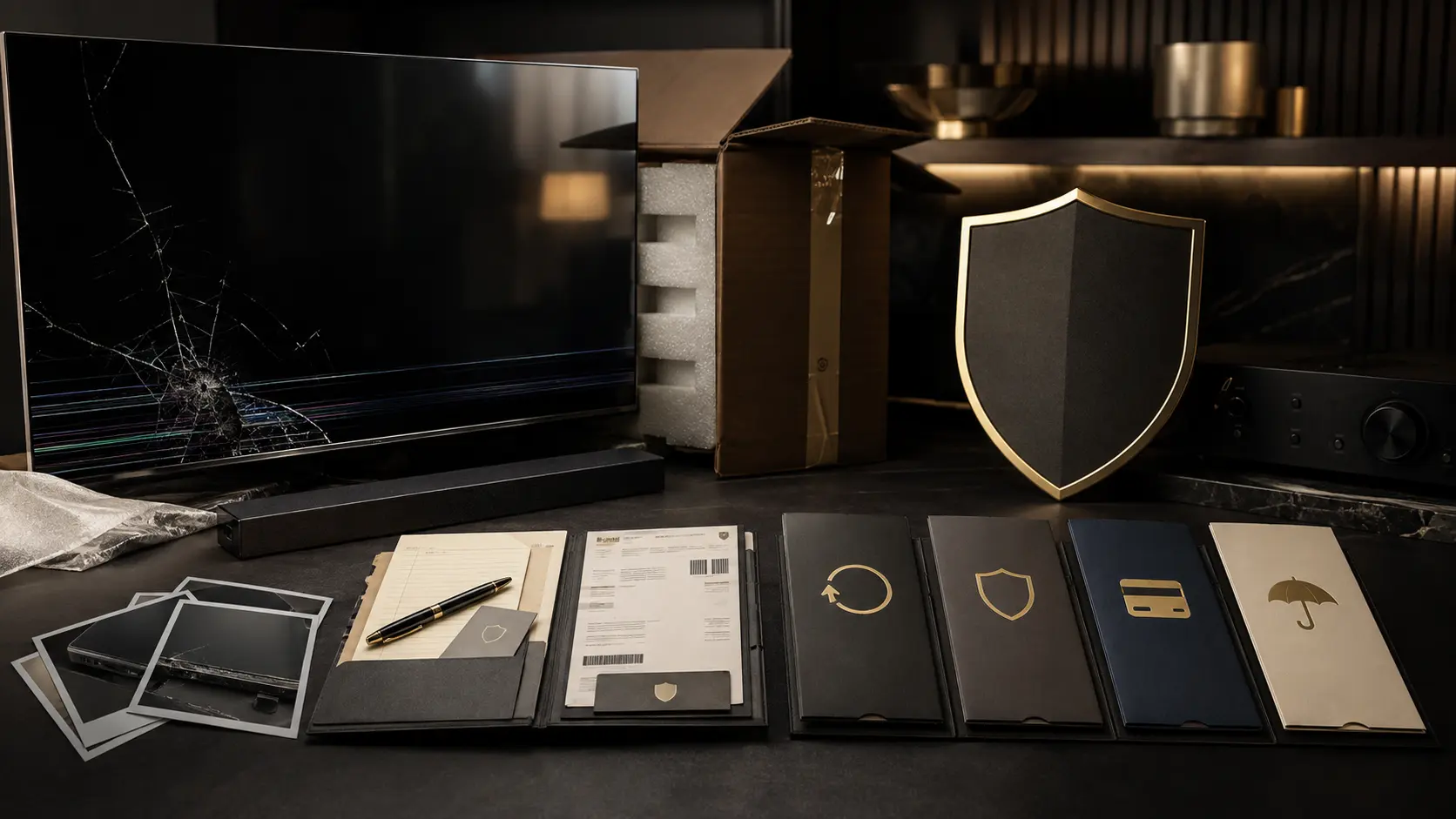
Returns, warranties, service contracts, card disputes, and insurance solve different failures. The fastest clean claim starts by choosing the right layer and proving exactly what happened.

Short on time?
The bottom line
- Use the lowest-friction remedy that actually applies: retailer first when the purchase is still in its return window, then the manufacturer, a valid service contract or card benefit, and insurance for a covered high-severity loss.
- Build one evidence folder before filing. The receipt, exact model, serial number, wide and close photos, failure video, contract, timeline, tracking, and written correspondence matter more than a long complaint.
- Compare every proposed remedy with the contract, not the original MSRP or the upgrade you would prefer. Push back with specific feature gaps, accept a fair outcome, and stop once the covered loss is resolved.
Affiliate link. I may earn a commission at no added cost to you.
Protection is a routing problem
My earlier household-electronics guide asks whether broad coverage is worth buying. This guide starts later, after the screen has dead pixels, the amplifier will not power on, the box arrives damaged, or a larger loss affects the home. At that point, the important question is not whether protection is good in theory. It is which agreement is responsible for this exact failure.
People create avoidable friction by starting at the most powerful-sounding layer. They open a card dispute when the manufacturer still owes warranty service, call homeowners insurance about a replaceable gadget, or spend weeks arguing with a service-plan administrator while the retailer's return window is still open. Every layer has a different job, proof standard, clock, deductible, and remedy.
The stack is an order of operations. It is not permission to recover twice for one loss. Use the first valid layer, disclose prior reimbursements when another provider asks, and stop when the covered loss has been resolved.
Use the cheapest clean remedy first
Start with the contract closest to the transaction. A retailer can often exchange a new defective product faster than anyone can diagnose it. A manufacturer warranty is usually the correct lane for a product defect during the written warranty period. A paid service contract becomes relevant only when its coverage actually applies. A card dispute is for a merchant or billing problem, not a universal extended warranty. Home and auto insurance are designed for covered events large enough to justify a deductible, investigation, and claim history.
The Federal Trade Commission makes an important distinction: a service contract sold separately is not the same thing as a warranty included with the product. It also notes that a company may have the right to attempt repair before issuing a refund. That repair step is not automatically delay. It can be part of the remedy you bought.
| Layer | Use it when | Have ready | Common mistake |
|---|---|---|---|
| Retailer | New item is wrong, damaged, missing, or defective inside the return policy | Order, delivery photos, packaging, accessories | Waiting until the return window closes |
| Manufacturer warranty | A covered defect appears during the written warranty period | Receipt, serial, symptom, required diagnostic | Assuming the seller must handle every repair |
| Service contract | The exact failure and product qualify under a paid plan | Agreement, model, serial, evidence, service fee | Treating marketing language as the contract |
| Card issuer or card benefit | The merchant failed to deliver or resolve a billing issue, or a separate card benefit applies | Statement, seller correspondence, benefit guide | Using a chargeback as a product warranty |
| Home or auto insurance | A covered high-severity event causes loss beyond the deductible | Policy, event record, inventory, photos, estimates | Cleaning up or making permanent repairs before documenting |
The protection stack is a routing order, not permission to collect twice for the same loss.
Build the claim file before you make the call
A clean claim is a small evidence packet, not an emotional autobiography. I keep the facts in chronological order and make it easy for a reviewer to answer five questions: what is the item, when did I obtain it, what failed, what does the agreement cover, and what remedy has already been attempted?
For my LG OLED claims, the useful proof was not a paragraph saying the picture looked bad. The administrator needed thorough picture evidence and serial numbers. A solid-color test screen made the dead pixels visible. A wide photo showed the issue in the context of the full display. Close photos showed the defect. A separate photo tied the evidence to the model and serial label.
- Save the order confirmation or receipt, exact model, serial number, purchase date, and retailer.
- Capture a wide photo, close photos, and a short video that reproduces the failure without editing.
- Download the warranty or service agreement that governed the purchase. Do not rely on a current sales page alone.
- Write a one-page timeline with the failure date, troubleshooting completed, every contact, every promise, and the next deadline.
- Keep repair authorizations, shipping labels, tracking, delivery confirmation, technician findings, and proposed replacements.
- Back up and erase personal data before shipping a computer or connected device, when the product allows it.
- Do not discard the failed item, packaging, or damaged parts until the responsible company gives written instructions.
Three Klipsch failures showed me the real cost of repair-first coverage
Across separate claims, three Klipsch SPL-150 subwoofers developed amplifier failures. None of the amplifiers proved repairable through the claim process, but that conclusion did not happen from a photo and a five-minute call. The process required shipping each subwoofer in for an attempted repair. Each claim took roughly a month from filing to resolution, and each ultimately ended with a check.
That is a successful outcome, but it was not frictionless. A large subwoofer is awkward, heavy, and easy to damage in transit. There is time in troubleshooting, packaging, scheduling, tracking, waiting for diagnosis, and following up. The value calculation has to include those hours, especially if the item is inexpensive enough that the service fee and logistics approach the replacement cost.
The lesson is not to demand cash on day one. The lesson is to understand the repair path before a failure. For large audio equipment, I want to know whether the provider ships the full cabinet or only the failed amplifier, who supplies packaging, who carries transit risk, and what written finding triggers replacement or reimbursement. I also keep original packaging longer for products that would be miserable to ship safely without it.
Two LG CX claims produced two different valid outcomes
My 55-inch and 77-inch LG CX OLED televisions both developed dead pixels. The symptom category was similar, but the resolutions were not. After I supplied the requested pictures and serial information, the 55-inch claim ended with a brand-new television delivered through Walmart Business.
The 77-inch claim became a replacement-comparison problem. The administrator initially wanted to provide a current television of comparable size, brand, and quality. I did not accept the first options just because they were available. I compared the models, explained the material gaps, and continued the discussion until we reached an offering I considered reasonable within the contract. Walmart then could not fulfill it, so the claim ended with a check at the plan's $2,000 per-claim cap.
I originally paid about $3,500 for the 77-inch OLED. The claim did not restore that original invoice amount, and it did not entitle me to a free 98-inch upgrade. It paid the contractual cap. Television performance and price had improved so much that the practical gap was less painful than the nominal $1,500 difference suggests. I chose to apply the settlement toward a 98-inch TCL QM7K, which was the replacement direction I wanted anyway.
| Item | Evidence | Process | Resolution | Main lesson |
|---|---|---|---|---|
| 55-inch LG CX | Dead-pixel photos and serial | Replacement arranged | New television delivered | A clean replacement can be the fastest finish |
| 77-inch LG CX | Dead-pixel photos, serial, model comparisons | Several offers, one accepted, fulfillment failed | $2,000 capped settlement | Features, availability, and caps control the outcome |
| Three Klipsch SPL-150s | Failure details and repair intake | Ship-in repair attempts | Checks after nonrepairable findings | Logistics and time belong in the ROI calculation |
The cap matters more than the word replacement
A plan can promise repair or replacement and still limit what it will spend. The Allstate Protection Plans page for the American Home Shield electronics plan currently lists a $2,000 per-claim limit and a $5,000 aggregate limit during a twelve-month period. It also says a replacement may be a product with equal or similar features and functionality, not necessarily the same brand or the model you would personally buy.
That creates three separate ceilings: the item's reasonable current replacement, the per-claim maximum, and the aggregate period limit. The lowest applicable ceiling usually matters most. Read the agreement tied to your own plan because a public page today may not match an older contract, a retailer-specific plan, or another state.
Do not compare only payout with premiums. Add the service fee, uncovered shipping, repair time, lost use, and the chance that the proposed replacement is refurbished or meaningfully different. Then subtract the real value of the remedy you received, not the MSRP printed on the box.
| Scenario | Quick math | Likely decision |
|---|---|---|
| $300 device with a $100 service fee | One-third of value is gone before time or shipping | Try retailer or manufacturer first; self-repair or replacement may beat the plan |
| $3,500 original TV with a $2,000 cap | At least $1,500 of original price is outside the cap | Compare the settlement with today's equivalent TV, not only the old receipt |
| Several failures inside one rolling year | Each can qualify but aggregate recovery may stop at the plan maximum | Check the rolling total before assuming the next claim has full room |
Negotiate the remedy, not the facts
The strongest pushback is a short feature comparison. Do not say, "I do not like this model." Say why it is not equivalent under the agreement. For a television, compare diagonal size, display technology, refresh rate, gaming inputs, brightness behavior, mounting constraints, and current availability. Three material mismatches are more useful than thirty adjectives.
A practical response is: "I understand the agreement allows a product with equal or similar features and functionality. Please show how this model matches the original product in these specific areas." Attach a small table. If the model is unavailable, ask for the next contractual remedy and a date for the decision.
Persistence is useful when it keeps the company anchored to the agreement. It becomes counterproductive when the goal quietly shifts from a fair covered remedy to an unrelated upgrade. State the failure accurately, do not inflate damage, do not hide another reimbursement, and accept a reasonable result when the contract has been satisfied.
- Identify the three features that materially affect use before discussing a substitute.
- Confirm stock, delivery, installation, taxes, accessories, and warranty coverage in writing.
- Ask whether accepting cash closes coverage for that item or changes the plan's aggregate limit.
- If fulfillment fails, request the alternative remedy specified in the agreement instead of restarting the story.
A credit-card dispute is not an extended warranty
Credit cards create two protections people often mix together. A billing dispute addresses a transaction problem, such as goods that were not delivered or a merchant credit that never appeared. Purchase protection or extended-warranty coverage, when a card offers it, is a separate benefit with its own guide, exclusions, filing window, and administrator.
The Consumer Financial Protection Bureau says to contact the card company promptly and send a written billing-error notice within sixty calendar days after the charge appears on the statement to preserve applicable billing-error rights. It also warns that defective goods may follow a different dispute process. Start with the seller, keep the correspondence, and read the issuer's current instructions instead of treating sixty days as a universal warranty period.
A chargeback is not a second chance after a valid warranty or service-contract decision you simply dislike. Use it for the merchant or billing failure it is designed to resolve. If a separate card benefit pays for damage or extends a warranty, disclose other recoveries and follow its coordination rules.
Insurance belongs at the high-severity end
My home and vehicle claims have involved much more friction than my electronics-plan claims. There are larger dollar amounts, more parties, and more room to dispute cause, scope, repair method, depreciation, and valuation. I cannot prove that claim size is the reason for every difficult interaction, but it is the practical difference I have observed.
The response should be better documentation, not a more dramatic story. The National Association of Insurance Commissioners recommends photographing and recording damage, keeping an inventory and receipts, and taking reasonable temporary steps to prevent further loss after documenting what happened. Permanent repairs can complicate an inspection, so distinguish emergency mitigation from final restoration.
An insurer's investigation letter, including a reservation of rights, is not a payout and is not automatically a denial. It means the claim is still being evaluated under the policy. Keep ongoing claims out of victory stories. Track what the insurer has accepted, what remains disputed, which expert supports each repair scope, and which deadline comes from the policy or state rules.
- Protect people and stop active damage first.
- Photograph the source, affected path, damaged property, and mitigation before disposal or demolition when safe.
- Save emergency invoices, moisture readings, estimates, permits, and proof of prior condition.
- Ask for an itemized written explanation of any settlement or reduction.
- Use your state insurance department when a covered insurance dispute cannot be resolved through the carrier's documented escalation path.
Run the claim on a clock you control
A month can be reasonable when a physical product must be shipped, inspected, and declared nonrepairable. A month of silence is different. I use a follow-up cadence that creates a record without turning every delay into a daily argument. These are operating checkpoints, not legal deadlines. Contractual and state deadlines still control.
| Checkpoint | Action | What to record |
|---|---|---|
| Day 0 | Mitigate, document, identify the responsible layer | Time, symptom, photos, policy or agreement |
| Day 1 | File through the required channel | Confirmation number and requested evidence |
| After 3 business days | Confirm the file is complete | Missing document and assigned owner |
| After 7 business days | Request status and next decision date | Specific blocker, not a generic update |
| After a missed promise | Escalate in writing to a supervisor or review team | Original promise and requested remedy |
| At resolution | Confirm remedy, delivery, return, and closure terms | Payment, tracking, release, and remaining coverage |
Use one page to prevent a four-week argument
For any meaningful claim, I build a one-page cover sheet. It includes the item, serial, purchase date, failure date, agreement section, troubleshooting, evidence list, prior contacts, and requested next step. The attachments can be extensive. The summary should not be.
The requested next step matters. "Please help" invites another generic response. "Please confirm whether the unit is being repaired, replaced, or reimbursed under section X, and identify the missing evidence by Friday" gives the reviewer a decision to make. Precision lowers the chance that a new representative restarts the file.
- Fact: what failed and how it can be reproduced.
- Coverage: the exact language that appears to apply.
- History: repair, shipment, inspection, offers, and missed dates.
- Gap: the one issue preventing resolution.
- Request: one reasonable next action with a response date.
Route four common failures correctly
The same product can belong in a different lane depending on timing and cause. A routing rule prevents you from wasting the strongest remedy on the wrong problem.
| Failure | First route | Why | Escalation if unresolved |
|---|---|---|---|
| New TV arrives cracked | Retailer delivery or return process | The problem existed at delivery and the return clock is short | Manufacturer only if the retailer policy directs you there |
| Subwoofer amplifier fails after factory coverage | Active service contract, if the model and failure qualify | It is a mechanical or electrical failure, not a billing error | Repair finding, then the contract's replacement or reimbursement path |
| Seller never ships an online order | Seller, then card billing dispute | The merchant did not complete the transaction | Follow the issuer's written dispute process within its deadline |
| Burst pipe damages floors and contents | Homeowners insurer after emergency mitigation | The event can exceed a service plan and requires cause and scope review | Written carrier escalation, then state insurance resources if needed |
Close the file as carefully as you opened it
A verbal promise is not a finished claim. Before disposing of the old item or spending a settlement, confirm what is being delivered or paid, whether taxes and installation are included, who owns the failed product, whether it must be returned, and what accepting the remedy does to future coverage.
For a shipped product, keep the tracking and delivery record. For a replacement, photograph its condition and verify the exact model before the return period expires. For cash, save the payment confirmation and settlement language. For an insurance repair, keep the final invoices, change orders, warranties, permits, and completion photos.
Then stop. The goal is to be restored under the agreement, not to turn every failure into profit. Good records and honest comparisons are what make assertive claims defensible.
The Mr ROI verdict
My Allstate and SquareTrade experience has been positive in the way that matters: legitimate covered failures were investigated, repair was attempted where required, and the claims reached usable outcomes. It also taught me that a successful result can still require a month, heavy shipping, detailed photos, serial verification, model research, and patient negotiation.
My larger home and vehicle claims taught the opposite side of the same lesson. As the loss grows, documentation, causation, valuation, and contract language matter more. The answer is not to assume every company is trying to cheat you, and it is not to assume a recognizable brand will make the process effortless.
Choose the correct layer. Prove the loss cleanly. Compare the proposed remedy with the written agreement. Escalate specific gaps on a written clock. Accept a fair resolution and close the file. That system will not make every claim easy, but it removes most of the avoidable ways a valid claim goes sideways.
Evidence
Sources and further reading
- Federal Trade Commission: warranties, service contracts, records, and product-problem resolution
- Federal Trade Commission: extended warranties and service contracts
- Allstate Protection Plans: American Home Shield electronics plan limits and claim process
- Consumer Financial Protection Bureau: how to dispute a credit-card charge
- National Association of Insurance Commissioners: filing a homeowners claim
- National Association of Insurance Commissioners: document damage before cleanup and mitigation
Disclosure
Some links may be affiliate links, which can earn Mr ROI a commission at no additional cost to you. Recommendations are based on usefulness, not commission size. Opinions are Sebastian's and are not personal financial or medical advice.
Keep the useful part
See what actually earned a recommendation.
My current gear, product picks, and affiliate links live in one place.
Shop the ROI list