
What a serious home theater teaches about diminishing returns
A roughly $37,000 replacement-equivalent theater built for much less shows where display, bass, seating, calibration, treatment, and used gear earn the money.
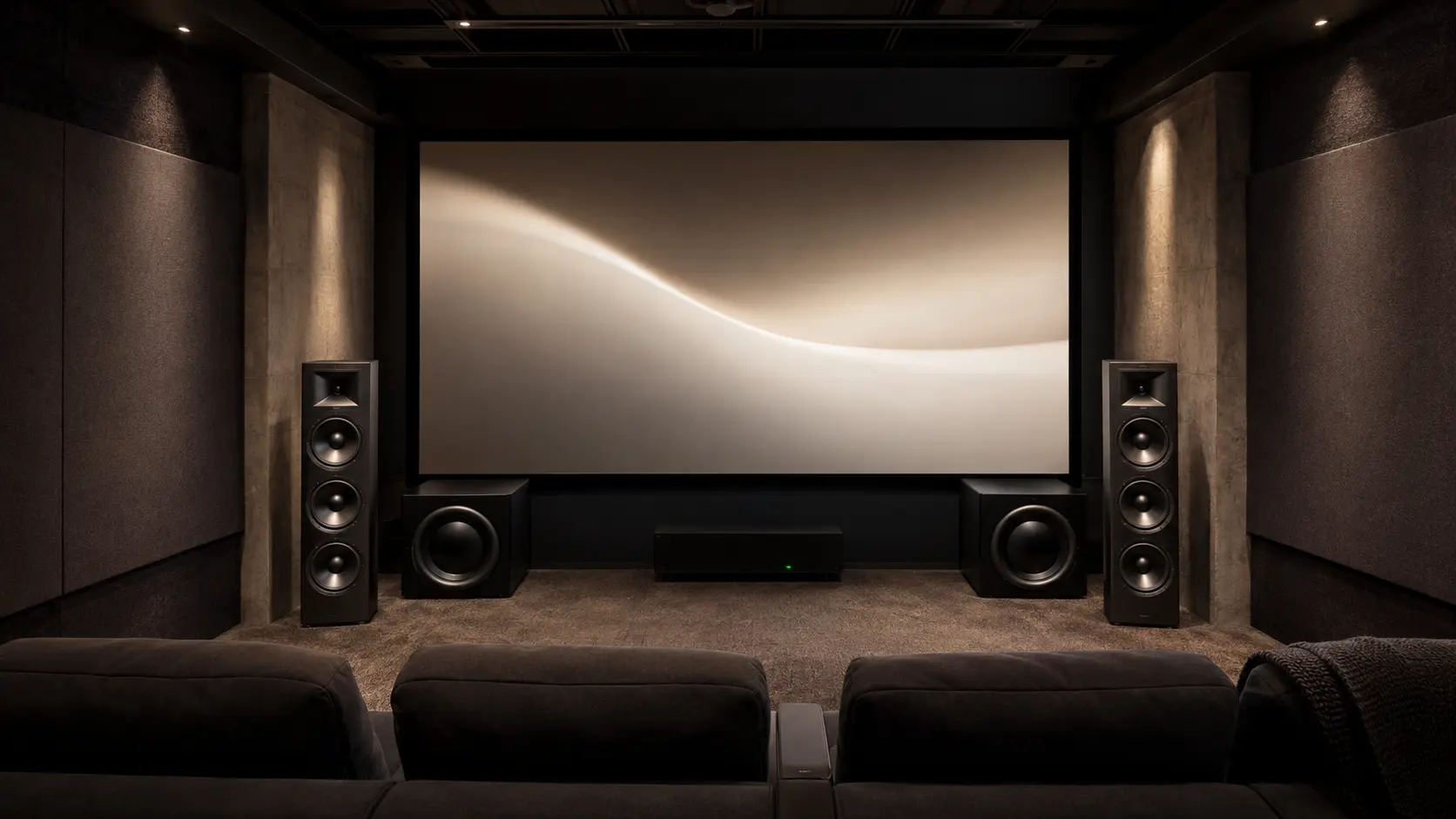
Why I built an expensive theater without buying luxury audio
My theater is a useful case study because it is both objectively expensive and intentionally built to avoid luxury-audio pricing.
I estimate the current equipment inventory at roughly $36,500-$37,500 at MSRP or replacement-equivalent pricing. Once professional paint, electrical/wiring, mounting, riser/infrastructure, and small hardware are included, a $40,000-plus finished-room replacement basis is plausible.
I estimate my actual equipment cash investment is roughly half of MSRP/replacement value because I bought used, refurbished, heavily discounted, or DIY where it made sense. The professional dark-room paint/finish would normally be roughly a $5,000 job; we paid about half.
That is the point of the room. I did not optimize for the lowest theater cost. I optimized for capability per dollar.
Design the room before choosing the gear
A home theater is a system of interacting constraints. The room dimensions, seating locations, light, noise limits, ventilation, wiring, and display geometry can dominate the result before speaker brand enters the conversation.
The first design sheet should include:
- room length, width, height, and total volume;
- primary and secondary seating locations;
- viewing distance for each row;
- desired screen size and aspect ratio;
- ambient-light conditions;
- maximum listening level and content mix;
- speaker/subwoofer placement options;
- HVAC noise and equipment heat;
- electrical circuits and outlets;
- rack/equipment location;
- door, window, and pathway constraints;
- noise transmission to the rest of the house or neighbors;
- future expansion paths.
A speaker that measures beautifully in free space can be the wrong speaker if the center cannot fit under the screen, the side surrounds are blocked by a second row, or the room cannot place the listening position away from a severe bass null.
Define performance targets instead of shopping by prestige
CEDIA’s RP22 recommended practice frames immersive-audio design around measurable performance levels. That is the useful starting point: decide what the system must achieve, then choose hardware that can achieve it in the room.
Useful targets include:
- listening distance and required output;
- seat-to-seat bass consistency;
- dialog intelligibility;
- low-frequency extension and headroom;
- directivity/coverage across the seating area;
- background noise;
- image field of view;
- display brightness/black level for the room;
- latency and gaming requirements;
- number of seats that need the full experience.
A two-seat room can spend differently from an eight-seat room because consistency becomes a larger part of the job.
Screen size and viewing geometry can produce one of the biggest experiential gains
The display decision should begin with viewing distance and field of view, not with technology prestige.
In a dark room, OLED's near-black performance can be exceptional. A much larger Mini-LED can still create a more dramatic overall experience if the smaller OLED does not fill enough of the visual field. Projection can exceed even 100-inch televisions when the room can control light and accepts the tradeoffs in black level, brightness, maintenance, installation, and screen geometry.
My 98-inch display made a bigger difference to immersion than several far more glamorous upgrades I could have chased. I'd already owned excellent OLED picture quality. What I wanted in this room was scale, and the larger screen delivered it.
Before buying a display I would tape the screen outline on the wall or project a test image, sit in every row, and watch real content. Ten minutes of room-scale testing can be worth more than another hour reading panel specifications.
TV versus projector is now a moving value boundary
Large LCD televisions have compressed the price gap that historically pushed serious theaters toward projection. That changes the rational crossover.
A large direct-view TV brings:
- high brightness;
- strong HDR impact;
- simpler installation;
- no lamp/laser alignment issues;
- better ambient-light tolerance;
- generally easier gaming;
- fewer geometry/focus concerns.
Projection still wins when:
- the desired image is materially above the affordable TV ceiling;
- cinematic scale is the primary goal;
- the room can control light completely;
- an acoustically transparent screen is valuable for speaker placement;
- the owner accepts projector/screen complexity.
Choose the technology after the required image size is known. The 98–100-inch TV versus projector guide compares the installation and picture-quality tradeoffs.
The center channel deserves disproportionate attention
Movies and television route a large amount of dialogue and front-stage information through the center. A weak or poorly placed center can make an expensive L/R pair feel disappointing.
I care about:
- coverage across both rows;
- output at the farthest seat;
- vertical placement relative to the screen;
- obstruction by furniture;
- dispersion and crossover behavior;
- whether an acoustically transparent screen would solve a placement compromise;
- matching enough timbre/output with L/R that pans do not collapse.
I won't split a theater speaker budget evenly just because every channel has a place on the diagram. Movies put an enormous amount of important content through the center. If dialogue coverage or output is the limiting factor, that's where the next dollar should go.
Surround and Atmos channels need geometry more than extravagance
Dolby's setup guides define reference positions for surround and height channels. Real rooms require adaptation, but the purpose of those guides is important: immersive formats assume speakers exist in particular spatial relationships.
A $500 surround placed correctly can outperform a $2,000 surround mounted where it cannot cover the seating area.
For a 7.1.4-style room I would verify:
- side surrounds actually sit to the sides rather than becoming extra rear speakers;
- rear surrounds have enough separation from the back row;
- heights create front-to-back and left-to-right separation;
- tweeters are not blocked by seat backs or furniture;
- all speakers can reach target output without obvious strain;
- distances/delays and levels are calibrated rather than guessed.
Atmos upgrades become low ROI when the room cannot create meaningful angular separation or when the bed layer is still weak.
Bass is where room physics humiliates product shopping
Subwoofers interact strongly with room modes. One giant subwoofer can deliver extreme output at one seat while another seat sits in a deep null. Multiple subs can improve spatial consistency when placement and calibration are done well, but adding quantity without measurement can just create more expensive chaos.
The order I prefer is:
- determine required extension and output for room volume/listening level;
- identify viable subwoofer locations;
- measure candidate placements;
- use multiple subs when seat-to-seat consistency or headroom justifies them;
- align delay/phase and levels;
- apply EQ after placement/alignment, not instead of them;
- verify with measurements and listening.
The subwoofer buying guide compares commercial and DIY options. Start with the bass missing at your seats, then buy the capability to fill it.
Midbass and tactile response are separate tools
I added dedicated mid-bass capability and tactile transducers because I want to feel the impact of movies and EDM. Get the core bass system working first; then these tools can add the physical experience I was chasing.
A subwoofer optimized for very deep extension can still leave an owner wanting more impact in the 30-80 Hz region depending on room, seats, integration, and taste. Tactile transducers can add physical sensation without requiring the room to produce the same acoustic SPL, but they need their own amplification, filtering, mounting, and delay alignment.
These are refinement tools. They make sense after the core bass system is already measured and competent.
Amplifiers are capacity devices, not jewelry
Power amplifiers should be sized around speaker sensitivity, impedance behavior, listening distance, crossover, target output, and the amount of simultaneous channel demand.
The receiver or processor needs enough clean voltage/output and thermal capacity for the job. External amplification becomes useful when:
- speakers are difficult loads;
- listening levels are high;
- many channels are driven hard;
- the AVR is thermally stressed;
- more power materially increases clean headroom;
- separate amplification improves system flexibility.
I love powerful equipment, but an external amplifier is a terrible upgrade if the receiver is already delivering everything the speakers need. The money belongs at the actual bottleneck, whether that's bass, room treatment, calibration, or seating.
For subwoofers, pro-style amplification can provide enormous power per dollar, but fan noise, voltage requirements, DSP, connectors, protection, and gain structure become part of the system.
Processing and room correction are valuable only with a correct physical setup
Audyssey, Dirac, miniDSP, ARC, Trinnov, and other correction systems can be powerful, but no algorithm repeals acoustics.
I would use correction after:
- speaker placement is reasonable;
- polarity is correct;
- distances are measured/verified;
- subwoofer placement is deliberate;
- delays and phase relationships are understood;
- levels are in range;
- gross room problems are addressed physically.
Then correction can improve response, integration, target shaping, and consistency.
The UMIK-1 has extremely high ROI in my system because it lets me see whether a change actually improved the response. A microphone and free/low-cost measurement software can prevent thousands of dollars of blind upgrading.
Measure before and after every meaningful change
At minimum I want:
- frequency response for each sub and combined subs;
- frequency response around the crossover region;
- multiple-seat measurements where multiple seats matter;
- decay/room behavior when investigating bass problems;
- channel levels and distances;
- before/after correction traces;
- subjective listening notes with the exact change documented.
The measurement does not replace listening. It tells me whether the physical mechanism I think I changed actually changed.
Acoustic treatment is usually better ROI than another electronics upgrade
Early reflections, decay time, bass behavior, and noise floor can limit clarity and imaging long before a speaker reaches its engineering limit.
Treatment should be placed for a purpose. I would not cover every wall in foam because "studios have panels." Useful categories include:
- broadband absorption at strong early-reflection locations;
- bass trapping where practical;
- controlled treatment behind/around speakers depending on design;
- ceiling treatment where reflections or room sound justify it;
- diffusion/scattering where sufficient distance and room design make it appropriate.
My room uses six 4x2-foot acoustic panels. The exact right amount for another room can be very different.
Sound isolation is construction, not acoustic treatment
Panels improve the sound inside the room. They do not meaningfully stop deep bass from leaving the room.
Isolation requires control of transmission paths: mass, damping, decoupling, airtightness, doors, ducts, penetrations, and structural flanking. This becomes much easier and cheaper to design before construction than after the room is finished.
For a future dedicated room, I would spend on isolation architecture before exotic speakers if loud playback around the rest of the home matters.
Seats change both comfort and acoustics
Theater seating affects:
- ear height;
- row spacing;
- sight lines;
- surround blockage;
- tactile response;
- bass response at the actual listener position;
- long-session comfort;
- aisle access.
My second row sits on a homemade carpeted riser, with commercial bar seating behind it. That configuration works because the room is used as a real entertainment space, not a showroom. The furniture has to serve the listening geometry and the people using it.
A $5,000 recliner package can be high ROI if the room is used constantly. It can also consume the budget while the speakers and room remain compromised.
Source devices and media convenience determine whether the room gets used
An excellent theater that requires ten minutes of troubleshooting has worse lifestyle ROI than a slightly less perfect room that starts reliably.
I care about:
- HDMI stability;
- lossless audio support where relevant;
- frame-rate/HDR switching;
- streaming-app availability;
- Plex/local-media behavior;
- gaming latency;
- remote/control simplicity;
- sync issues;
- consistent startup sequences.
Apple TV, Nvidia Shield, game consoles, local media, and dedicated movie-server products solve different jobs. I do not pay for a premium source simply because its library or interface is prestigious. It needs to improve the actual playback workflow.
Cables: pay for specification and installation, not mythology
Cables matter when they fail to meet bandwidth, length, shielding, connector, fire-rating, or installation requirements. Long in-wall HDMI runs can justify certified active/fiber solutions. Subwoofer runs may need balanced/pro interfaces in some systems. Speaker wire needs appropriate gauge and installation rating.
Beyond meeting the electrical/specification job and reliability requirement, I have not found a rational reason to treat exotic cable pricing as a core sound-quality upgrade.
The hidden ROI is running enough conduit and spare cable while walls are open.
Electrical, cooling, and equipment access are part of reliability
High-output theaters can contain amplifiers, receivers, consoles, displays, network gear, chargers, and lighting. Heat and service access matter.
Design for:
- safe circuit capacity and code-compliant installation;
- surge/protection strategy appropriate to the home's electrical system;
- rack ventilation;
- amplifier fan noise if equipment is in-room;
- accessible cable paths;
- labeled connections;
- room for replacement equipment;
- network reliability.
A power conditioner does not compensate for bad branch-circuit design or a hot sealed cabinet.
Lighting changes perceived quality for little money
The room should become dark enough to support the display and comfortable enough to enter without stumbling.
High-ROI lighting can include:
- dimmable zones;
- low-level path lighting;
- bias/accent lighting that does not wash the screen;
- automation tied to playback;
- blackout treatment where ambient light is a problem.
My Govee corner lighting and HDMI sync lighting are entertainment additions, not reference-video necessities. They earn their place only if they improve how the room is actually enjoyed.
My theater: replacement value versus what I actually paid
The room is a useful case because retail-equivalent capability and cash outlay are very different numbers.
I estimate the current equipment at roughly $36,500-$37,500 MSRP/replacement-equivalent, and I would record it as about a $37,000 theater before construction/paint, wiring, mounting hardware, and labor. A complete finished-room replacement basis above $40,000 is plausible once the professional finish and infrastructure are included.
I did not pay retail for most of it. My rough estimate is around half of MSRP across the equipment because I bought used, refurbished, heavily discounted new, or DIY where practical. The paint/finish is roughly a $5,000 professional job at normal pricing; we paid about half.
That is the purchasing philosophy in physical form: buy expensive capability without automatically paying expensive retail pricing.
Current replacement-equivalent inventory
| System area | Major items | Replacement-equivalent role |
|---|---|---|
| Display | 98-inch TCL QM7K + HDMI 2.1 sync lighting | large-format HDR image and gaming |
| Processing | Denon AVR-X3700H, miniDSP, UMIK-1 + boom arm | decoding, routing, bass management, measurement |
| Front/bed layer | Klipsch Reference Premiere / matching surround system | high-output multichannel bed layer |
| Heights | 4 Atmos speakers | 7.4.4 immersive layer |
| Bass | SKHORN Baltic-birch cabinet with dual B&C 21DS115-4 drivers + additional bass architecture | extreme deep bass/headroom |
| Amplification | CVR 3302 DSP and supporting amps | subwoofer/high-output power and processing |
| Tactile | 4 BST-1 bass shakers | physical low-frequency feedback |
| Treatment | six 4x2-foot acoustic panels | reflection/room control |
| Seating | two theater rows + three commercial-grade bar seats + dark-walnut commercial bar surface | long-session comfort and third-row social use |
| Riser | homemade carpeted second-row riser | sight line / seating geometry |
| Sources | Apple TV, Nvidia Shield Pro, Xbox, Switch, local media | streaming, gaming, local playback |
| Media | movie collections + Nintendo game library | content inventory |
| Lighting | four corner-light systems + TV sync lighting | room experience / ambience |
The exact line-item MSRP table should be kept in the insurance inventory and refreshed when equipment changes. The useful distinction is replacement value versus actual spend.
The budget allocation ladder I would use today
These are directional allocations, not brand lists.
Around $2,000-$3,000: build the competent foundation
- good-value 65-85-inch display depending room;
- competent 3.1/5.1 speakers;
- one capable subwoofer;
- entry AVR;
- basic light control and placement work.
Do not spend on separate amps, exotic cables, or premium furniture while dialogue, bass, and screen scale are unresolved.
Around $5,000-$8,000: remove the obvious weaknesses
- larger/better display;
- stronger center/front stage;
- two-sub strategy where room/seat needs justify it;
- 5.1.2/5.1.4 or 7.1.x geometry;
- measurement microphone;
- basic acoustic treatment;
- seating comfort.
Around $10,000-$20,000: build a serious room
- large-format TV or competent projection;
- high-output speaker system sized to room;
- multiple strong subs;
- more capable AVR/processing;
- deliberate acoustics;
- room finish/light control;
- wiring/infrastructure;
- seating and ventilation.
$20,000-$40,000+: specialize
At this point the room should already be excellent. The money buys:
- extreme low-frequency headroom/extension;
- multiple-row consistency;
- very large display or premium projection;
- advanced room correction;
- isolation/construction;
- architectural integration;
- tactile systems;
- premium seating/finish;
- lower distortion and higher output;
- convenience/automation.
This is where every upgrade needs a named bottleneck.
Cost per hour is the right way to think about a high-use room
An expensive theater can still be rational entertainment if it replaces hundreds or thousands of hours of lower-value spending outside the home and is used for years.
A simple model:
net annual ownership cost = depreciation + maintenance + electricity + media/subscriptions + financing/opportunity cost - resale retained.
Then divide by household use hours, not by calendar years alone.
I do not use cost-per-hour to prove the theater is an "investment." It is consumption. The calculation tells me whether it is high-use consumption or an expensive museum.
Insurance documentation is part of owning a system this large
For a room with tens of thousands of dollars of equipment, I want an insurance-grade inventory with:
- item;
- quantity;
- serial number;
- purchase source/date;
- amount paid;
- MSRP/new replacement price;
- realistic current replacement price;
- photos of the item and serial label;
- room-wide photos;
- receipts/invoices;
- custom/DIY documentation;
- amplifier/driver/cabinet relationships;
- installation/finish receipts where relevant.
That file is more useful after a loss than trying to reconstruct a complex system from memory.
The home-theater BUY / WAIT / PASS
BUY / UPGRADE when you can name the bottleneck, demonstrate it in the room, and the intervention improves a large portion of actual use.
WAIT when the room, placement, calibration, or source problem has not been diagnosed, or when a major display/audio product transition is likely to change the value curve soon.
PASS when the purchase is mostly prestige, the current system has no meaningful flaw for your use, or the money would produce a larger experiential gain in screen size, bass integration, treatment, seating, light control, or content.
The system should become better because the room needed the component, not because the component needed a room to justify it.
Sources
Disclosure
Some links may earn Mr ROI a commission at no added cost to you. That does not change the recommendation. This is general information, not personal financial or medical advice. Read the full disclosure.