
Dirac vs. miniDSP: The Calibration Upgrade That Fits a Changing Theater
A measured decision between included Audyssey, an existing miniDSP, Dirac Live Bass Control, and repeat professional calibration for a 7.4.4 theater that keeps evolving.
In brief
Start here
- The failing AVR channel, terminals, HDMI behavior, and switching create a receiver decision independent of room correction; software should not be used to justify hardware the theater does not otherwise need.
- The existing miniDSP remains useful for four-output routing, unlike bass-source roles, manual filters, and portable presets, while the AVR-X3900H creates a simpler baseline with four independent subwoofer outputs and included Audyssey MultEQ XT32.
- At current prices, the $599 Dirac Room Correction and Bass Control bundle crosses roughly two quoted $350 professional recalibrations, but only if repeatability is genuinely used and the receiver remains in service.
My theater keeps changing, which makes it tempting to buy the newest calibration system every time I move a subwoofer or change equipment. The better question is which tool solves a problem I can measure. I already own a miniDSP; replacing that workflow needs to earn the money.
The cost that matters in my room is repeat calibration. I have a 7.4.4 setup with multiple large subwoofers, a separate midbass module, external amplification and a miniDSP 2x4 HD. I change equipment often enough that a perfect one-time calibration can become obsolete. Dirac earns the price only if it helps me measure and restore a better result more easily than the gear I already own.
When I began this comparison, my Denon AVR-X3700H gave me independent reasons to plan a replacement: a dead back-surround channel, loose speaker terminals, a troublesome dedicated 8K input, and slow HDMI switching. Room correction did not cause those problems, and room correction will not repair them.
For my room, the useful split is simple:
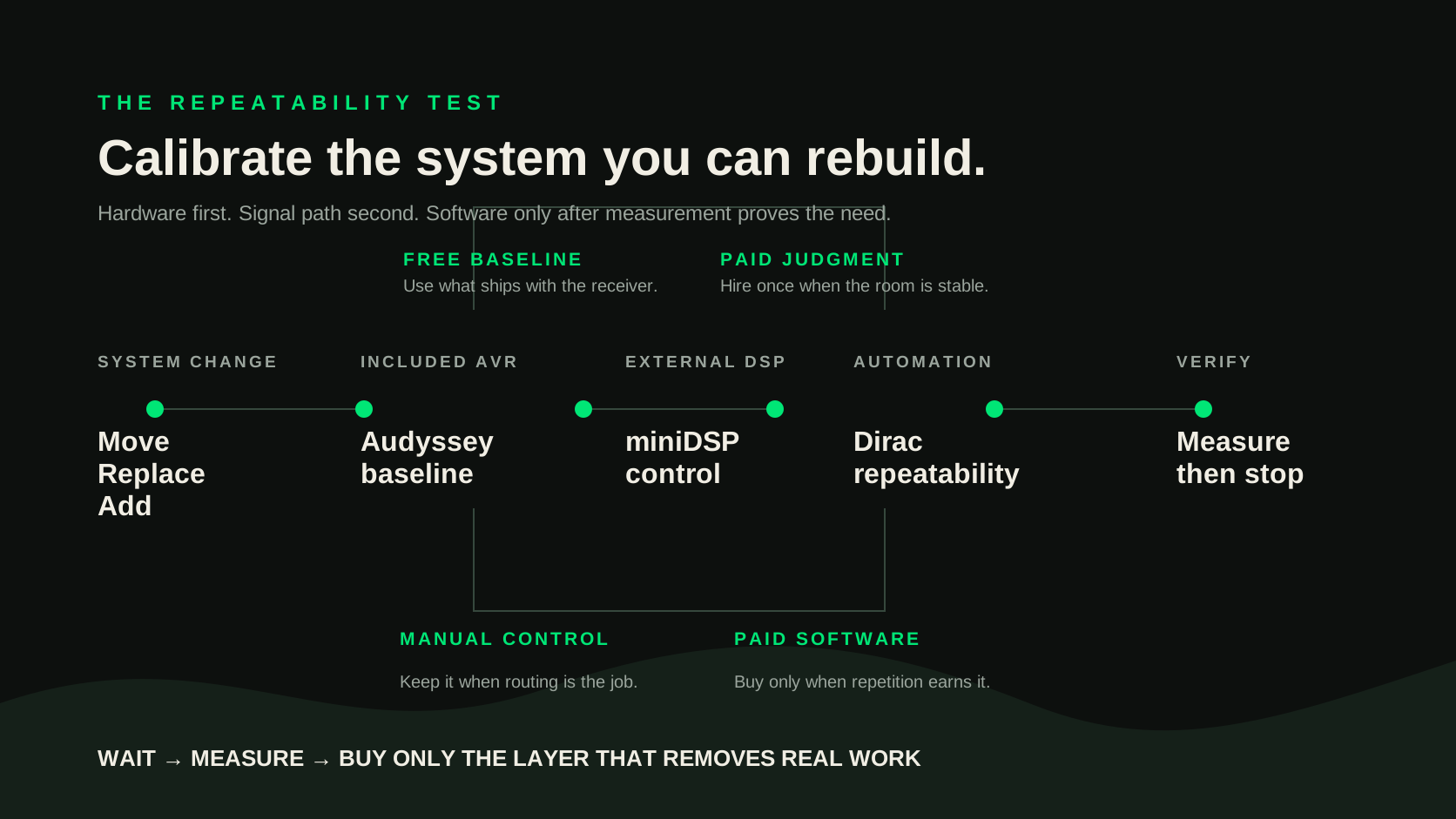
Replace hardware for hardware reasons. Buy calibration software only when it makes the next correct calibration easier to repeat.
The decision at that stage was WAIT on the full Dirac stack until I chose the receiver. Keep the miniDSP because it already solves routing, gain, delay, and equalization across four bass outputs. If I buy a Denon AVR-X3900H, start with its included Audyssey MultEQ XT32 and four independent subwoofer outputs. Add Dirac Live Bass Control only if its repeatability replaces at least two paid recalibrations or materially improves the multi-seat result. Do not buy Active Room Treatment merely because it is the newest box on the feature list.
Separate the four jobs people call room correction
One product does not have to own every layer.
| Job | What it actually changes | Tools that can do it |
|---|---|---|
| Speaker setup | Levels, distances, crossovers, channel assignment | AVR setup, Audyssey, Dirac, manual measurements |
| Subwoofer integration | Gain, polarity, delay, crossover interaction, seat-to-seat response | AVR sub outputs, miniDSP, Dirac Bass Control, manual optimization |
| Response shaping | Cuts, limited boosts, target curve, tonal balance | Audyssey, Dirac, miniDSP PEQ, REW-assisted filters |
| Acoustic decay | What the room continues doing after the signal stops | Placement, treatment, multiple sources, and systems such as Dirac ART within supported limits |
This distinction prevents category mistakes. A miniDSP 2x4 HD is a two-input, four-output processor with per-output delay, parametric EQ, crossovers, and four presets. It is an extremely flexible bass-management tool. It does not automatically decide where the microphone should go, whether the target curve is appropriate, or whether the result is good across several seats.
Dirac Live Room Correction measures the speakers and room, then creates filters for frequency and timing. Bass Control is a separate add-on that analyzes the subwoofers and their interaction with the rest of the system. Active Room Treatment is another layer that coordinates speakers to reduce low-frequency resonances and decay within the compatible system.
Audyssey MultEQ XT32 is already included on the current Denon models I am considering. On the AVR-X3900H, Denon says Sub EQ HT can set level and delay for as many as four subwoofers before MultEQ XT32 corrects them together.
Choose by the control you need and the calibration work you want to do yourself.
My current architecture explains why the miniDSP still earns its shelf space
All of my subwoofer channels currently begin with one AVR output and then split through the miniDSP 2x4 HD. That gives me four independently adjustable outputs downstream. I can set gain, delay, polarity, crossover behavior, and parametric filters for different bass sources without asking the receiver to understand the whole physical system.
That is particularly useful when the system contains unlike jobs. My large subwoofers provide deep-bass capacity. The separate midbass module is there for a different sensation and operating range. Treating every cabinet as four interchangeable copies would be easier, but it would not describe the system.
The limitation is equally important. Feeding one mono subwoofer signal into the miniDSP means the receiver sees one bass system. The miniDSP can optimize what happens after that output, but the AVR cannot natively identify and automate each downstream cabinet as an independent source. Manual measurement and filter design carry that burden.
A carefully tuned manual bass system can sound exceptional. You own the measurements, filter choices and checks across the seats.
The miniDSP remains valuable after a receiver upgrade if I want:
- four independently controlled bass outputs without paying for a new software license
- separate presets for music, movies, testing, or a different target curve
- manual control over unlike subwoofer and midbass roles
- a configuration that survives replacing the AVR with another brand
- the ability to inspect every gain, delay, crossover, and filter rather than accepting an automated result
The strongest reason to remove it would not be tidiness. It would be a measured result showing that the AVR and chosen correction platform can reproduce the performance with less complexity and enough control.
The AVR-X3900H changes the baseline before Dirac enters the calculation
On October 21, 2026, Denon lists the AVR-X3900H at $1,849. It processes 11.4 channels, amplifies nine, provides four independent subwoofer outputs, includes Audyssey MultEQ XT32, and is upgradeable to Dirac Live Room Correction, Bass Control, and Active Room Treatment.
For a 7.4.4 layout, nine onboard amplifiers still mean at least two channels need external amplification. That is not a problem in my theater because external amps are already part of the system. It is a cost another buyer must include.
The four subwoofer outputs are more important than the model-number change. They create three legitimate starting architectures:
| Architecture | Signal path | Best fit | Main compromise |
|---|---|---|---|
| Denon only | Four AVR outputs to four bass channels | Similar subs, simple system, lowest complexity | Less manual routing flexibility than miniDSP |
| Denon plus miniDSP | One or more AVR outputs into external DSP | Unlike bass sources, custom filters, reusable presets | More gain staging, wiring, measurement, and failure points |
| Denon plus Dirac Bass Control | Independent AVR outputs managed by Dirac | Repeatable automated multi-sub integration | Additional license cost and receiver-bound ecosystem |
I would not buy the X3900H because it has Dirac logos. I would buy it if the receiver solves the failing channel, terminals, HDMI behavior, processing, and current connection needs at the best complete price. The included Audyssey system is then the free calibration baseline that a paid option must beat.
The calibration ladder at a glance
Room correction is not one purchase. It is a stack, and every higher rung assumes the layer below it has already been completed well enough to expose the next problem.
| Rung | Working cost | Job | Verdict |
|---|---|---|---|
| Placement and included setup | $0 incremental | Set geometry, levels, distances, crossovers, and a credible receiver baseline | USE FIRST. Optional software has to beat this measured result |
| Measurement ownership | $100-$300 | Make room and integration problems visible through a calibrated microphone, REW, repeatable positions, and saved baselines | BUY for any serious system that changes regularly |
| Manual routing and DSP | $225-$800 and up | Control unlike bass sources, delay, gain, crossovers, PEQ, protection, and reusable presets | KEEP while it solves routing the receiver cannot reproduce |
| Repeatable automated integration | $599-$799 plus compatible hardware at the current comparison | Automate speaker and multi-sub integration after the receiver is already the right hardware | WAIT, THEN BUY when repeatability replaces enough paid recalibration or manual work |
| Professional judgment | About $350 per remote session in my current comparison | Add diagnosis, target selection, protection, verification, and tradeoff judgment | HIRE EARLY for diagnosis or late for a stable final system, not for every temporary iteration |
The higher rung does not retire the lower ones. Dirac still needs a credible microphone position and verification. A professional still benefits from saved measurements and known signal routing. A miniDSP remains useful when it owns functions the receiver cannot duplicate.
Price the calibration system, not the license headline
As checked on October 21, 2026, Dirac's X3900H page lists Room Correction at $259 to $349 depending on bandwidth, Bass Control at $299, and the Room Correction plus Bass Control bundle at $599. The full Room Correction, Bass Control, and ART bundle is currently $799.
Those are software prices, not complete project prices. Dirac recommends a calibrated USB microphone such as the miniDSP UMIK-1. Measurement also consumes setup time, quiet-room time, learning time, filter comparison, and verification. The license is tied to supported hardware, and Dirac says a license generally cannot move to a different model. A same-model warranty replacement can be handled through support, but a future AVR change can require buying again.
My alternative quote is about $350 for a professional remote calibration. That can be excellent value when the person is genuinely skilled and the system is stable. It becomes expensive when every major configuration change creates another appointment.
| Path | Upfront cash | Two major recalibrations | Five major recalibrations | Who owns repeatability? |
|---|---|---|---|---|
| Included Audyssey | $0 beyond AVR | $0 | $0 | Owner and AVR workflow |
| Existing miniDSP | Already owned | $0 software cost | $0 software cost | Owner or hired filter designer |
| Professional remote calibration | About $350 each | About $700 | About $1,750 | Professional, with owner preserving files and process |
| Dirac Room Correction + Bass Control | Currently $599 | $599 plus microphone and time | Same license cost while hardware remains supported | Owner and software workflow |
| Full Dirac stack with ART | Currently $799 | $799 plus microphone and time | Same license cost while hardware remains supported | Owner and software workflow |
Repeatability has value even before a listening comparison. At my quoted calibration price, the $599 Room Correction and Bass Control bundle crosses two paid sessions; the $799 full bundle crosses three.
A professional calibration is worth more when the system stops moving
A good calibrator provides judgment that software does not automatically supply.
They can identify bad measurements, choose a useful target, and notice crossover or gain-structure problems. They can also protect driver headroom, decide where not to correct, and explain why one seat cannot have everything. That judgment is valuable.
It is also perishable when the physical system changes.
Moving a subwoofer, replacing the LCR speakers, changing amplifiers, adding a midbass module, changing seating, or altering acoustic treatment can invalidate part of the previous work. The exact consequence depends on the change. Swapping a source device usually does not require acoustic recalibration. Moving a subwoofer absolutely can.
My rule is:
- Hire the professional early when the system has a problem I cannot diagnose and the expert will teach me what to preserve.
- Hire the professional late when the room is close to finished and the goal is the best final result.
- Avoid paying for every middle iteration when I already know another meaningful hardware change is coming.
If I pay for calibration, I want the measurement files, target curves, crossover decisions, gain notes, filter export, and a simple change log. A screenshot of a pretty response is not a transferable system.
Dirac earns the money through repeatability, not magic
Dirac Bass Control appeals to me because it automates repeated measurements and manual coordination. I would check the result across my seats, then keep the calibration if it solves the problem.
A serious workflow still needs:
- sensible subwoofer placement before correction
- clean gain structure with no clipping
- a calibrated microphone and consistent orientation
- measurement positions that represent actual seats
- a target curve chosen for the room and listening preference
- before-and-after verification outside the correction interface
- a saved configuration and notes for the next change
Software cannot manufacture low-frequency output where the hardware has none. It cannot fully erase a severe cancellation with boost. It cannot turn a poorly placed subwoofer into a good multi-seat layout without consequences. It cannot decide that my midbass module should be treated differently unless the architecture and configuration express that job.
The value is that I can rerun the same documented process after a real system change instead of starting from a blank page or paying for another appointment.
Use a change threshold before recalibrating
Not every adjustment deserves a full measurement session.
| Change | Full recalibration? | Why |
|---|---|---|
| New streaming box or game console | Usually no | The acoustic system did not change |
| AVR replacement | Yes | Processing, levels, delays, routing, and filters reset |
| Main speaker replacement | Yes | Response, sensitivity, directivity, and crossover behavior changed |
| Subwoofer moved or added | Yes | Modal interaction and timing changed |
| Amplifier replacement | Verify first | Gain can change even if acoustic geometry does not |
| Seat moved several feet | Usually yes | Listener position relative to room modes changed |
| Minor furniture change | Measure before deciding | The effect may be too small to matter |
| Target curve preference change | Recalculate or reload | Geometry may be unchanged, but filter intent changed |
This prevents calibration theater. I do not want to rerun twenty measurements because a cable changed. I also do not want to keep using a beautiful old filter after moving the object that produced half of the bass.
The stopping rule for my system
The receiver decision comes first because the X3700H now has hardware problems that affect daily use. I will compare the complete X3900H replacement with current alternatives on channel count, pre-outs, HDMI reliability, and subwoofer architecture. Warranty, street price, and compatibility with my existing external amplification also matter.
Then I would use this sequence:
- Install the receiver and establish a clean hardware baseline.
- Run the included Audyssey MultEQ XT32 workflow with four independent subwoofer outputs where the architecture fits.
- Measure the result at the main seat and the seats I actually care about.
- Compare that result with the existing miniDSP architecture, not with memory.
- Keep the simpler path if it meets the target.
- Buy Dirac Room Correction plus Bass Control only if the remaining problem is integration and repeatability, not inadequate hardware or placement.
- Add ART only after the lower layers are verified and a trial or controlled comparison demonstrates a meaningful improvement in my room.
This is deliberately slower than buying every license with the receiver. Optional software is easy to add later. License cost and setup time are harder to recover if the included system already completes the job.
Four worked decisions
One subwoofer in a normal living room
Run the AVR's included correction. Verify crossover and level. Spend the next dollar on placement, a measurement microphone, or the subwoofer itself before buying multi-sub software.
Verdict: USE THE INCLUDED SYSTEM.
Two similar subwoofers in fixed positions
Use independent AVR outputs when available. Compare seat-to-seat response. If included Sub EQ HT and MultEQ XT32 produce a controlled result, stop. If variation remains and placement is already optimized, Dirac Bass Control becomes a rational trial.
Verdict: WAIT, THEN BUY ONLY IF MEASURED.
Four unlike bass sources with custom roles
Keep external DSP unless the replacement platform can express the same routing and target behavior. Automation is valuable, but not if simplification deletes the architecture that created the result.
Verdict: KEEP THE miniDSP UNTIL THE REPLACEMENT PROVES EQUIVALENCE.
Finished dedicated theater with no planned changes
Paying a qualified professional once can be better than owning software that will not be used well. Require files, targets, notes, verification, and a clear explanation of the final tradeoffs.
Verdict: HIRE JUDGMENT, NOT A SCREENSHOT.
Conclusion
WAIT on buying room-correction software before the receiver and signal architecture are settled.
KEEP the miniDSP when it is already providing flexible routing, independent bass-channel control, presets, and a portable configuration. Its current official price is $225, which is modest beside the hardware it can coordinate.
BUY Dirac Live Room Correction and Bass Control when a supported receiver is already the right hardware choice and several subwoofers need repeatable integration. The owner must also be willing to rerun and verify the process. At current pricing, my break-even is roughly two $350 professional calibrations, but only if I perform the work and keep the receiver long enough to use the license.
PASS on ART as a checkbox. It should clear a measured room-specific test after placement, bass capacity, crossover behavior, and the correction layers below it are already right.
The best calibration system is not the one with the most advanced product page. It is the one I can reproduce after the next real change, understand well enough to verify, and stop upgrading once the room does the job.
The broader home-theater diminishing-returns guide explains where equipment spending stops compounding. The subwoofer ladder covers capacity by room and use. If the complete receiver, subwoofer, amplification, and calibration path needs to be designed together, the Decision Desk is the appropriate next step.
Sources
- Denon: current AVR-X3900H price, channels, HDMI, room correction, and technical specifications
- Denon manual: four independent subwoofer outputs and Audyssey Sub EQ HT behavior
- Denon manual: Audyssey MultEQ XT32 and Sub EQ HT setup
- Dirac: current AVR-X3900H Room Correction, Bass Control, ART support, and license pricing
- Dirac: what Bass Control measures and automates
- Dirac: recommended measurement-microphone requirements
- Dirac support: license transfer limits across hardware models
- miniDSP: current 2x4 HD price, two-input/four-output architecture, PEQ, delay, presets, and processing
- miniDSP 2x4 HD user manual - signal flow
- miniDSP Flex HTx user manual
Disclosure
Some links may earn Mr ROI a commission at no added cost to you. That does not change the recommendation. This is general information, not personal financial or medical advice. Read the full disclosure.