
98-100 inch TV vs. projector in 2026: the giant-display value equation changed
Giant Mini-LED TVs changed the projector break-even point. Compare 98-100 inch TVs with projectors on scale, HDR, black level, gaming, installation, and cost.
Bottom line
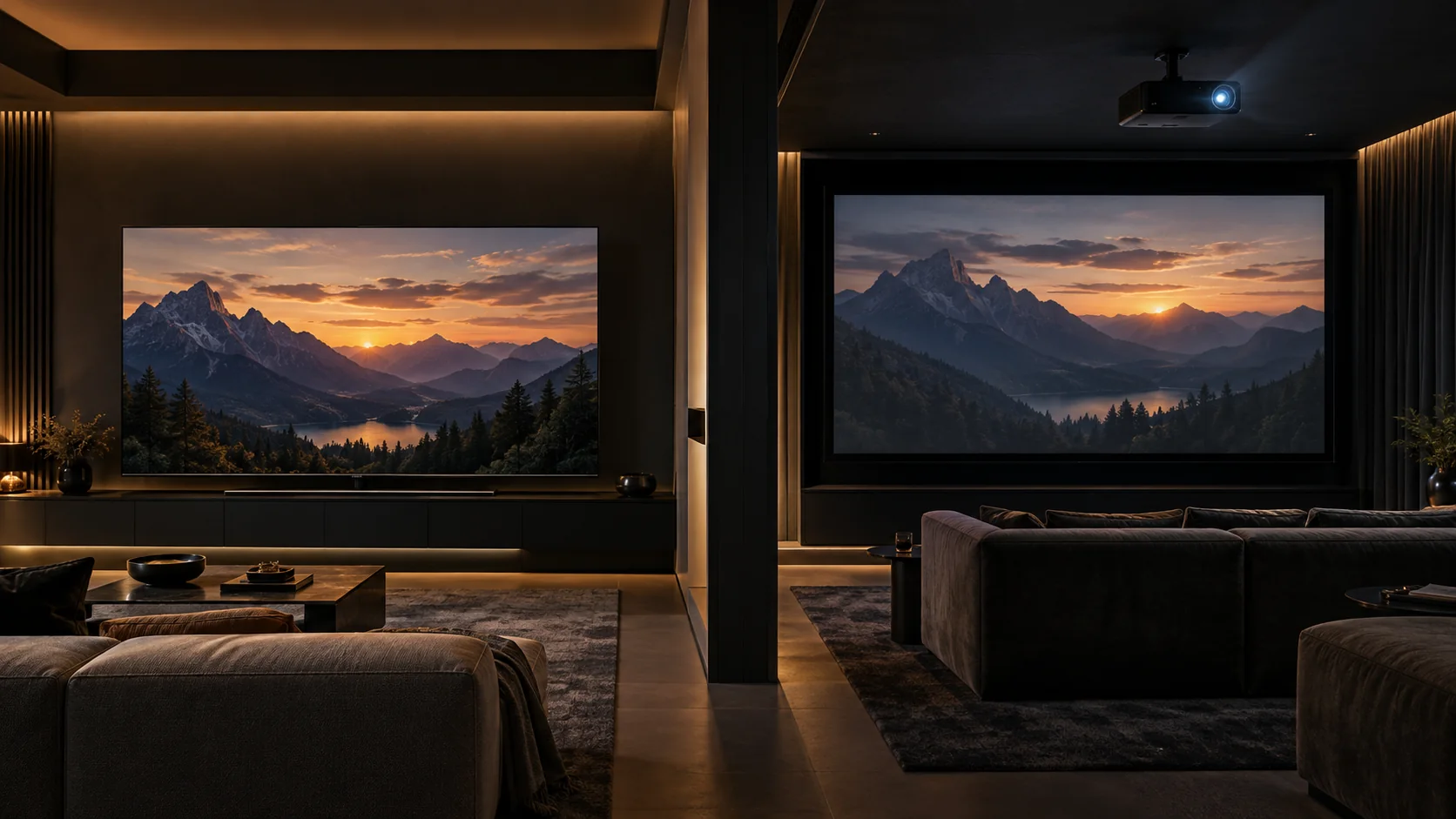
At 98-100 inches, a modern Mini-LED television is now a legitimate projector replacement for many dedicated rooms. A projector still wins when the buyer wants substantially more image area, an acoustically transparent screen, or the lowest cost per inch above roughly 100 inches.
The old rule “TV for living room, projector for serious theater” is obsolete.
My own move to a 98-inch TV is why I think the break-even deserves a fresh framework.
The display decision model
The correct display is not the one with the best isolated picture-quality score. It is the one that maximizes the whole-room visual experience after size, seating distance, room reflectance, HDR, gaming, audio placement, installation and cost are included.
Compare image area, not only diagonal
For the same 16:9 aspect ratio, image area scales with the square of diagonal.
Approximate relative area:
| Diagonal | Area vs 98-inch |
|---|---|
| 83 in | ~72% |
| 98 in | 100% |
| 100 in | ~104% |
| 120 in | ~150% |
| 135 in | ~190% |
| 150 in | ~234% |
That is why projection still has a defensible lane. Going from 98 to 120 inches is not a trivial 22-inch change. It is roughly 50% more image area.
Field of view should set the first threshold
Before shopping, measure seating distance and decide whether a 98-100-inch image is already immersive enough.
If the front row is close enough that 98 inches provides the field of view I want, paying thousands more and accepting projection compromises just to say "120 inches" can be poor ROI.
If the room is deep, has multiple rows, or the entire point is a cinema-scale image, projection gains value quickly.
Brightness and HDR are not the same contest
A modern Mini-LED TV can produce far higher highlight luminance and maintain brightness in ambient light. That makes HDR effects, sports, gaming and mixed-use viewing easier.
Projection trades absolute luminance for image scale and reflected-light presentation. Premium projectors, dynamic tone mapping and a dark room can look excellent, but buyers should not assume that a projector reproduces direct-view HDR simply because both accept an HDR signal.
Black level depends on both device and room
Direct-view displays create the image at the panel. Projection depends on light bouncing off the screen and through the room.
In a light-colored room, reflected light can return to the screen and raise the black floor. Dark paint, controlled light and non-reflective finishes therefore function like part of the projector hardware.
My own professionally darkened theater is unusually favorable to projection, which makes the fact that a 98-inch TV remains compelling even more important to the value argument.
Screen and projector are one system
A projector comparison must include:
- projector;
- screen material/frame;
- mount;
- signal/power run;
- throw distance/lens shift;
- calibration;
- room light control;
- possible hush-box/cooling considerations;
- replacement/maintenance where applicable.
A $3,000 projector is not a $3,000 display if the room needs another $2,000 of infrastructure to make it perform.
The center-channel problem can reverse the answer
A television usually forces the center speaker below or above the image. In a dedicated multi-row theater, that can be an audible/visual compromise.
An acoustically transparent projection screen allows identical or closely matched LCR speakers behind the image at appropriate height. If front-stage integration is a top priority, that can be worth giving up some direct-view picture advantages.
Gaming checklist
For gaming, verify the exact display's:
- 4K refresh combinations;
- HDMI bandwidth/ports;
- VRR range;
- input lag at the desired mode;
- HDR game behavior;
- chroma/text handling for PC use;
- console compatibility;
- burn-in risk if comparing OLED.
Do not treat "HDMI 2.1" as a complete specification.
Reliability and serviceability
A giant TV is mechanically simple in daily use but physically difficult to move or service. Panel failure can mean replacing a huge object.
Projection separates the imaging device from the screen. A projector can be upgraded/repaired without replacing the screen, but it adds optics, filters/fans, alignment and sometimes lamp/laser aging concerns.
Total-cost lanes
98-100-inch Mini-LED: best when current street pricing is aggressive, 100 inches is enough, HDR/gaming matter and simplicity is valuable.
Premium 98-100-inch direct view: worth more when the panel materially improves black level, processing, viewing angle or brightness without crossing into absurd $/inch territory.
120-135-inch projection: strong dedicated-theater value when scale or acoustically transparent audio placement is the goal.
150-inch+ projection: a specialized room decision. At this point seating geometry, brightness, throw, speaker layout and construction dominate the product choice.
BUY / WAIT / PASS
BUY a giant TV when 98-100 inches already delivers the desired field of view, current street price is rational, and HDR/gaming/ease matter more than another 20-50 inches.
BUY projection when the room earns it: larger-than-100-inch scale, multiple rows, acoustically transparent front stage, controlled light and willingness to design the room around the image.
WAIT when giant-TV pricing is between cycles, a desired panel technology is about to move down-market, or the room itself is not finished.
PASS on projection if the buyer is unwilling to control ambient/reflected light or maintain alignment/infrastructure.
PASS on a giant TV if it physically cannot reach the room or 100 inches is visibly too small from the planned seating distance.
Sources
Disclosure
Some links may earn Mr ROI a commission at no added cost to you. That does not change the recommendation. This is general information, not personal financial or medical advice. Read the full disclosure.