
98-inch Mini-LED vs 83-inch OLED: when size beats picture quality
The technically better panel is not always the better room. Viewing distance, light, content, installation, and recurring regret decide.
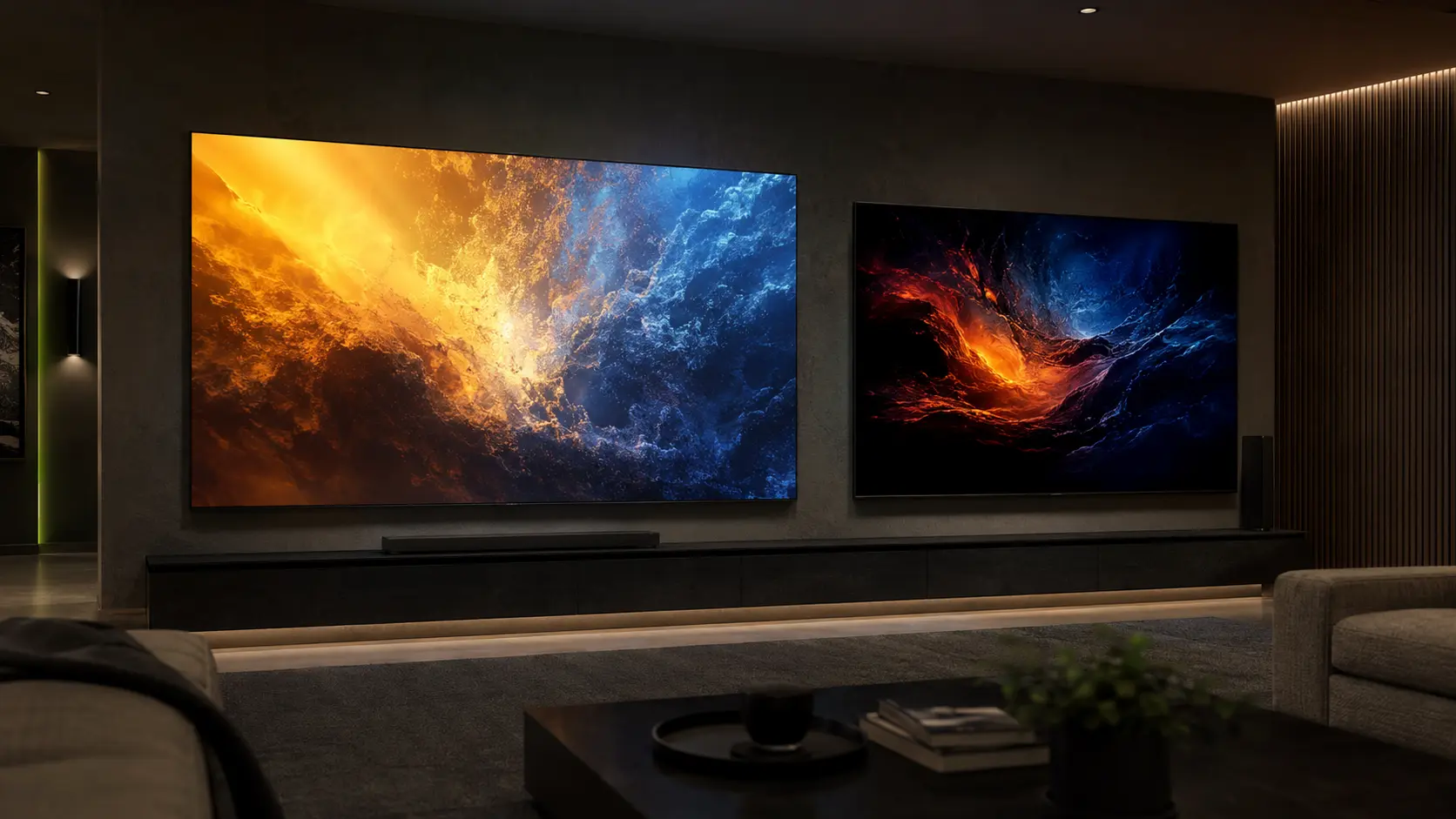
In brief
Start here
- Choose the 98-inch Mini-LED when scale and mixed-room brightness are the repeated constraints.
- Choose the 83-inch OLED when dark-scene precision, viewing angles, and local-dimming artifacts matter more than image area.
- Tape both exact outlines on the wall and compare total installed offers, not model rank or list price.
I went from a 77-inch OLED to a 98-inch Mini-LED because I wanted a more immersive theater, not another small picture-quality improvement. The bigger screen changed the scale of the room. I still value OLED blacks, but size can be the upgrade you notice more often from a real seat.
Do not decide from a store wall or a model ranking. Tape both outlines on your wall, measure from your eyes to the screen plane, and watch familiar content in the light you actually use.
The size difference is not fifteen inches
At the same aspect ratio, screen area grows with the square of the diagonal. A 98-inch image has about 39 percent more area than an 83-inch image. Compared with a 77-inch image, it has about 62 percent more area.
That extra area explains why the larger image can change a room even when the smaller panel has better contrast.
OLED controls light at the pixel level. A good Mini-LED television manages zones of pixels and can produce far more light than older LCDs, but dark objects beside bright ones can still reveal blooming or raised blacks. The better technology depends on which compromise your room exposes most often.
Run the room test before the specification test
Measure the main eye-to-screen distance. Mark the manufacturer’s actual width and height for both models with painter’s tape. Check the outlines from the main seat, side seats, doorways, and walking paths for several days.
Then map the practical constraints:
- windows, lamps, reflections, and willingness to control light;
- mount rating, wall structure, outlets, console height, and speaker placement;
- delivery path, safe lifting plan, packaging storage, and return logistics;
- side-seat angles and the position of subtitles from normal seats;
- content mix, including sports, games, films, streaming quality, and static interfaces.
A large display can be physically possible and still be badly placed. A premium OLED can be technically excellent while looking too small from the actual seat.
Online distance charts are useful starting points, not verdicts. Vision, content, resolution, room use, and personal tolerance change what feels comfortable. The taped outlines are cheap evidence from the actual room.
What each choice does better
| Priority | 98-inch Mini-LED | 83-inch OLED |
|---|---|---|
| Immersion from distance | Clear area advantage | Large, but visibly smaller |
| Dark-scene precision | Strong on a good model, with blooming risk | Pixel-level black and highlight control |
| Bright mixed-use room | High light output can help | Room reflections can reduce the black-level advantage |
| Wide seating | Model-dependent | Usually more consistent off-axis |
| Sports and group viewing | Scale and brightness are persuasive | Excellent motion can still win for sensitive viewers |
| Critical dark-room film | Impact-first choice | Precision-first choice |
These are category-level tendencies. Exact models and screen sizes can behave differently. Manufacturer specifications confirm supported formats and inputs; independent measurements are more useful for brightness, local dimming, motion, and viewing-angle performance.
Why I moved from a 77-inch OLED
My prior theater television was a 77-inch LG CX. I still use OLED elsewhere, including LG OLEDs in the bedroom and living room. I know what its blacks, dark-scene control, and wide viewing angles add.
The theater’s bottleneck was scale. I bought a 98-inch TCL QM7K for roughly $1,900 during a promotion. The 62 percent increase in image area affects every film, game, and sporting event. OLED’s advantage remains visible in the scenes that expose it, but the size advantage is visible before playback starts.
For my room, scale won. A closer seat, wider seating arrangement or greater sensitivity to blooming could make the OLED the better choice.
I also passed on the more expensive QM8K. The QM7K was already big enough, bright enough, and capable enough for this room. At the prices I found, the extra money wasn't solving a problem I could justify paying to fix.
Ignore permanent price ladders
Television prices move too quickly for a fixed model table to stay useful. Compare the exact delivered offers on the day you can buy. Save the model number, seller, warranty, delivery service, return policy, and promotion terms.
The total installed cost includes the mount, wall work, wiring, light control, source devices, delivery, and enough qualified help to handle the panel safely. An open-box discount must also pay for greater handling and return risk. On a 98-inch television, a difficult return can erase a modest saving.
For current TCL models, the manufacturer lists native 144 Hz capability on the QM7K and QM8K families. Verify the exact model manual and use independent tests for the behavior that controls your decision.
Before ordering, I would put both finalists on one decision card. Record:
- delivered price and exact model suffix;
- return deadline and panel-inspection process;
- warranty, mount, installer, and delivery path;
- actual width and height from the manufacturer;
- the two picture flaws most likely to bother you.
If a game console or computer matters, verify the relevant inputs, resolution, refresh rate, and format support on the exact ports. The card keeps a dramatic showroom impression from replacing the requirements that decide whether the screen can stay.
Use the regret test
Picture two recurring annoyances. In one, a dark subtitle or star field reveals blooming and less-perfect blacks. In the other, the image feels undersized every time you sit down. Which one will occur more often in your real content?
If possible, audition both with familiar material and non-store picture modes. Include a difficult dark scene, bright sports, low-bitrate streaming, subtitles, and an actual game. A television has to survive ordinary sources, not only a demo reel.
Who should not choose the 98-inch option
Do not buy it when the mount, wall, delivery path, safe handling, or return plan is unresolved. Do not use size to excuse obvious panel defects or local dimming that bothers you constantly. A critical viewer in a controlled dark room may get more value from the OLED.
Do not choose the 83-inch OLED merely because it wins a generalized picture-quality ranking either. If the taped outline feels small from the main seat, that limitation will remain after the review scores are forgotten.
For my theater, size was the repeated constraint, so the 98-inch QM7K was the better system purchase. The correct answer is the screen whose strength the room reveals and whose compromise you notice least.
Use Home Theater Diminishing Returns to decide whether the display is actually the next system upgrade, and read the live audio-event record for the mistakes that changed my stopping point.
Sources
Disclosure
Some links may earn Mr ROI a commission at no added cost to you. That does not change the recommendation. This is general information, not personal financial or medical advice. Read the full disclosure.