
What Audio Advice Live taught me about $75,000 speakers, diminishing returns, and building a better theater
What Sonus faber, ASCENDO Black Swan, Bowers & Wilkins, JBL Synthesis, REL, and Klipsch taught me about the value ceiling in high-end audio and where a better theater actually begins.
In brief
What I learned
Room construction, bass integration, and calibration often change the experience more than a prestige component swap.
High-end demonstrations are useful when they reveal a real bottleneck, not when price is treated as proof of audible value.
Build toward the experience you want, then stop when the next tier no longer changes normal use enough to justify its whole cost.
I Heard $75,000 Speakers. My Klipsch System Survived.
The show did not make my theater obsolete
I went to Audio Advice Live ready to be impressed by systems that cost far more than mine. Several sounded excellent. But no $50,000-plus speaker pair I heard made me want to throw out my Klipsch system and start over. That is my subjective impression from show-floor demonstrations, not a controlled comparison. I came home more interested in room design, bass integration, and getting more out of what I already own.
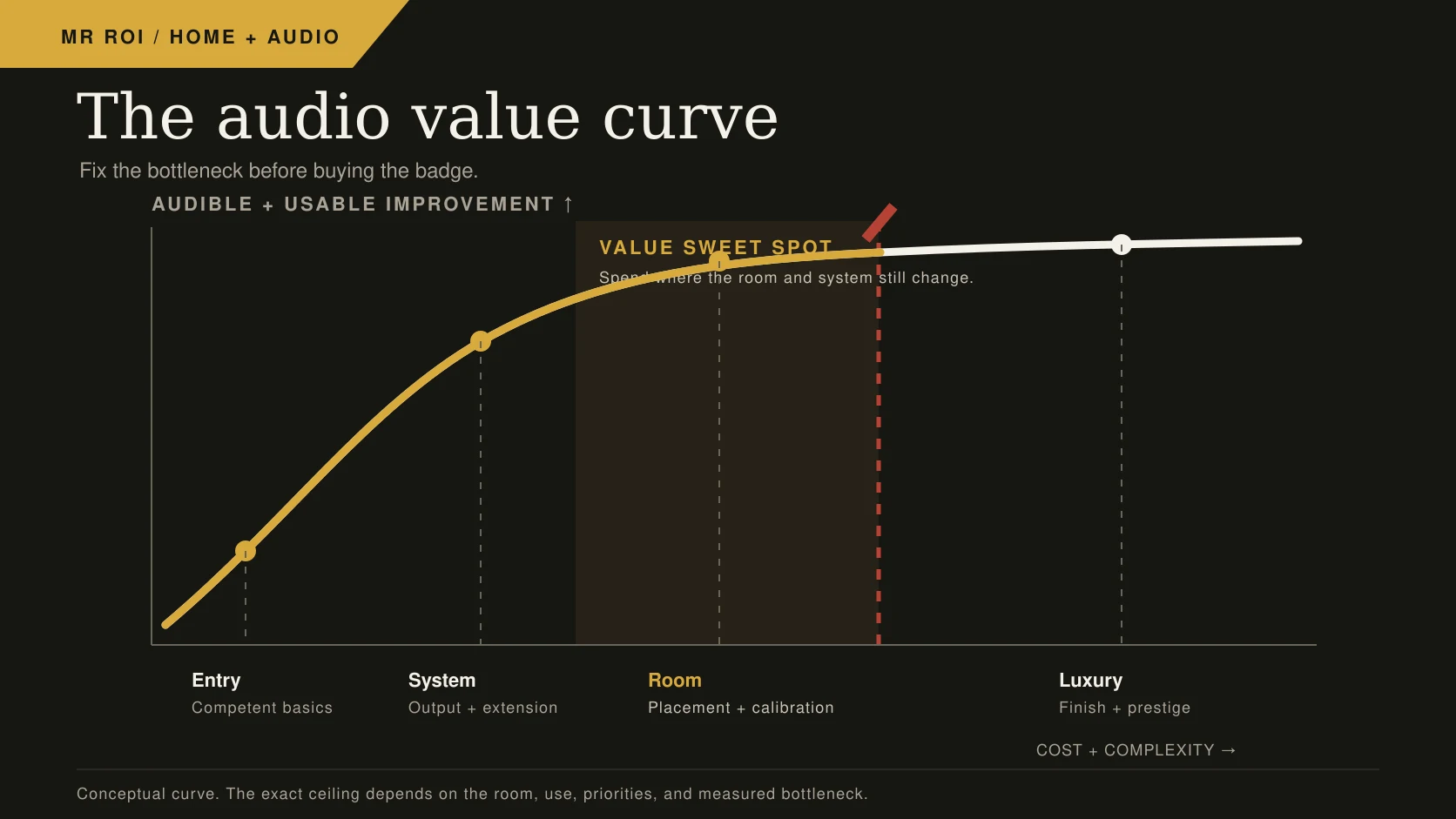
At the show, many luxury speakers sounded only modestly better to me, roughly 5% to 20% by my subjective judgment. Different rooms, levels and short auditions made precise comparison impossible. Room setup, bass and dynamics changed the experience much more obviously than the price tag.
I came home more interested in construction, isolation, calibration, and system design than in prestige speakers.
The subwoofer buying guide turns those listening lessons into a purchase and room-fit process.
The value ceiling is not where improvement stops. It is where each additional dollar buys less of what you can actually hear, see, or use.
What actually stood out
- Demonstration
- Sonus faber Amati Supreme at roughly $75,000 per pair
- What I noticed
- Beautiful finish and refined presentation
- ROI conclusion
- Craftsmanship may justify the premium for the right buyer; sound alone did not erase the value gap
- Demonstration
- ASCENDO Black Swan
- What I noticed
- Extreme capability and output, but the demo did not connect with me
- ROI conclusion
- Specifications and maximum SPL do not guarantee a preferred experience
- Demonstration
- JBL Synthesis
- What I noticed
- Cohesive, controlled, and impressive
- ROI conclusion
- Strong system engineering, but the complete installed price still needs a room-level justification
- Demonstration
- Four REL HT/1510 Predators
- What I noticed
- Much more output and physical impact than I expected from the form factor
- ROI conclusion
- Multiple-sub placement and integration can outperform assumptions based on enclosure appearance
- Demonstration
- Emotiva
- What I noticed
- Credible performance without luxury pricing
- ROI conclusion
- Value brands remain relevant when the system job is defined correctly
- Demonstration
- 135-inch Dreamwall LED display
- What I noticed
- Large, bright, seamless presentation at about $30,000 installed
- ROI conclusion
- A real experience change, but still a luxury purchase with a steep premium over high-value projection or large TVs
The show was most valuable where it changed a belief. The REL room challenged my expectations. The ASCENDO demo reminded me that maximum capability is not identical to enjoyment. The luxury rooms proved that finish and ownership experience are legitimate products, even when the sound-per-dollar case is weak.
My current theater is already past the normal value ceiling
My system is not a budget baseline. I have spent roughly $40,000 across the theater, use a 98-inch TCL QM7K, run a 7.4.4 layout, and care about bass output, dynamics, placement, processing, and integration. My Klipsch Reference Premiere speakers are efficient, direct, and capable enough that the next front-stage upgrade needs to solve a specific limitation.
The serious candidates are not random luxury speakers. They are high-output designs such as PSA, JTR, and DIY Sound Group options that could increase controlled output, dialogue headroom, and consistency across seats. Even then, the right answer may be KEEP KLIPSCH if the room, subwoofer integration, or calibration remains the dominant bottleneck.
The installed system creates option value. Existing speakers are mounted, matched, wired, and calibrated. A replacement requires purchase, freight, positioning, possible amplification changes, resale work, and another calibration. The new product must repay the whole transition, not merely win a specification.
The room can be the highest-return component
High-end audio is often sold as a chain of boxes. The listening experience is a room-plus-system problem. Speaker capability matters, but so do dimensions, boundaries, seat locations, subwoofer positions, crossover behavior, delay, level, decay, noise floor, isolation, and repeatable calibration.
CEDIA's RP22 framework is useful because it treats immersive audio as a design target rather than a product pile. The practical implication for me is that a future shop theater should spend early dollars on geometry, construction, HVAC noise, mass, separation, conduit, power, and equipment access. Those decisions are difficult to retrofit and continue paying regardless of which speaker brand is installed later.
Kinetics IsoMax clips were one of the useful construction products I discovered at the show. They can decouple a finished wall or ceiling assembly from the framing before drywall goes up. Doors, HVAC paths, outlets, adjoining framing, floors, ceilings, and every other flanking path still have to be designed as one system. The lesson was to solve isolation during construction, when the option is available, rather than expect a speaker swap to repair the building later.
- Priority
- Room geometry and seat plan
- Why it comes before a prestige swap
- They determine modal behavior, sightlines, and layout options
- Priority
- Isolation and noise control
- Why it comes before a prestige swap
- A lower noise floor improves every source and protects the rest of the house
- Priority
- Subwoofer placement and integration
- Why it comes before a prestige swap
- Bass consistency across seats can change the experience more than a cosmetic speaker tier
- Priority
- Measurement and calibration
- Why it comes before a prestige swap
- Level, delay, crossover, and response errors can hide equipment capability
- Priority
- Main speaker capability
- Why it comes before a prestige swap
- Upgrade when output, coverage, distortion, or directivity is the measured constraint
- Priority
- Luxury finish
- Why it comes before a prestige swap
- Buy it knowingly as design and ownership value
This order does not make speakers unimportant. It prevents an expensive speaker from being asked to repair a room problem it cannot control.
Bass created the most obvious differences
My taste is not subtle background bass. I want the 30-Hz-and-up impact that makes EDM and action content feel physical, plus useful extension below that. In a roughly 3,600-cubic-foot theater, subwoofer count, placement, enclosure design, and calibration can change the experience dramatically.
That is why a switch from a conventional consumer subwoofer to a high-output DIY or pro-style design can feel more transformative than moving between two already competent main speakers. The upgrade still needs complete-cost math: enclosure size, amplifier power, electrical needs, freight, assembly, finish, integration time, and resale.
The four-REL demonstration was useful because it showed how much a well-integrated multi-sub system could do without looking like the most extreme room at the event. I would not infer that four HT/1510s are automatically the best value for my room. I would infer that quantity, placement, and system tuning deserve more attention than one-sub brand rankings.
Luxury audio often sells three products at once
A high-end speaker can sell sound, industrial design, and ownership experience. Reviewers and buyers create confusion when they defend all three with audio-performance language.
Exotic veneer, sculpted cabinets, dealer setup, rarity, and a beautiful object in the room can be worth real money. A person furnishing a design-led living space may get more value from those qualities than I do in a dedicated theater where output and immersion dominate. That buyer is not irrational. The purchase becomes irrational only when the aesthetic premium is hidden inside claims of proportional sonic superiority.
I separate the invoice:
- What is paid for measurable acoustic capability?
- What is paid for finish and furniture value?
- What is paid for dealer design, installation, and support?
- What is paid for scarcity or status?
Only the first category should be compared as raw sound-per-dollar.
How I would audition an upgrade
Show impressions create a shortlist, not a verdict. Before an expensive front-stage change, I want level-matched listening with familiar dialogue and music. I also want to test seats beyond the sweet spot, let the initial excitement settle, and measure the current system's actual limitation.
I would keep the comparison narrow:
- Define the required output, distance, coverage, and placement.
- Measure the current system under normal listening conditions.
- Shortlist designs that address the observed constraint.
- Include freight, amplification, installation, calibration, and resale.
- Trial the most promising option when return terms make the downside acceptable.
- Keep the current system if the difference is incremental or limited to rare use.
This process gives an expensive contender a fair chance without letting price create the expectation of improvement.
The value ceiling by buyer
BUY the luxury speaker when its finish, dealer support, fit, and sound are all part of the desired product and the premium does not displace a more important room fix. BUY the high-output value design when measured capability and dynamics matter more than furniture-grade finish.
WAIT when the current speakers are competent and the room, bass integration, calibration, or seating plan is unresolved. Those interventions transfer to future equipment and can expose whether a speaker upgrade is still necessary.
PASS when the argument is MSRP, prestige, or capability you cannot use. A $75,000 speaker can be better and still be a poor upgrade.
Audio Advice Live did not prove that expensive audio is fake. It proved that the last increments are sold at luxury prices, and that the room remains the most important component no one gets to unbox.
Sources
- Audio Advice Live: 2026 event information
- Sonus faber: Amati Supreme specifications and price
- ASCENDO: Black Swan Pro Active EXT
- Kinetics Noise Control: IsoMax sound-isolation clips
- CEDIA Recommended Practice RP22: immersive-audio design
- Dolby: home theater speaker setup guidance
- CEDIA: standards and best practices
- Audio Advice Live 2026 official event release
- Audio Advice Live 2026 official schedule
Disclosure
Some links may earn Mr ROI a commission at no added cost to you. That does not change the recommendation. This is general information, not personal financial or medical advice. Read the full disclosure.