
My Endgame Front Stage: PSA vs. JTR vs. DIYSG vs. Keeping Klipsch
A room-specific decision on movies, music, horns, headroom, center channels, surrounds, and why a current $2,999.99 PSA LCR package may beat a $11,997 JTR front stage for my theater.
In brief
Start here
- I want speakers that handle movies and music with clear dialogue, consistent coverage and clean output at my listening level.
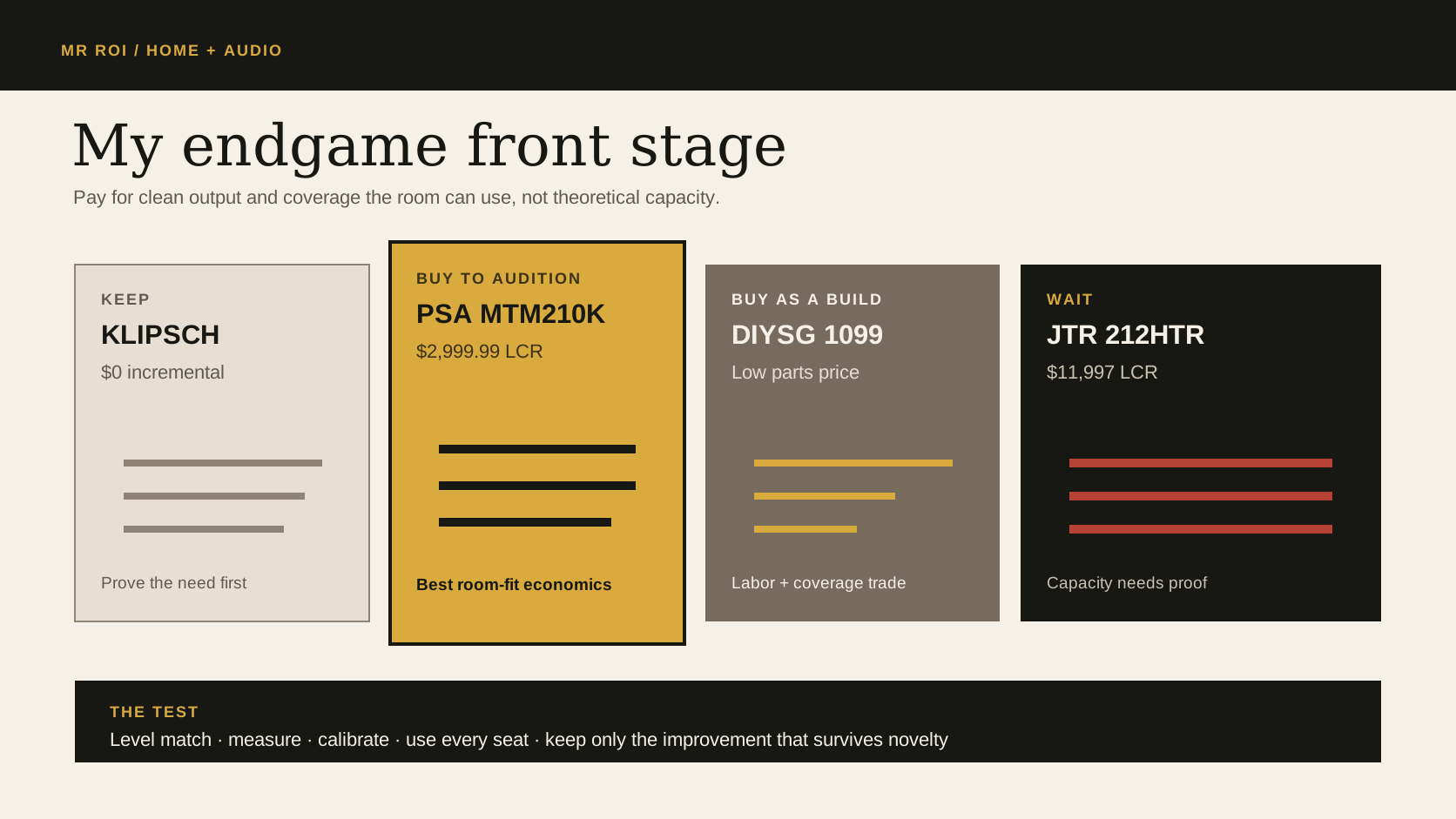
- For my room, the PSA MTM210K-M LCR package is the next audition candidate. JTR needs to solve a clear output or coverage limit to earn its much higher cost.
- Keep the existing Klipsch surrounds first. Replace them only if a level-matched trial reveals a mismatch that bothers me.
I already own a capable front stage. My Klipsch RP-8000Fs can play loudly, measure far more neutrally than the old stereotype suggests, and have survived both music and movie use without making me desperate to replace them.
That makes the next speaker purchase harder, not easier.
The job is not to find a speaker that is merely better. It is to find a front stage that produces a meaningful improvement in a roughly 3,600-cubic-foot, 7.4.4 theater with serious subwoofers, an approximately 80 Hz crossover, Denon processing, Audyssey calibration, and a listener who wants both music quality and violent movie dynamics.
My current answer is unusually specific: the Power Sound Audio MTM210K-M family is the highest-ROI endgame direction for this room. JTR can buy more capability. PERLISTEN can buy a more luxurious full-range and two-channel package. DIY Sound Group can buy enormous output per hardware dollar. Keeping the Klipsch can still be the correct decision until a controlled audition proves the improvement.
Movies and music do not require opposite speakers
The usual split is too simple. Theater speakers are described as aggressive, efficient, and exciting. Music speakers are described as smooth, neutral, and refined. That framing implies a speaker becomes cinematic by coloring the sound and musical by running out of headroom gracefully.
A good speaker for both jobs needs the same underlying things:
- smooth direct sound through the listening window
- predictable off-axis behavior so room reflections do not acquire a different tonal balance
- enough sensitivity and power handling for the desired seat distance and level
- low distortion and limited compression at the loudest real use
- suitable coverage for the seating width
- clean integration with the subwoofers and center channel
- geometry that works in the actual room
Movies demand more sustained dialogue from the center, more channel-to-channel movement, and more peak output. Music can expose tonal imbalance, image instability, and fatigue more consistently. Those are different stress tests of the same design, not different definitions of quality.
A speaker does not become musical by running out of headroom, or cinematic by making treble aggressive.
Horns are not inherently harsh
A horn or waveguide changes the acoustic loading and radiation of a high-frequency driver. It can improve efficiency, control coverage, reduce the amplifier power required for a given level, and let a compression driver operate with less strain. None of those properties requires elevated treble.
Harshness can come from an uneven frequency response, a directivity discontinuity, distortion, compression, reflections, a poor target curve, excessive level, the recording itself, or a listening position outside the intended coverage. A flat on-axis curve does not guarantee good sound if the response changes badly a few degrees away. A horn badge does not diagnose any of those problems.
The original RP-8000F is a useful example. Klipsch published 98 dB sensitivity, but Audioholics measured 92.1 dB at 2.83 volts and one meter using its method. That is still above average. More importantly, its measurements showed a generally neutral direct-axis response, controlled horizontal dispersion, and a narrower region around the 1,750 Hz woofer-to-horn transition. The speaker looks more aggressive than it measures.
The useful question is not, “Does it use a horn?” It is, “How smoothly does the whole speaker behave on and off axis at the levels, angles, and distances I use?”
My room changes the ranking
A recommendation for a quiet two-channel apartment should not control a high-output dedicated theater. My system changes the value of several common speaker features.
| Constraint | What it does to the decision |
|---|---|
| Roughly 3,600 cubic feet | Requires real output, but does not justify commercial-cinema capacity without evidence |
| 7.4.4 layout | Makes center performance, coverage, placement, and surround integration more important than tower bass |
| Serious subwoofers near an 80 Hz crossover | Reduces the value of paying heavily for full-range towers below the crossover |
| High playback levels and dynamic content | Rewards sensitivity, low compression, controlled directivity, and clean headroom |
| Music matters substantially | Penalizes response irregularities, poor imaging, fatigue, and one-note “movie speaker” tuning |
| Existing RP-series surrounds | Makes a staged LCR-first upgrade far more rational than replacing eleven speakers at once |
| Possible future two-channel room | Reduces the need to make this theater front stage solve every future audiophile use case |
This is why a sealed speaker designed to hand bass to subwoofers can beat a beautiful full-range tower for this specific room. I should not pay twice for deep bass I already own in much greater quantity.
The front-stage ladder at a glance
This is the upgrade path I would test in a dedicated room with capable subwoofers: spend the front-stage budget on coverage, dialogue, dynamics and music performance.
| Rung | Complete LCR spend | Job | My verdict |
|---|---|---|---|
| Keep the calibrated baseline | $0 incremental | Preserve a capable owned system until a controlled audition proves a repeatable improvement | KEEP the Klipsch while the replacement case is still theoretical |
| DIY output value | Roughly $1,600 and up before finish and labor | Put more of the budget into drivers, sensitivity, and output when building is part of the hobby | BUY AS A PROJECT, subject to availability, coverage, and finish cost |
| Commercial sweet spot | About $3,000 at the current package price | Buy materially more headroom and defined coverage without paying for redundant tower bass | BUY TO AUDITION; PSA is the current ROI leader, not a declared result |
| Maximum commercial headroom | About $12,000 at current listed pricing | Add extreme output, heavier construction, and longer-distance capacity | WAIT unless the lower rung fails output, coverage, or refinement in-room |
| Reference or luxury system | $20,000 to six figures | Buy integrated-room engineering, full-range two-channel performance, finish, dealer support, or genuine prestige utility | CONDITIONAL; each of those is a different job and price is not proof of proportional improvement |
The ladder has two intentional gaps. There is no automatic tower rung because my subwoofers make deep front-speaker bass redundant. There is no automatic whole-room replacement because the LCR can be tested before four surrounds and four height channels are turned into another five-figure assumption.
Use the subwoofer buying guide when the next dollar should improve extension, seat-to-seat consistency, or room integration instead of the front stage.
The shortlist at current prices
Prices and availability below were checked on August 25, 2026. They are release-day verification items, not permanent facts.
| Direction | Current front-stage cost | What I am buying | What keeps it from winning automatically |
|---|---|---|---|
| Keep Klipsch RP-8000F front stage | $0 incremental | Proven ownership, strong value, easy output, no installation change | The upgrade question remains unanswered until a better speaker is heard in-room |
| PSA MTM210K-M family | $2,999.99 for the current three-speaker package | 98 dB published IEC sensitivity, 90 by 60 degree coverage, sealed 80 Hz design, B&C drivers, matched center, 60-day trial | New generation has limited independent measurement history; stands and exact placement still matter |
| DIYSG Elusive 1099 | $465 kit plus $66 flat pack per speaker at listed legacy prices, currently out of stock | Approximately 95.7 dB measured sensitivity, high output, DIY value, horizontal or vertical center options | Availability, labor, finish, narrow coverage, response irregularities, and vertical-axis sensitivity |
| JTR Noesis 212HTR | $3,999 each, or $11,997 for three | 101 dB published sensitivity, 60 by 60 coverage, 134 dB published usable output, Baltic birch construction | About four times the PSA package price for capacity my room may never exploit |
| PERLISTEN R7t family | Dealer-priced | Full-range four-way design, 90 dB published sensitivity, controlled directivity, polished finish, THX Dominus certification | Pays heavily for tower bass, finish, and refinement that overlap existing subwoofers and a possible future music room |
Compare sensitivity and output figures only after checking the test method. Manufacturers use different measurement and calculation conventions.
Why PSA is the current ROI winner
The new MTM210K-M is built around the job I actually have. Power Sound Audio lists a sealed 80 Hz-to-18 kHz response, 98 dB IEC sensitivity, and 90 by 60 degree horn coverage. It uses dual proprietary B&C ten-inch woofers and a B&C DE250 compression driver, with four-ohm nominal impedance and 250-watt program handling. PSA says 90 watts produces 108 dB at ten feet under its stated conditions.
The current package is the decisive part. Two vertical MTM210K-M speakers plus the matching MTM210KC-M center are listed together at $2,999.99. That is less than one JTR Noesis 212HTR. The tower version costs more because it eliminates stands, not because it changes the acoustic design.
For my room, PSA appears to buy the useful middle:
- materially more published sensitivity and headroom than the current Klipsch
- a design intended to cross directly to subwoofers instead of charging for redundant low bass
- defined 90 by 60 degree coverage that should fit a normal theater seating area
- a matching center using the same drivers and crossover concept
- a domestic trial and warranty path
- a complete LCR price that leaves money for stands, placement, calibration, and treatment
PSA says it optimized the new “K” model with a Klippel Near Field Scanner. That earns a place on my audition list. I would still listen in my room before committing to the upgrade.
What four times the money buys from JTR
The JTR Noesis 212HTR uses two twelve-inch woofers and a coaxial compression driver on a wooden 60 by 60 degree horn. JTR rates it at 101 dB sensitivity at two volts, with a 60 Hz-to-24 kHz response and 134 dB calculated usable output after the company’s compression allowance. The cabinet uses 24 mm, 18-ply Baltic birch and weighs 135 pounds shipped.
Three cost $11,997 before any placement hardware or room work. Compared with the $2,999.99 PSA package, the incremental price is $8,997.01.
That premium can buy:
- more maximum output
- a lower published bass limit
- a coaxial point-source midrange and high-frequency architecture
- heavier construction
- more capability at longer distance or in a larger room
JTR earns its premium when the less expensive system runs out of clean output, fails to cover the seats or has a tonal problem I cannot fix. If the PSA already handles my loudest listening comfortably, more headroom would sit unused.
My current verdict is WAIT. JTR is the flex-capacity option, not the value default.
DIYSG is a project decision, not just a speaker price
The Elusive 1099 remains attractive because its listed kit price is absurdly low relative to its output. Erin’s Audio Corner measured approximately 95.7 dB sensitivity and found it capable of playing loudly and enjoyably. The same measurements also showed a high-frequency lift, midrange issues, narrow horizontal radiation around plus or minus 30 degrees, and a sensitive vertical listening window.
That means the 1099 is not a $465 PSA substitute. The complete decision includes:
- whether the kit and exact components are actually in stock
- the $66 listed flat pack or another cabinet path
- glue, binding posts, damping, primer, paint or veneer, grille work, and feet
- assembly and finishing time
- the value of a horizontal center option versus its placement tradeoffs
- toe-in, ear height, seating width, and room-correction limits
- no conventional finished-product audition or return experience after assembly
For someone who wants the build as part of the hobby, those are not penalties. They are part of the return. For someone who wants to open boxes, calibrate, and watch a movie, the labor and uncertainty are real costs.
The 1099 is BUY AS A PROJECT when DIY is part of the pleasure and the room fits its coverage. It is PASS AS THE EASY VALUE ANSWER while the kit is unavailable and the PSA package exists at its current price.
The center and surrounds should not be upgraded by reflex
The front three speakers deserve the tightest match because dialogue, music, and on-screen movement live there. Three identical vertical speakers behind an acoustically transparent screen are the cleanest geometry when the room supports it. My room may instead need a horizontal center, which is why the PSA MTM210KC-M belongs in the real package math.
I would keep my Klipsch RP-series surrounds when changing the front stage, then listen for an actual mismatch. Audyssey can align level, timing and target response; dispersion and output behavior still depend on the speakers.
The upgrade sequence should be:
- Install and calibrate the new LCR.
- Level-match before comparing.
- Use scenes with slow front-to-side pans, ambience, music spread across channels, and high-output effects.
- Listen from every important seat.
- Replace surrounds only if the transition, output limit, or tonal discontinuity remains obvious.
PSA currently lists the MT110SR-M surround at $674.99 each. Replacing four Klipsch surrounds would add $2,699.96 before rear or height channels. That is a separate decision, not a mandatory tax attached to the front-stage purchase.
How I would test “endgame” without lying to myself
Speaker comparisons fail when one option is louder, positioned differently, or calibrated with a different target. My test would keep the room and procedure as controlled as practical.
| Test | What I need to learn | Failure signal |
|---|---|---|
| Level-matched music at normal volume | Tonal balance, image, vocal texture, width, and fatigue | “Better” disappears after level matching |
| Music at my loudest sustained use | Compression, glare, congestion, and ease | Treble hardens or image collapses as level rises |
| Dialogue from several seats | Center consistency and intelligibility | One good center seat hides poor off-axis behavior |
| Dynamic movie sequence | Transient headroom and recovery | Audible strain before my real maximum level |
| Front-to-surround pans | Integration with existing Klipsch channels | Tonal or spatial jump breaks the illusion |
| 80 Hz crossover sweep and measurements | LCR-to-sub phase, seat response, and placement | A placement null is mistaken for a speaker flaw |
| Two-week ordinary use | Whether the improvement survives novelty | I stop noticing the upgrade before the return window closes |
I would save the current Klipsch calibration, use the same source material, compare at matched playback level, and keep the boxes until the decision is final. “Endgame” should mean the remaining flaw is smaller than the next complete upgrade cost, not that the internet ran out of more expensive speakers.
My stopping condition
The Klipsch RP-8000F is not disqualified because it uses a horn, and an audiophile tower is not automatically better for music because it is expensive or inefficient. My current system already proves that one competent speaker can do both jobs.
KEEP THE KLIPSCH until an in-room trial demonstrates a material improvement. BUY THE PSA MTM210K-M PACKAGE TO AUDITION when I am ready to test the upgrade; its current $2,999.99 LCR economics align unusually well with my room, subwoofers, level, and music priorities. WAIT ON JTR unless the PSA exposes a real output, coverage, or refinement limit. BUY DIYSG AS A BUILD, not as a frictionless substitute. BUY PERLISTEN only if finish, full-range two-channel use, and its particular refinement are part of the job rather than expensive overlap.
The front-stage upgrade is successful when movies become more effortless, music becomes more convincing, and I stop thinking about speakers. Anything less is an expensive change of boxes.
Sources
- Power Sound Audio: MTM210K-M package pricing and current specifications
- Power Sound Audio: matching MTM210KC-M center specifications
- Power Sound Audio: tower-format MTM210KT-M package and geometry
- Power Sound Audio: current MT110SR-M surround pricing and specifications
- JTR Speakers: Noesis 212HTR price, construction, coverage, and output claims
- DIY Sound Group: current home-theater kit prices and Elusive 1099 stock state
- Erin's Audio Corner: independent Klippel measurements of the DIYSG Elusive 1099
- Klipsch: original RP-8000F design and specification sheet
- Audioholics: independent RP-8000F measurements, sensitivity, and directivity
- PERLISTEN: R7t directivity, sensitivity, output, and alignment specifications
- Audio Engineering Society: research overview on loudspeaker directivity and listener preference
- Audyssey: MultEQ-X measurement, target, and room-calibration controls
- Dolby: official multichannel speaker-layout and room-position guidance
- Power Sound Audio MTM210 official product page
- JTR Speakers home-theater loudspeakers
- Klipsch Reference Premiere speaker series
Disclosure
Some links may earn Mr ROI a commission at no added cost to you. That does not change the recommendation. This is general information, not personal financial or medical advice. Read the full disclosure.