
The Best Nashville Suburbs for Quality of Life per Dollar
A property-first comparison of Hendersonville, West Gallatin, White House, Mt. Juliet, and the rest of the Nashville value map for buyers balancing commute, land, HOA limits, shop space, and actual housing cost.
In brief
Start here
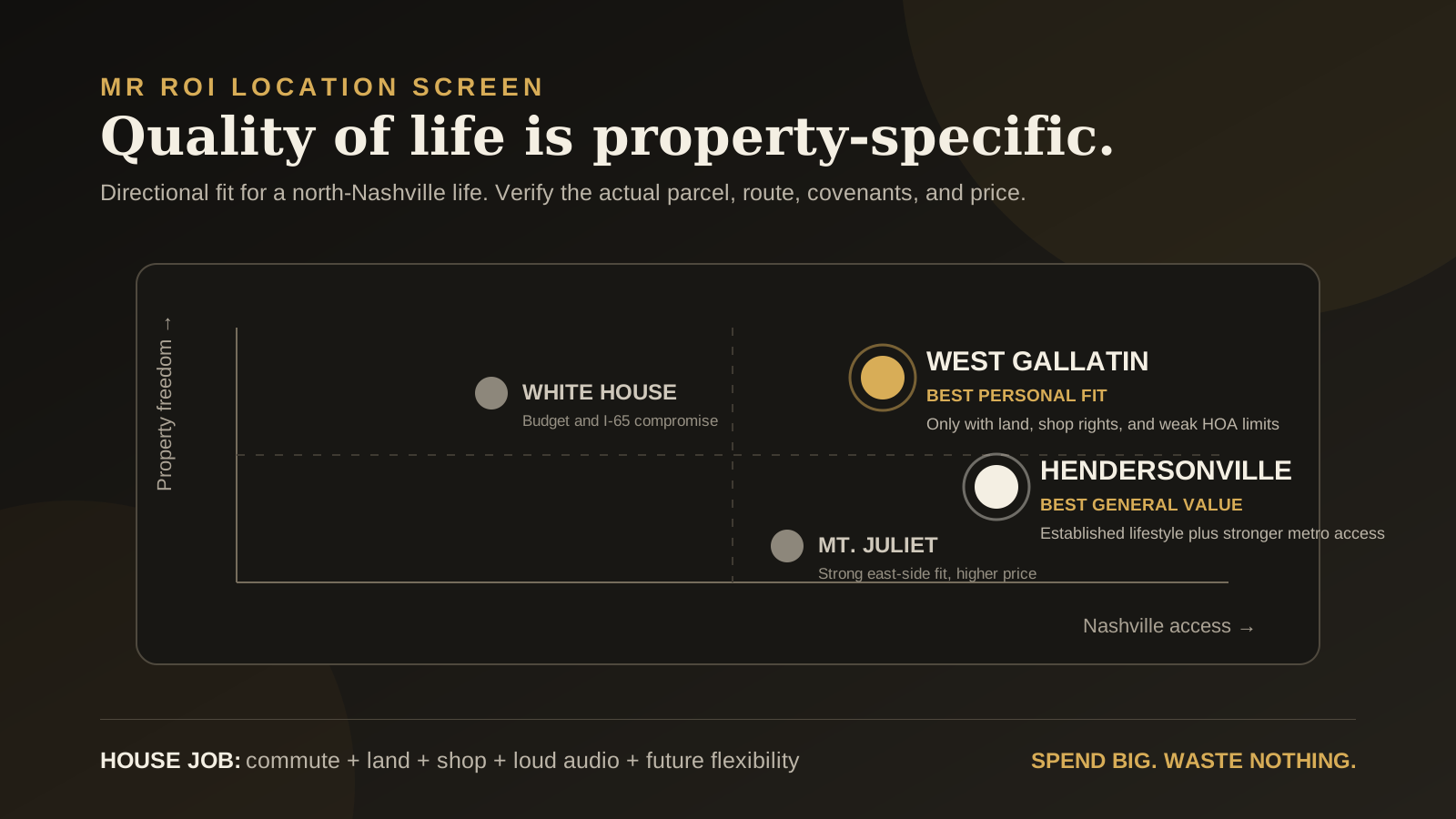
- Hendersonville is the strongest general lifestyle-adjusted value because it combines an established suburb, lake and retail access, and a better Nashville position without the Williamson County premium.
- West Gallatin is the stronger spreadsheet fit for this household only when a rare parcel combines State Route 386 access with enough land, legal shop capacity, neighbor separation, and weak or no HOA restrictions.
- The East Gallatin purchase was still rational: the market offered the better house for the job, and moving merely to save roughly 15 minutes would not clear transaction costs, a new rate, or the value already built into the current property.
The winner changes when the house has to fit your life
If I had to name the best all-around quality of life for the money around Nashville, I would start with Hendersonville. It is close enough to keep the metro useful and established enough to feel like a real place instead of a subdivision boom. It is also generally less expensive than the Williamson County prestige tier. Old Hickory Lake, mature neighborhoods, retail, healthcare, and a direct route toward Nashville give it a strong complete package.
My requirements push the answer slightly northeast to West Gallatin, close to State Route 386. It is the best spreadsheet fit when the property has enough land, weak or no HOA restrictions, room for a shop, and enough separation for loud audio systems.
Two years ago, we would have bought in Hendersonville if the right house had existed at a price we could defend. It did not. The market favored a property in East Gallatin, so we bought the better asset rather than forcing the preferred city. The house delivered roughly an acre, a garage, gym and shop potential, privacy, and room for hobbies. The tradeoff appears every time I drive through Gallatin before I can begin the faster part of the trip.
The article's conclusion has two layers:
- Hendersonville is the strongest general lifestyle-adjusted value.
- West Gallatin is my stronger property-and-commute fit if the rare right house appears.
The city label is only a filter. The parcel, route, restrictions, and complete transaction decide the purchase.
Current price establishes the burden of proof
Market trackers do not measure identical baskets of homes, so I use them as directional evidence rather than a precise appraisal. Redfin reported a roughly $533,000 Hendersonville median sale price for the three months ending July 2026 and roughly $440,000 for Gallatin. Zillow's July 2026 typical Gallatin value was about $438,000. The data support the basic trade: Hendersonville asks a meaningful premium, while Gallatin offers more chances to buy space or land below it.
| Area | Market signal | What the premium may buy | What it does not guarantee |
|---|---|---|---|
| Hendersonville | About $533,000 median sale price, three months ending July 2026 | Established neighborhoods, lake access, retail, closer Nashville position | Large lot, weak HOA, updated systems, quiet street |
| Gallatin | About $440,000 median sale price, three months ending July 2026; about $438,000 typical value in July | Lower entry point and broader property variety | Short commute, low growth pressure, or useful outbuilding rights |
| White House | Lower-cost northern alternative in many searches | Interstate access and more budget room | Equivalent amenities or a better commute for every job location |
| Mt. Juliet | Usually priced above Gallatin and often near or above Hendersonville | Strong east-side access, retail, newer housing | Good value for a north-side or Hendersonville-oriented life |
| Franklin or Brentwood | Premium tier | Amenities, schools, prestige, and south-side access for buyers who use them | Proportionate improvement in ordinary quality of life |
The correct comparison uses houses that can perform the same job. A $430,000 home with no usable shop site is not a cheaper substitute for a $520,000 property that already solves the space problem. A beautiful new townhome is irrelevant if attached walls, parking, or HOA rules prevent the hobbies that justified moving.
Hendersonville wins the general ranking
Hendersonville offers an unusually balanced package for someone who wants suburban quiet without abandoning Nashville access. It has older neighborhoods with mature trees, Old Hickory Lake, and a substantial retail and service base. It also feels more established than areas where most of the visible product is new construction.
Its value is relative. Franklin and Brentwood can be excellent places to live, but the price includes Williamson County demand, prestige, and school-driven competition that a buyer may not fully use. Mt. Juliet is attractive for airport, east-Nashville, and Wilson County job geography, but it often carries a high price while exposing the buyer to rapid growth. Murfreesboro and Spring Hill can offer newer inventory, yet their commute geometry is weak for someone whose life points north or downtown.
Hendersonville is not cheap and is not free of congestion, lake-related flood questions, or small-lot development. Its case is that the premium over Gallatin can purchase recurring lifestyle utility instead of primarily a more expensive address.
| Buyer need | Fit |
|---|---|
| Frequent trips to downtown Nashville or the north side | Stronger than driving through Gallatin first |
| Established retail, healthcare, and ordinary convenience | Strong |
| Lake access and mature neighborhoods | Strong |
| Large detached shop, acreage, or loud hobby use | Property-specific; many homes fail |
| Lowest purchase price | Weak |
| Brand-new home with minimal maintenance | Available, but often with the lot and HOA tradeoff |
West Gallatin is the spreadsheet winner for my use
Gallatin is not one commute. East and West Gallatin can share a city name while producing different daily friction. From East Gallatin, the trip toward Hendersonville or Nashville often begins with the slow work of crossing town. Based on routes I have driven, a West Gallatin property near State Route 386 can remove roughly 15 minutes from my normal trip. In favorable conditions, it can turn a 45- to 60-minute downtown pattern into something closer to 30 minutes.
Test the route at your departure times. Saving fifteen minutes each way on two weekly round trips returns 48 hours a year across 48 weeks.
| Assumption | Annual result |
|---|---|
| 15 minutes saved each way | 30 minutes per round trip |
| 2 round trips per week | 1 hour saved per week |
| 48 working weeks | 48 hours saved per year |
| 4 round trips per week | 96 hours saved per year |
The time matters only if the person actually makes the trip. A remote worker could rationally choose more land farther east. A downtown commuter should weight the first ten miles much more heavily.
West Gallatin also puts the buyer near some of the county's higher-priced development and close to the high-speed corridor. The problem is inventory. Much of the new product is attached housing or detached homes on small lots inside planned communities. That can be a great low-maintenance choice. It does not fit a 40-by-30 shop, multiple vehicles, a serious home gym, high-output audio, or the desire to use the property without negotiating with restrictive covenants.
Growth is improving the west side and consuming it
Gallatin's own development inventory shows substantial approved or proposed growth around Highway 386, Big Station Camp Boulevard, GreenLea Boulevard, Nashville Pike, and Highway 109. The list includes mixed-use projects, townhomes, apartments, detached homes, commercial space, and large master plans.
That growth brings restaurants, retail, services, and resale demand. It also adds traffic, reduces open land, and makes low-density non-HOA property harder to find near the best access. TDOT lists a State Route 386 project under development, with construction forecast for spring 2031, subject to change. The agency is also addressing the I-65 corridor north of Nashville because of high traffic volumes and peak-hour delays.
I would not buy based on the promise that a future road project fixes today's route. Infrastructure schedules move, and new capacity can arrive alongside more development. I price the house using the commute and congestion that exist now, then treat future improvement as upside.
The property filter comes before the ZIP code
For my use, a house fails before the showing if the legal or physical property cannot support the job. I would screen:
- Covenants and HOA rules: detached structures, height, exterior materials, parking, trailers, noise, and architectural approval.
- Zoning and setbacks: permitted accessory-building size, lot coverage, easements, and required distances.
- Utilities: electrical-service capacity, EV charging, shop HVAC, sewer or septic, water, gas, and internet.
- Topography and drainage: buildable pad, driveway access, retaining work, stormwater path, and crawlspace exposure.
- Flood risk: current FEMA map, elevation information, insurance quote, and local drainage evidence.
- Sound and neighbors: separation, road noise, future adjacent development, and whether theater or shop use creates conflict.
- Route friction: timed drives to work, Hendersonville, groceries, healthcare, and the interstate at the hours that matter.
Sumner County directs flood-zone development through its engineering and floodplain administration process and points buyers to FEMA maps. That is a starting point, not a complete risk report. A parcel can have drainage or water problems outside a mapped high-risk zone, and a mapped zone can affect only part of a larger lot. Survey, insurance, elevation, disclosures, inspection, and walking the property after rain can all change the answer.
For the renovation-quality and hidden-repair risk behind an attractive listing, use Why Cheap House Flips Cost Twice.
Property taxes are not the deciding difference here
Sumner County's currently published rate is $1.421 per $100 of assessed value. Verify the tax year and parcel with the county before budgeting a purchase. The listed municipal rates are $0.5295 for Gallatin and $0.5883 for Hendersonville. Tennessee residential property is generally assessed at 25% of appraised value.
On an illustrative $500,000 appraisal, the municipal-rate difference between Gallatin and Hendersonville is only about $74 per year before any changes in appraisal or rates. That is not nothing, but it is far smaller than the house-price gap, mortgage rate, insurance, commute, or one major repair.
| Item | Gallatin | Hendersonville |
|---|---|---|
| Appraised value | $500,000 | $500,000 |
| Residential assessment at 25% | $125,000 | $125,000 |
| Published city rate per $100 assessed | $0.5295 | $0.5883 |
| Approximate city tax | $662 | $735 |
Verify the current assessment and rate before acting. The table shows why I would not choose East Gallatin over Hendersonville merely for municipal property tax.
The rest of the Nashville ROI ranking
The ranking changes with job location and property needs, but my default order is:
1. Hendersonville: best general quality-of-life value for a buyer who uses Nashville and wants an established suburb.
2. West Gallatin: best spreadsheet value for more house or land with strong north-corridor access, but only when the parcel escapes small-lot and HOA constraints.
3. White House: useful budget and I-65 compromise, with fewer amenities and a different commute pattern.
4. Mt. Juliet: high-quality east-side choice whose premium makes more sense for airport, Wilson County, or east-Nashville geography than for my routine.
Next tier: west Lebanon or rural Wilson County for land; Smyrna and Murfreesboro for southern job geography and inventory; Spring Hill when the south-side commute works. Franklin and Brentwood can be excellent, but they are lower ROI when the buyer does not receive enough value from their school, prestige, or south-side location premium.
I rank these areas by what they deliver for the price: the route, property and amenities I would actually use.
Buying the better house beat forcing the better suburb
Our East Gallatin purchase still makes sense. The market offered a house that supported the actual life: land, privacy, garage and gym space, shop potential, animals, equipment, and audio without an attached-wall problem. Hendersonville did not offer an affordable substitute at that moment.
That is a useful correction to location-first advice. A buyer can overpay for the preferred city and end up with the wrong house. The address performs only part of the job.
I would prefer West Gallatin now because it preserves much of the property value while improving access. I would not move merely to save 15 minutes. Selling costs, a new mortgage rate, taxes, repairs, moving, and the value already created in the current house set a high hurdle. The next property would need to be an extreme deal, support the shop and audio requirements, and improve the route without creating lifestyle inflation.
The Mr ROI decision rule
BUY Hendersonville when the premium buys a materially better weekly life and the property itself fits. BUY West Gallatin when access, land, outbuilding rights, and price align in one rare parcel. WAIT when the location improves but the interest rate, transaction cost, or property compromises erase the gain. PASS on a perfect-looking new build whose HOA, lot, utilities, or neighbors prevent the life the house is supposed to support.
The best Nashville suburb is not the one with the highest reputation. It is the place where housing cost, route, restrictions, land, amenities, and future flexibility produce the highest recurring return. For most buyers like me, that puts Hendersonville first. For the exact property I want, the answer moves a few exits east to West Gallatin.
Sources
- Redfin: current Hendersonville housing-market data
- Redfin: current Gallatin housing-market data
- Zillow: current Gallatin home-value and market data
- Sumner County: current county and municipal property-tax rates
- Sumner County: residential real-property assessment method
- City of Gallatin: approved and proposed development inventory
- TDOT: State Route 386 project status
- TDOT: I-65 Nashville-to-Kentucky corridor study
- Sumner County: engineering and floodplain administration
- FEMA: address-level flood map search
- U.S. Census QuickFacts - Gallatin, Tennessee
- U.S. Census QuickFacts - Hendersonville, Tennessee
- U.S. Census QuickFacts - White House, Tennessee
- U.S. Census QuickFacts - Mount Juliet, Tennessee
- U.S. Census QuickFacts - Lebanon, Tennessee
- U.S. Census QuickFacts - Franklin, Tennessee
- Sumner County Assessor of Property - appraisal and tax framework
Disclosure
Some links may earn Mr ROI a commission at no added cost to you. That does not change the recommendation. This is general information, not personal financial or medical advice. Read the full disclosure.