
Why I Put 18-Inch Wheels on My Model 3 Performance
The installed-result case for replacing fragile 20-inch Uberturbines with 18-inch T Sportline wheels: nearly an inch more sidewall, 33.6 pounds less published wheel mass, cheaper tires, and a $935.17 net swap.
In brief
What I learned
My TSH wheels and Goodyear Eagle F1 All Season tires are installed and clear the brakes on my 2022 Model 3 Performance.
The complete new setup cost $1,935.17; selling the repaired and recently rashed Uberturbines locally for $1,000 instead of accepting a $500 trade-in reduced the net swap to $935.17.
The 235/45R18 tire adds about 0.93 inch of nominal sidewall with only about a 0.6 percent change in nominal overall diameter.
The 20-inch Uberturbines made my 2022 Model 3 Performance look like the version I wanted to buy. They also made ordinary roads feel like a recurring damage claim.
One wheel had already been repaired. Two days before my new wheels were installed, I hit another pothole and added fresh minor curb rash. That timing was almost too perfect. The factory setup demanded that I scan imperfect pavement, dodge every ugly patch, and treat a daily driver like a display car.
It was especially annoying when using Autopilot or Full Self-Driving. Driver assistance can manage the lane while I remain responsible for the car, but it does not make a fragile wheel-and-tire package stop being fragile. I still found myself anticipating potholes and deciding whether to intervene just to protect the wheels.
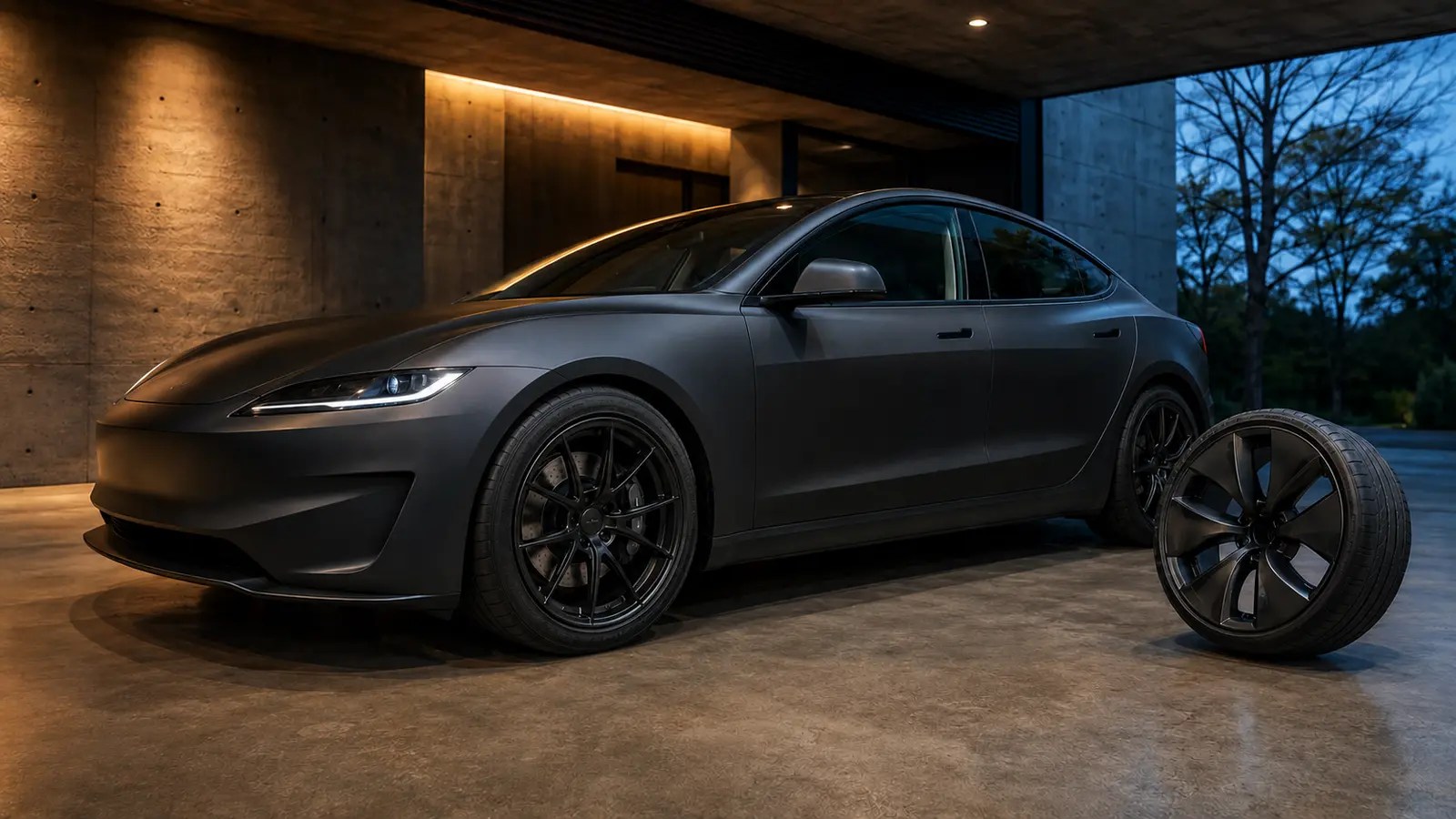
I replaced the factory setup with satin-black 18-by-8.5-inch T Sportline TSH Directional wheels and 235/45R18 Goodyear Eagle F1 All Season tires. They are installed now. They fit over the Performance brakes, look right on the car, and have been a much better daily-driver setup.
The visual downgrade I feared never arrived. The practical upgrade did.
The entire swap cost me $935.17 after the sale
I did not compare the wheel invoice by itself. The useful number is the complete changeover after disposing of the factory set.
- Transaction
- T Sportline wheels, locks, tax, and order total
- Amount
- $1,108.84
- Transaction
- Goodyear tires, all-in
- Amount
- $826.33
- Transaction
- Gross new setup
- Amount
- $1,935.17
- Transaction
- Local sale of Uberturbines with factory tires
- Amount
- -$1,000.00
- Transaction
- Net swap cost
- Amount
- $935.17
The factory tires had roughly 10,000 miles of wear when I sold the set locally.
T Sportline's trade-in offer was $500. That was not compelling before I read the condition language, and it became less attractive after I did. One wheel had been repaired, and another had fresh minor rash. I did not want to ship a heavy set across the country and discover that someone else's interpretation of “pristine” controlled the final credit.
Selling locally doubled the gross proceeds, put the buyer in front of the actual condition, and eliminated the return-shipping argument. The extra $500 was meaningful, but the cleaner transaction mattered too.
The sidewall calculation explains the whole decision
Wheel diameter is only half the comparison. Tire size determines the amount of rubber between the rim and the road.
The original 235/35R20 size has a nominal sidewall height of:
235 mm × 0.35 = 82.25 mm, or about 3.24 inches.
The new 235/45R18 size has a nominal sidewall height of:
235 mm × 0.45 = 105.75 mm, or about 4.16 inches.
That is approximately 0.93 inch, or 28.6 percent, more nominal sidewall on every corner. It creates more tire between a sharp road impact and the wheel edge. It does not make a wheel pothole-proof, and tire construction and pressure still matter, but it changes the margin in exactly the direction I wanted.
The total diameter stays remarkably close:
- Size
- 235/35R20
- Nominal sidewall
- 3.24 in
- Nominal overall diameter
- 26.48 in
- Size
- 235/45R18
- Nominal sidewall
- 4.16 in
- Nominal overall diameter
- 26.33 in
- Size
- Difference
- Nominal sidewall
- +0.93 in of sidewall
- Nominal overall diameter
- -0.15 in overall
The new nominal diameter is only about 0.6 percent smaller, so the extra sidewall comes with nearly the same overall tire height. Check the tire model’s actual dimensions and update the car’s wheel setting for the installed setup.
I removed wheel mass without buying a delicate forged showpiece
T Sportline publishes a nominal average weight of 23.6 pounds for the TSH 18-inch wheel. Its guide lists the 20-by-9-inch Model 3 Uberturbine at approximately 32 pounds.
That is 8.4 pounds per wheel, or 33.6 pounds across four bare wheels.
Wheel-only weight leaves out the tire, so I would compare complete assemblies before putting a number on acceleration or range gains. I have not weighed both complete setups on the same scale.
The direction is still useful. Less wheel mass and more compliant tire generally support the daily-driver goals: lower impact harshness, less rotational inertia, and less expensive damage when the road wins. Those gains do not automatically beat every 20-inch setup. A light forged 20 can weigh less than a heavy cast 18, and tire choice can reverse much of the result.
The TSH is a flow-forged 18-by-8.5-inch wheel with a +35 offset, 5-by-114.3 bolt pattern, 64.1 mm center bore, and published 750 kg load rating. Those details matter more than the generic phrase “18-inch Tesla wheel.”
Fitment is a brake-clearance problem, not a diameter rumor
The internet version of this question is usually, “Can 18s fit a Model 3 Performance?” The real question is whether one exact wheel clears one exact generation of Performance brakes. Check the barrel, spoke profile, width, offset, center bore, load rating, hardware, full rotation, and real manufacturing tolerances.
My T Sportline TSH set clears the brakes on my 2022 Model 3 Performance. For another wheel, verify the exact brake package and caliper clearance as well as the bolt pattern.
My fitment checklist is:
- documented compatibility with the 2022 Model 3 Performance brake package
- 18-by-8.5 size, +35 offset, 5-by-114.3 pattern, and 64.1 mm center bore
- adequate wheel and tire load ratings
- no spoke-to-caliper or barrel-to-caliper contact through a full rotation
- correct seating surface, lug hardware, torque, and recheck procedure
- working tire-pressure monitoring and the correct in-car wheel configuration
- cold pressure based on the vehicle's Tire and Loading Information label, not the tire sidewall maximum
Tesla instructs owners to use the pressure on the driver-door-pillar label and notes that accessory wheels and tires can change some information. This is a safety system, not a styling detail.
For the complete ownership, range, charging, comfort, and cost decision, use Why the Tesla Is My Best Overall Daily Car.
The tire was a deliberate compromise
The Goodyear Eagle F1 All Season in 235/45R18 is an XL, Y-speed-rated ultra-high-performance all-season tire with a published 45,000-mile tread-life warranty. I paid $826.33 all-in for the set.
That choice tells you what I was optimizing. I wanted a performance-oriented daily tire, year-round flexibility for Tennessee conditions, more sidewall, and a replacement price that did not punish every road hazard as aggressively as the original package.
The factory summer setup can offer sharper response and more warm-weather grip. My all-seasons trade some of that peak capability for the daily driving I actually do; dedicated winter conditions call for appropriate winter tires.
I bought the tire for the way I actually use the car. Most miles are not laps. They are commuting, errands, trips, rain, imperfect pavement, and ordinary driving punctuated by the acceleration that justified buying the Performance in the first place.
The right comparison is not “which tire wins every performance test?” It is “which complete setup preserves enough performance while removing the recurring failure mode I hate?”
The road-hazard problem was already costing attention
Damage cost is easy to see. Attention cost is easier to ignore.
The 20-inch setup made every rough lane a small decision tree:
- Is that dark patch a harmless repair or a sharp pothole?
- Is there room to avoid it without leaving the lane?
- Is Autopilot or Full Self-Driving going to track directly through it?
- Is this impact another bent wheel, damaged tire, or alignment check?
That is not the end of the world. It is still a bad feature in a daily driver.
The new setup does not transfer responsibility to the car, and I still supervise driver assistance exactly as required. What changed is the amount of low-value intervention I feel compelled to make solely to protect a low-profile wheel package. More sidewall gives the car a more appropriate relationship with the roads it actually encounters.
My pre-swap wheel history made the point better than a forum debate could. A previous repair established that the risk was real. The pothole and fresh rash two days before installation established that it was recurring. I did not need a third event to make the original wheels feel financially legitimate.
The 18s did not erase the Performance
The fear behind this swap is that the car will stop looking or feeling special. Mine did not.
The satin-black directional wheel still has enough visual aggression for the Performance body, and the tire does not look comically tall. The car remains brutally quick. It simply looks less like one imperfect expansion joint can ruin the week.
There are tradeoffs:
- Dimension
- Steering and transient feel
- 20-inch Uberturbine setup
- Potentially sharper with a shorter sidewall
- My 18-inch TSH setup
- Slightly more compliance; exact difference depends on tire
- Dimension
- Warm dry grip
- 20-inch Uberturbine setup
- Factory summer tire can have the advantage
- My 18-inch TSH setup
- All-season compromise
- Dimension
- Pothole margin
- 20-inch Uberturbine setup
- Less nominal sidewall
- My 18-inch TSH setup
- About 28.6% more nominal sidewall
- Dimension
- Wheel-only weight
- 20-inch Uberturbine setup
- About 32 lb published
- My 18-inch TSH setup
- 23.6 lb nominal published
- Dimension
- Replacement economics
- 20-inch Uberturbine setup
- Large performance tire and factory wheel exposure
- My 18-inch TSH setup
- Less expensive tire size and lower net capital in the setup
- Dimension
- Appearance
- 20-inch Uberturbine setup
- Factory, dramatic, wheel-forward
- My 18-inch TSH setup
- Still aggressive, with visibly more usable tire
I am much happier with the 18s. They fit the daily-driver job I wanted this car to do. I have not measured a range or stopping-distance change, so those numbers are not part of my verdict.
How I would make the decision today
I would choose 18s again for a daily-driven 2021-to-2023 Model 3 Performance. The exact wheel still needs documented Performance-brake fitment, and the tire must meet the car's load and speed requirements.
I would keep 20s when:
- factory appearance is the controlling priority
- the car spends meaningful time in warm-weather performance driving
- roads are unusually good
- the owner accepts higher tire and wheel exposure
- a second wheel set already handles winter or daily duty
I would move to 18s when:
- pothole avoidance has become part of every drive
- bent wheels, tire bubbles, curb damage, or prior repairs are no longer theoretical
- cheaper replacement tires materially change operating cost
- ride compliance matters more than the last increment of steering sharpness
- the car is a daily tool before it is a static design object
The net number matters. At $1,935.17 gross, this was a meaningful purchase. After selling the factory set locally for $1,000, the $935.17 net cost bought a lighter published wheel, nearly an inch more nominal sidewall, lower future tire exposure, and a car I enjoy using more.
That is a much better return than accepting $500 because a trade-in button was easier.
The decision
The 20-inch Uberturbines were not a bad product. They were a bad match for the daily-driver job I kept asking them to do.
The Performance badge already gave me the acceleration, software, drivetrain, and character I wanted. I did not need the wheel-and-tire package to keep charging me an attention tax to prove the car was special.
BUY the smaller-wheel strategy when exact fitment is verified and durability, replacement economics, and real-road usability outrank the factory look. WAIT if the only evidence is a forum comment that “18s fit.” KEEP the 20s when their handling and appearance benefits are worth the risk in your roads and use.
My answer is now installed, paid for, and tested by the same roads that made me want it: 18 inches was the better Performance wheel for my life.
Sources
- T Sportline: TSH Directional 18-inch wheel specifications
- T Sportline: complete TSH 18-inch package dimensions and fitment
- T Sportline: 2017–2023 Model 3 wheel guide and Uberturbine weight
- T Sportline: 18-inch Model 3 Performance brake-fitment guidance
- Goodyear: Eagle F1 All Season product information
- Goodyear: 235/45R18 size, load range, and speed rating
- Goodyear: tread-life limited-warranty schedule
- Tesla: Model 3 tire-pressure, TPMS, and maintenance guidance
Disclosure
Some links may earn Mr ROI a commission at no added cost to you. That does not change the recommendation. This is general information, not personal financial or medical advice. Read the full disclosure.