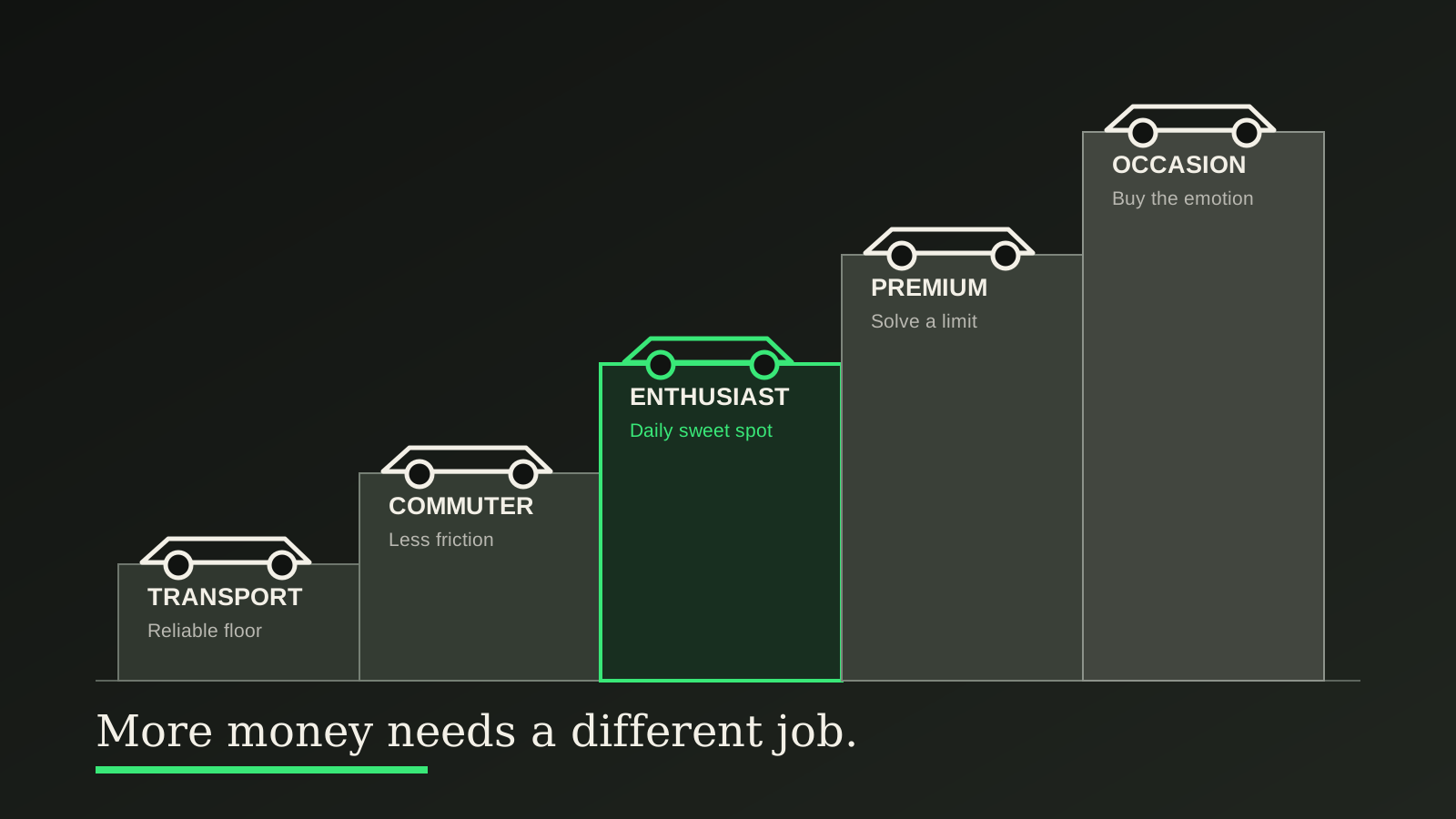
The Daily-Driver Ladder: Buy Less Car Until More Car Fixes Your Week
A complete vehicle escalation framework from reliable used transportation through friction-reducing commuters, enthusiast daily drivers, premium capability, and emotionally honest occasion cars.
In brief
Start here
- The ladder separates transportation economics, commuter friction, integrated performance, premium capability, and emotional theater instead of pretending every buyer is solving one universal car question.
- Sebastian's roughly 60,000-mile Model 3 Performance record anchors the enthusiast rung while preserving the counterevidence: charging prerequisites, tire and wheel exposure, depreciation, service constraints, software changes, and phone-key failures.
- Every move up requires a different recurring job, complete five-year exposure, an infrastructure and service check, and evidence that the lower rung creates a meaningful limitation.
Most car rankings fail before the first vehicle enters the table. They mix transportation, commuting comfort, enthusiast performance, luxury, towing, family capacity, and emotional theater into one score, then pretend the highest number is the best car.
A daily driver has a narrower job. It should remove recurring friction from the trips, weather, parking, charging or fueling, cargo, passengers, roads, and service network the owner actually faces. More money is justified when it materially improves that repeated experience. It is wasted when it buys capability that appears twice a year or status that has to be explained.
My reference point is a 2022 Tesla Model 3 Performance with roughly 60,000 miles. It has given me instant performance, home charging, excellent integrated technology, strong stock audio, preconditioning, route planning, and low daily operating effort. It has also exposed expensive tire and wheel compromises, software frustrations, service constraints, phone-key failures, depreciation, and the difference between a feature I use constantly and one I admired during research.
That does not make Tesla the answer to every rung. It gives me a long ownership record for judging what daily utility is worth.
The ladder at a glance
The price bands below are working market bands, not permanent fair values. A clean used example can move a vehicle down a cost rung. Financing, insurance, taxes, incentives, mileage, title history, and local inventory can move it back up.
| Rung | Working purchase band | Job | Default verdict |
|---|---|---|---|
| Transportation floor | $10,000-$20,000 used | Reliable mobility with manageable insurance, fuel, service, and depreciation | BUY when transportation economics dominate experience and technology |
| Friction-reducing commuter | $20,000-$35,000 used | Add efficiency, quiet operation, driver assistance, useful technology, and low daily effort | BUY BY INFRASTRUCTURE; charging, service, commute, and parking decide the powertrain |
| Enthusiast daily-driver sweet spot | $25,000-$55,000 | Combine real performance with four-door utility and ordinary commuting convenience | BUY when the performance and technology are recurring utility, not a demonstration trick |
| Premium integrated vehicle | $50,000-$100,000 | Add space, ride, materials, charging speed, service, towing, or a substantially different ownership experience | CONDITIONAL; the premium must solve a daily limitation below it |
| Occasion car | $100,000 and up | Buy theater, sound, craftsmanship, rarity, track ability, or emotional value | BUY FOR EMOTION only after separating it from transportation ROI |
There is no universal instruction to climb. A $17,000 used hybrid can be the correct top rung for a driver who wants predictable transportation. A $40,000 performance EV can be rational for someone who uses its performance, home charging, software, and climate controls every day. A $120,000 sports car can be a worthwhile experience and still be a poor daily-driver value.
Rung 0: the transportation floor is not punishment
The floor is a clean, reliable used car with a known service path and no expensive mismatch between the vehicle and the owner. It does not need to be miserable, unsafe, or stripped. It needs to complete ordinary transportation without exposing too much capital to depreciation or too much cash flow to insurance, fuel, tires, and repairs.
A vehicle in this rung should clear five gates:
- The seating position, visibility, ingress, and controls work for the driver.
- A local independent shop or dealer can service it without a logistics project.
- Insurance is quoted using the exact VIN or a close equivalent before purchase.
- The title, history, recall status, and independent inspection are clean enough for the price.
- The complete cost does not depend on an optimistic resale forecast.
The Federal Trade Commission recommends both a vehicle-history report and an independent inspection because the report is not a substitute for finding hidden mechanical or collision damage. NHTSA provides VIN-specific open-recall lookup. Those are minimum controls, not advanced research. (FTC) (NHTSA)
The main mistake at this rung is buying the cheapest listing instead of the cheapest credible ownership path. Deferred maintenance, weak tires, a branded title, missing records, a difficult seller, or an unsupported powertrain can make a low asking price the expensive option.
Rung 1: pay to remove commuter friction
The next rung earns money by improving the hours spent driving, parking, charging or fueling, and preparing the vehicle. That improvement could be a quieter hybrid or an EV with reliable home charging. It could also mean better driver assistance, climate control, highway behavior, cargo space, or simply a seating position that does not cause pain.
This is where infrastructure can reverse the ranking.
With reliable charging where the car normally parks, an EV can remove routine fueling trips and start most days at the selected charge level. The Department of Energy identifies home Level 1 and Level 2 charging as the normal consumer paths and provides a vehicle-cost calculator for comparing individual driving patterns. Without dependable charging, the same EV can add special trips, waiting, volatile public-charging prices, and route dependence. (DOE Alternative Fuels Data Center)
A hybrid can beat an EV for an apartment resident even if the EV is more efficient on paper. A gasoline car can beat both when purchase price, rural service access, towing, cold-weather range, or irregular long-distance travel dominates. The powertrain is an operating-system choice, not an identity.
BUY this rung when the upgrade removes a weekly annoyance that can be named and valued. WAIT when the argument is a longer feature list with no change to the actual commute.
Rung 2: the enthusiast daily driver is where performance can become rational
Performance is often treated as automatically irresponsible. That is too simple. Performance can create repeated enjoyment without destroying utility when the vehicle remains comfortable, efficient enough, easy to park, serviceable, and useful for passengers and cargo.
That is why the Model 3 Performance has made sense for me. Its acceleration is available on an ordinary entrance ramp without warm-up, noise, launch preparation, or a second vehicle. The same car carries groceries, pets, audio equipment, and four adults. Home charging and preconditioning serve the commute regardless of whether I use full acceleration.
The critical distinction is between performance integrated into the daily job and performance that asks the owner to organize life around it.
| Question | Integrated performance | Occasion-first performance |
|---|---|---|
| Access | Available during ordinary driving | Requires a special road, weather, warm-up, or event |
| Utility | Preserves normal seating, cargo, and parking | Sacrifices space, visibility, comfort, or clearance |
| Operating burden | Tires, energy, and service remain tolerable | Consumables and maintenance punish normal use |
| Driver return | Makes routine trips more enjoyable | Delivers most of its value only during special use |
| Financial honesty | Premium is acknowledged as recurring enjoyment | Premium is defended as an investment or necessity |
My factory 20-inch wheel setup is a good counterexample inside the same vehicle. It looked right and supported the Performance identity, but it added pothole anxiety, less sidewall, expensive tire exposure, and damage risk to a daily driver. Moving to compatible 18-inch wheels improved the match between the car and the job. A higher specification was not the higher-ROI configuration.
BUY this rung when the performance survives the complete ownership calculation and gets used without making the car worse at being the primary car. PASS when a cheaper vehicle already supplies all daily utility and the remaining premium is admired more than experienced.
Rung 3: premium must solve something, not merely feel expensive
A premium vehicle can rationally add ride quality, cabin isolation, seat comfort, towing, usable space, faster charging, better headlights, a stronger service model, or materials that improve every drive. Those are real benefits.
The value problem appears when several smaller upgrades are bundled into a $30,000 or $50,000 jump. The buyer may genuinely prefer the larger or more luxurious vehicle while using only a fraction of what the premium purchased.
For me, the Model S Performance or Plaid question exposes the limit. The larger car can be faster, roomier, more dramatic, and more substantial. It also puts considerably more capital at risk and adds features and complexity that do not fix the main daily-driver job. A Model 3 Performance already makes acceleration, technology, charging, and ordinary utility abundant. The next rung has to beat abundance, not scarcity.
Use a bottleneck ledger before paying:
| Claimed upgrade | Evidence required |
|---|---|
| Better ride | Drive both over the actual bad roads and expansion joints that create the complaint |
| More space | Load the real passengers, pets, equipment, or luggage that currently does not fit |
| Faster charging | Model the routes where the time difference occurs, not a peak-rate specification |
| Better driver assistance | Test the roads and conditions that make up the commute |
| Better service | Confirm local appointment access, repair capacity, loaner policy, parts, and warranty handling |
| More luxury | Identify the feature used weekly and separate it from showroom atmosphere |
BUY the premium rung when one or two limitations below it are expensive, frequent, and impossible to solve another way. WAIT when the case requires ten small advantages to manufacture one large justification.
Rung 4: an occasion car should be allowed to be emotional
At the top, transportation math becomes the wrong defense. A sports car, exotic, grand tourer, collectible, or track build may buy sound, steering feel, craftsmanship, theater, scarcity, community, or a childhood ambition. Those can be valid uses of discretionary money.
The mistake is describing them as daily-driver efficiency or guaranteed appreciation. Low mileage can preserve resale while destroying cost per experience. Rarity can create negotiating leverage for the seller, parts risk for the owner, and fear of ordinary use. A vehicle that is too valuable or fragile to enjoy has converted money into custody.
I do not care enough about rarity to pay heavily for it. If the same emotional job can be completed by a more available vehicle with easier service and less exit friction, availability is an advantage. I want the experience, not the obligation to protect the market's story about the object.
BUY FOR EMOTION when the financial foundation is strong, the use is deliberate, and the complete cost is acceptable without resale heroics. PASS when the purchase depends on public recognition or the belief that expensive automatically means special.
Calculate the complete five-year exposure
Monthly payment is almost useless for comparing vehicles. Use the complete amount of wealth and cash flow exposed over the expected holding period.
Five-year ownership exposure
purchase price + tax + fees + interest + insurance + energy + maintenance + tires + repairs + charging or parking infrastructure + accessories - realistic resale value
Then add two noncash quantities:
- hours spent fueling or charging away from home, traveling for service, handling repairs, and managing the vehicle
- recurring utility from comfort, performance, automation, cargo, safety features, and enjoyment
The Department of Energy's Vehicle Cost Calculator can compare modeled ownership and operating costs across several vehicles, while FuelEconomy.gov provides side-by-side energy-use data. Those tools are inputs. Local insurance quotes, actual electricity or fuel rates, financing, tire fitment, depreciation, and the owner’s routes still control the decision. (DOE vehicle calculator) (FuelEconomy.gov)
Do not use the IRS mileage rate as a forecast of what one personal car will cost. It is a tax and reimbursement standard, not a model-specific ownership estimate. The useful lesson is that fuel alone is only one part of vehicle cost.
Used pricing changes the ladder, but condition can erase the discount
Depreciation can turn a premium vehicle into a lower-rung purchase price. It does not necessarily turn premium parts, tires, insurance, electronics, suspension, or service into lower-rung expenses.
For every used finalist:
- Check the VIN, title, history, open recalls, and warranty start date.
- Get the independent inspection appropriate to the powertrain and vehicle value.
- Quote insurance before negotiating.
- Price the next tires, brakes, scheduled service, keys, charging hardware, and known wear items.
- Confirm that modifications are legal, insurable, professionally executed, and reversible where that matters.
- Treat missing records, evasive answers, strange payment demands, and refusal of inspection as transaction evidence.
- Compare the complete ready-to-own cost with the cleanest credible alternative, not the seller's claimed retail reference.
The FTC's dealer Buyers Guide tells the buyer whether the vehicle is being sold as-is or with warranty coverage and recommends getting promises in writing. A private-party listing offers even less standardized protection. The discount needs to pay for condition uncertainty, inspection, transport, and weaker recourse. (FTC Buyers Guide)
Four worked decisions
The reliable commuter with a short ownership horizon
The buyer drives moderate miles, has no home charging, dislikes repair uncertainty, and may move within three years. Buy the clean transportation-floor gasoline or hybrid vehicle with strong local service and low transaction friction. Pass on the discounted premium EV whose charging and resale case depend on the next address.
The homeowner with a long commute and reliable charging
The buyer can install Level 2 charging, values quiet operation and preconditioning, and drives a predictable route covered by local service. Move to the friction-reducing EV rung after quoting insurance and modeling winter, road-trip, and tire behavior. The EV does not win because electricity is morally superior. It wins when the system deletes enough recurring work.
The enthusiast who needs one car
The buyer wants serious performance but still needs four doors, cargo, ordinary parking, and manageable consumables. Buy inside the enthusiast sweet spot and configure it for the daily job. That can mean more tire sidewall, less fragile wheels, a non-track seat, or the smaller performance model. Pass on the faster premium car when the lower rung already makes usable speed abundant.
The buyer who already owns a good car
The current vehicle is reliable, fits the commute, and creates no repeated limitation. A new model adds range, acceleration, screens, and driver-assistance claims but does not change a real trip. Keep the car. The cheapest transaction, lowest depreciation reset, and least administrative work is no transaction.
Conclusion
The daily-driver ladder is not a command to buy cheap. It is a requirement that each premium buy a different and repeatedly useful job.
BUY the transportation floor when dependable mobility is the goal. MOVE TO the friction-reducing rung when comfort, efficiency, charging, driver assistance, or technology changes the actual week. BUY enthusiast performance when it remains integrated with ordinary utility and produces recurring enjoyment. PAY FOR premium only when a lower rung has a daily limitation that can be demonstrated. BUY an occasion car for emotion, not by laundering desire through transportation math.
My Model 3 Performance sits at the enthusiast daily-driver sweet spot for me because it combines speed, home charging, technology, climate, audio, and utility in one repeatedly used system. It is not the economic floor, not the universal answer, and not an excuse to climb to a more expensive Tesla automatically.
The correct stopping point is the first rung where the car stops creating meaningful problems and the next dollar buys less improvement than exposure.
For the narrower Tesla ownership case, read When Tesla Is the Best Overall Daily Car. For the transaction math of replacing a working EV, use When Upgrading an EV Actually Makes Financial Sense. For the point where performance premiums become emotional purchases, read Tesla Made the Middle of the Performance-Car Market Financially Stupid.
Sources
- U.S. Department of Energy: Vehicle Cost Calculator
- FuelEconomy.gov: official side-by-side vehicle comparison
- U.S. Department of Energy: electric vehicles for consumers and charging prerequisites
- Federal Trade Commission: used-car history and independent-inspection guidance
- Federal Trade Commission: dealer Buyers Guide, warranty, and written-promise rules
- NHTSA: VIN-specific safety recall lookup
- NHTSA: vehicle safety rating comparison
Disclosure
Some links may earn Mr ROI a commission at no added cost to you. That does not change the recommendation. This is general information, not personal financial or medical advice. Read the full disclosure.