
Home gym ROI: when equipment beats a membership
A home gym earns its cost when it turns commuting, waiting, and setup friction into more completed training around movements already proven.
In brief
Start here
- Compare complete five-year costs and completed training, not equipment price against dues alone.
- Build around the last three months of movements and add only one repeated constraint at a time.
- Keep a membership when coaching, classes, community, childcare, specialized equipment, or leaving home improves adherence.
A home gym can be a phenomenal purchase if it turns commute time and waiting into actual training. It can also become one of the most expensive storage rooms in the house. The deciding factor is whether the equipment makes your existing routine more consistent, not how motivating the shopping process feels.
Do not compare equipment cost with membership dues alone. Compare the complete five-year cost and the behavior each environment produces.
Run the break-even in both money and sessions
For the home option, include equipment, delivery, rigging, flooring, electrical work, climate control, storage, maintenance, repairs, and the value of the room. Subtract a conservative resale estimate.
For the membership, include dues, initiation, parking, fuel, vehicle wear, and round-trip time. Count every household user. Then run a bad case with half the expected workouts, a move, a repair, and lower resale.
The calculation cannot prove adherence. Track three months of actual training first. If the gym commute repeatedly causes missed sessions or waiting makes the program worse, the home setup has a named job. If home distractions already defeat simple workouts, expensive equipment will not repair the environment.
Buy the movements already in the log
List the exercises from the last three months. Cover their movement patterns with the smallest safe system.
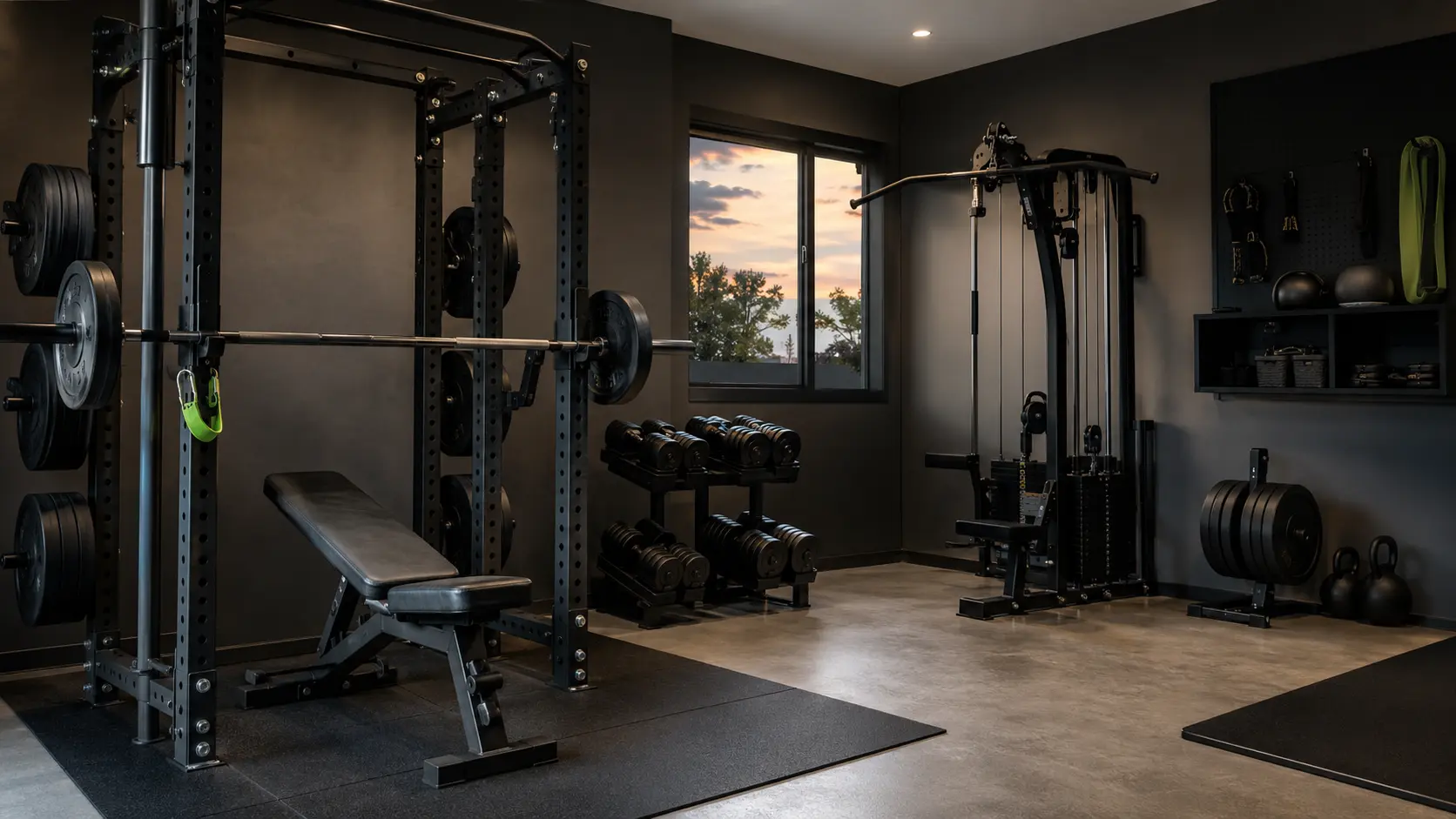
For strength and hypertrophy, a rack with appropriate safeties, bar, plates, stable adjustable bench, dumbbells, pulling option, flooring, and storage can cover most of the work. Specialized machines earn floor space only after a repeated programming or comfort limitation appears.
I pay for touch points and safety systems. That includes a stable bench, usable safeties, a bar suited to the lift, and cable motion that feels right. I save on weight that is only weight, simple storage, bands, and many attachments that can be inspected used.
Confirm load ratings, anchoring, clearances, and compatibility with the manufacturer. “Three by three” does not guarantee two rack ecosystems fit because hole size, spacing, and metric or imperial dimensions can differ.
The room is part of the equipment
Measure ceiling height, door width, stairs, floor level, electrical service, temperature, humidity, ventilation, and the path for every heavy component. Leave the manufacturer’s required operating clearance around racks, cables, weight stacks, treadmills, and moving arms. Protect children, pets, and visitors from stored plates, loaded bars, cables, and machines they do not understand.
Flooring has several jobs: traction, surface protection, impact control, cleaning, and tolerable odor. Stall mats can be excellent raw value in a garage, but weight, seams, smell, and cleanup may make rolled rubber or purpose-built flooring better inside a finished room. The subfloor and structure still need to tolerate the intended loads and impacts. Qualified advice is appropriate when the capacity or installation is uncertain.
Climate control can earn money before another machine. A gym that is unusably hot, cold, damp, or poorly ventilated will not deliver the planned sessions. Price heating, cooling, dehumidification, and their operating cost as part of the system.
Maintenance also belongs in the plan. Tighten hardware according to the manual, inspect cables and safeties, clean contact surfaces, control rust, and remove damaged equipment from use. A private gym has no facilities staff arriving after closing.
What my own gym is built to do
I have trained consistently since 2018 with a powerbuilding emphasis. My target of a six-post rack, dumbbells from 5 to 100 pounds, and a commercial FreeMotion-style dual cable station supports movements and two-person use that already exist.
I bought a used commercial FreeMotion unit for about $1,500. That price was attractive because the motion and durability matched a proven use. It also created real transaction costs: footprint, disassembly, transport, installation, cable condition, parts availability, and eventual resale.
A beginner can start with adjustable dumbbells, a bench, a pull-up option and a repeatable program. Build the room around the training you keep coming back to.
Add one constraint at a time
Use this sequence:
- Prove the habit with a membership, bodyweight work, or a minimal setup.
- Build a safe foundation that covers the main movement patterns.
- Improve climate, lighting, storage, and setup before adding novelty machines.
- Add one station when a logged limitation repeatedly affects the program.
- Review use, maintenance, and floor-space cost before the next purchase.
Used commercial gear can be excellent value when transport and service are solved. It can also become a permanent 1,000-pound problem. Inspect cables, bearings, upholstery, welds, adjustment points, weight-stack travel, dimensions, disassembly route, and replacement-parts availability before payment.
Leave open floor. Empty space supports warm-ups, carries, mobility, conditioning, loading, and safe movement. A room can photograph as “complete” while becoming harder to train in.
Use a 90-day expansion gate
After the foundation is installed, freeze major equipment purchases for 90 days. Log sessions, users, setup delays, exercise substitutions, maintenance, and unused stations. At the end, rank the recurring constraints by lost training value.
The next purchase should solve the first constraint and have a planned location, maintenance path, and exit. If the limitation appeared twice while the existing equipment was used 40 times, it may not deserve permanent floor space. If two people repeatedly wait on the same station, duplication may beat novelty. This gate turns the room’s actual behavior into evidence before enthusiasm fills the remaining space.
Design for the session you almost skip
The test is a rushed weekday, not an ideal Saturday. Keep the room at a usable temperature, the first movement easy to start, the program visible, and frequently used attachments within reach. Store plates and dumbbells where setup does not become part of the negotiation.
A fixed start time, shoes reserved for training, or a short warm-up cue can create separation from home life. Convenience only becomes return when a routine converts it into work.
When a membership is better
Keep the commercial gym when coaching, classes, social accountability, childcare, pools, courts, specialty machines, or getting out of the house materially improves training. A hybrid can be best: a compact home setup for routine strength sessions and a modest membership for specialized work.
Someone who may move soon, has little climate-controlled space, cannot install equipment safely, or has not trained consistently should delay the full room. Someone rehabilitating an injury or managing a health condition may need qualified clinical or coaching guidance rather than an equipment list.
The home gym earns its return when it serves movements already practiced, removes measured friction, and gets used for years. Start smaller than the initial enthusiasm suggests, log every limitation, and let completed sessions decide what earns the next square foot.
For deeper implementation, read the training mistakes that changed my practice, the tall-lifter exercise-selection guide, or the minimum viable cut when recovery or time is constrained.
Disclosure
Some links may earn Mr ROI a commission at no added cost to you. That does not change the recommendation. This is general information, not personal financial or medical advice. Read the full disclosure.