
Stop Forcing Tall Lifters Into Short-Lifter Exercises
A 6-foot-5 advanced lifter's evidence-based framework for adapting squats, hinges, presses, pulls, machines, and range of motion to segment lengths, goals, fit, stimulus, and recovery.
In brief
Start here
- Height is a clue, not a prescription: femur, tibia, torso, arm, mobility, joint structure, training goal, and machine pivot all affect fit.
- Full range is a strong default, but the useful range must keep the target loaded, the position controlled, the joint response tolerable, and progression repeatable.
- Judge exercises by target stimulus, stability, progression, fatigue, equipment fit, and joint response instead of one universal textbook silhouette.
At 6 feet 5 inches, I can perform the same named exercise as a shorter lifter and still be solving a different geometry problem.
The bar travels farther. My joints begin and end in different relationships to the load. A machine's pivot may sit above or below mine. A bench that supports someone else's head and hips may leave part of me hanging off the end. Long femurs can demand more ankle motion or torso inclination in a squat. Long arms can help a deadlift and make a press travel farther.
The answer is not to declare tall lifters fragile or ban basic exercises. It is to stop treating one visual template as the only legitimate way to train a muscle.
Height is a clue, not a diagnosis
At 6'5", I learned quickly that forcing my squat, press, and hinge to look exactly like a shorter lifter's can be counterproductive. Height alone doesn't determine technique, either. Segment lengths, mobility, muscle emphasis, and the equipment in front of me matter more than whether a rep looks textbook-perfect from the side.
That is why “tall lifter” is a useful starting clue and a poor final prescription.
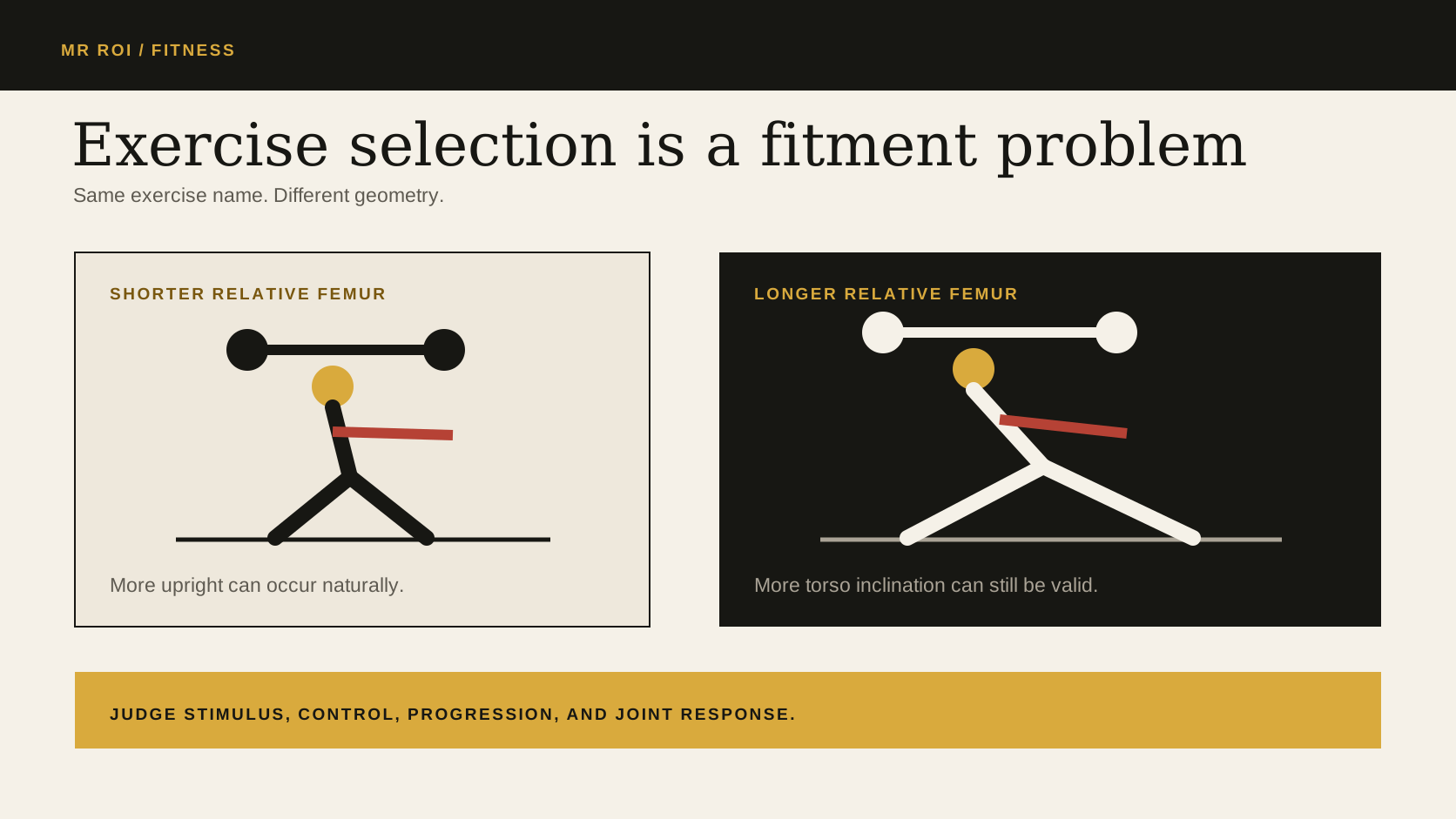
Research supports the underlying point. A study of squat stance and body proportions found that relatively long thighs changed lower-limb joint demands. People with long legs or limited ankle dorsiflexion may benefit from a wider stance. A separate study found that ankle mobility and segment ratios influenced trunk lean during a barbell squat. Research on deadlift variants found only a modest relationship with body proportions and did not support simplistic internet rules about who must pull conventional or sumo.
The practical lesson is individual assessment, not destiny.
| Variable | What it can change | What to test |
|---|---|---|
| Femur-to-torso ratio | Squat torso angle, knee travel, balance | Stance, heel elevation, bar position, squat variant |
| Arm length | Press range, pull range, deadlift start | Grip, implement, bench setup, pull height |
| Tibia and ankle motion | Knee travel and squat depth | Foot angle, heel wedge, stance, machine placement |
| Shoulder width and structure | Pressing comfort and machine fit | Grip width, dumbbells, converging handles, cables |
| Hip structure | Comfortable depth and stance | Stance width, toe angle, unilateral options |
| Machine pivot alignment | Joint path and resistance curve | Seat height, back pad, starting position, alternate machine |
None of these variables makes one exercise morally superior.
For progression, volume and full-program design, use The Fitness 80/20 System.
A textbook squat is not one set of joint angles
The bar and combined center of mass need to stay balanced over the base of support. How the body accomplishes that depends on segment lengths, stance, load position, mobility, and the squat's purpose.
A lifter with long femurs and a shorter relative torso will often need more forward torso inclination in a back squat than a lifter with short femurs. Trying to force both into the same upright silhouette can create a new compensation rather than fix the movement.
My squat decision order is:
- Can I keep the load balanced and controlled?
- Can I reach a useful range for the target without pain or loss of position?
- Does the variation train the intended muscle rather than my ability to survive the setup?
- Can I progress it consistently?
Useful adjustments can include a wider stance, modest toe-out, heel elevation, a safety-squat bar, a front-loaded variation, a belt squat, or a machine with a path that fits. The correct choice depends on whether the goal is powerlifting specificity, quad hypertrophy, general strength, or a tolerable way to keep training.
For a competitive powerlifter, the competition squat still matters. For a bodybuilder trying to grow quads, loyalty to a bar position that turns every set into a lower-back endurance test has little value.
Machines are not automatically more accommodating
Machines remove some stabilization and can make hard training more repeatable. They can also impose one pivot, pad position, track, and range on every user.
A hack squat may feel excellent when the shoulder pads, back angle, footplate, and sled path match the lifter. It may feel terrible when long legs place the hips and knees into an awkward bottom position before the target muscles reach a useful limit. A leg press can run out of room at the hips. A chest-supported row can place the pad too low. A pulldown thigh restraint can sit on the kneecap. A preacher curl can put the elbow far from the intended pivot.
My machine-fit check is simple:
- Does the machine's pivot roughly align with the joint it is organizing?
- Can the seat and pads support my body without forcing a shortened or jammed position?
- Can I enter and exit safely under fatigue?
- Does the resistance stay on the target instead of creating a sharp joint complaint?
- Is the usable range large enough to justify the machine?
If not, the machine is the wrong size or design for me. That is not a mobility defect.
Range of motion should serve the goal
Full range of motion is a strong default. Systematic reviews generally find full-range training superior to partial range for strength across the trained range and favorable for lower-body hypertrophy. Newer research also suggests that lengthened partials can produce similar hypertrophy to full repetitions in some exercises when the muscle is loaded in the stretched region.
Use the range you can control for the intended muscle, rather than forcing the end of a machine’s travel.
I use the deepest range that satisfies four conditions:
- The target muscle remains meaningfully loaded.
- The position is controlled, not reached by collapsing into passive structures.
- The joint response is tolerable during the set and afterward.
- The range can be reproduced and progressed.
A taller lifter may need a different setup to achieve the same muscular objective. That is not “cheating.” Shortening range only to move more weight is different from selecting a stable range because the equipment stops fitting.
The hinge exposes proportion differences quickly
My long legs and high hip position make a conventional deadlift from the floor a less natural fit than it is for some lifters. I can still perform it. The question is whether the exercise is the best tool for the current goal.
For posterior-chain hypertrophy, a Romanian deadlift gives me a controlled eccentric and lets me stop where hamstring length and spinal position dictate. I have performed 405-pound RDLs with a three-second eccentric and no reset. That variation lets me load the hinge hard without forcing every rep to start from the floor.
Other useful options include:
- a trap bar when handle position and stance fit the goal
- block pulls when floor height creates the limiting position
- hip hinges in a cable or machine when fatigue cost needs to fall
- 45-degree back extensions for a lower-load hip-extension pattern
- single-leg RDLs when stability and side-to-side control matter
Competitive specificity can override convenience. Outside competition, the exercise must justify its fatigue and setup cost.
Pressing and pulling need equipment that respects wingspan
Long arms increase pressing range. That can create a large loaded stretch, but it also raises the setup demands.
For presses, I look for:
- a bench long enough to support my head and torso
- a rack height that does not turn every unrack into a half repetition
- safeties that catch the bar at the actual bottom position
- grip and implement choices that let the shoulder move comfortably
- dumbbells or converging handles when a fixed bar path is the bottleneck
For pulling, I look for full scapular movement, enough cable travel, thigh restraint that actually holds me, and handles that do not force an artificial wrist or elbow position.
The taller the lifter, the more likely a “standard” station becomes a fitment decision.
Judge exercises by stimulus, fatigue, and repeatability
I do not need an exercise to look conventional. I need it to produce a high-quality training effect at an acceptable cost.
| Test | Good sign | Bad sign |
|---|---|---|
| Target stimulus | Intended muscle is the clear limiter | Setup, balance, grip, or another joint ends the set |
| Stability | Repetitions are reproducible | Every rep follows a different path |
| Progression | Load or reps can rise without form changing | Only range reduction creates progress |
| Fatigue | Recovery matches the benefit | Axial or joint fatigue dominates the week |
| Fit | Pads, pivots, and supports match the body | Body must contort to match the equipment |
| Joint response | Normal training discomfort resolves predictably | Sharp pain or worsening irritation persists |
This is especially important for an experienced lifter. Beginners need practice with stable patterns. Advanced trainees need enough specificity to measure progress, but they also have more accumulated joint history and more strength to amplify a poor fit.
Do not turn anthropometry into an excuse
Proportions explain constraints. They do not excuse uncontrolled repetitions, ego loading, or avoiding difficult positions that are safe and relevant.
A tall lifter can still improve ankle motion, bracing, balance, and technique. A wide stance is not automatically better. A machine that feels strange on the first session may need adjustment and practice. Pain can reflect programming, fatigue, injury, or load management rather than geometry alone.
The correct response to persistent sharp pain, weakness, neurological symptoms, or a changing mass is not a new exercise hack. It is appropriate clinical evaluation.
BUY / WAIT / PASS
BUY exercises that fit the body, target, and equipment while remaining measurable and progressive. WAIT before abandoning a useful lift until stance, range, setup, load, and fatigue have been tested. PASS on the idea that one lifter's textbook silhouette is the universal standard.
The goal is not to make a tall body imitate a short one. The goal is to train the intended tissue hard, safely, and repeatedly enough to improve.
Sources
- ACSM: 2026 resistance-training guidelines and the importance of individualization
- Demers et al.: stance width, anthropometrics, and lower-extremity range of motion during the squat
- Lorenzetti et al.: ankle mobility and segment ratios in barbell-squat trunk lean
- Cholewa et al.: anthropometrical determinants of conventional versus sumo deadlift performance
- Pallarés et al.: systematic review and meta-analysis of resistance-training range of motion
- Wolf et al.: full range versus lengthened partial repetitions in trained individuals
Disclosure
Some links may earn Mr ROI a commission at no added cost to you. That does not change the recommendation. This is general information, not personal financial or medical advice. Read the full disclosure.