
The Gym Is Not Intuitive: The Training Mistakes That Cost Me Years
An advanced lifter's correction system for exercise execution, progression, fatigue, warmups, cardio, and the difference between moving weight and training the intended tissue.
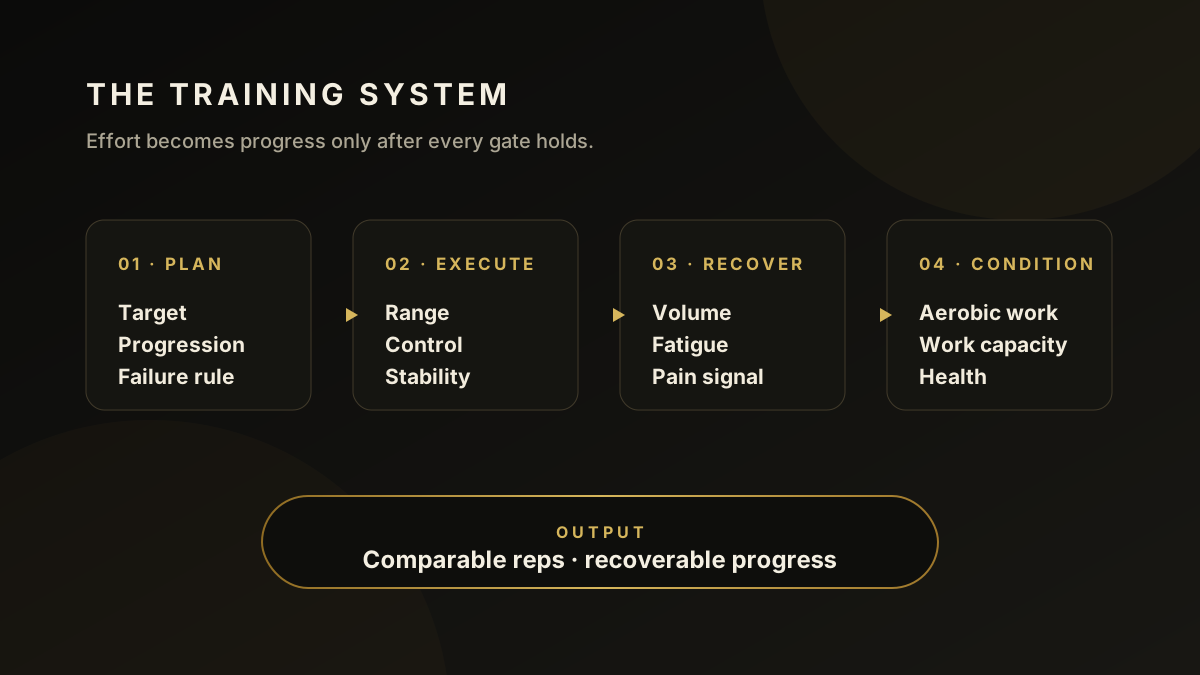
In brief
What I learned
The largest hidden losses come from undefined progression, changing the repetition standard, surrendering useful range of motion, and adding volume before improving stimulus quality.
Keep double progression while it works. Use undulating periodization when you have a specific strength or fatigue problem to solve.
Use controlled reps, movement-specific warmups and exercises that fit your body. Put cardio in the weekly plan and address recurring pain rather than training around it indefinitely.
I have trained consistently since 2018, usually four or five days per week. I have followed coached programs, tracked loads and RPE, built a serious home gym, and spent years combining heavy compound work with bodybuilding.
I still lost time to mistakes that looked normal from the outside. I moved weight without fully controlling it. I used ranges of motion that protected the number instead of training the muscle. I added volume when execution was the real constraint. I also treated cardiovascular fitness as optional because I cared more about strength and size.
At 6 feet 5 inches with long legs and high hips, I was never going to squat like a compact lifter. My proportions did not excuse years of shallow squatting. They meant I needed better exercise selection, stance, setup, load management, and patience.
The biggest lesson is simple:
Hard training cannot rescue a poorly designed system. Effort only magnifies whatever the system is already rewarding.
These are the mistakes that cost me progress and the corrections I now use. Look for the ones that explain a problem in your own training.
Use The Fitness 80/20 System to put those corrections into a repeatable program.
Treating effort as a substitute for a plan
I spent enough time training to learn that effort alone isn't a program. If I can't tell whether a lift is improving, what causes me to add weight, or why I'm changing an exercise, I'm just making each session up as I go. A useful plan turns those decisions into a repeatable process while leaving room to adjust when a movement doesn't fit.
A real plan does more than list exercises. It defines the movement, order, working range, set count, proximity to failure, rest period, progression rule, substitution rule, and the condition that triggers a deload or change. Without those constraints, every session becomes a new interpretation of how I feel.
That creates three problems:
- good days become accidental max-outs
- bad days become random exercise substitutions
- plateaus become an excuse to add volume, intensity techniques, or novelty without identifying the actual constraint
My best training periods have always been the least ambiguous. The program told me what performance counted, the logbook showed whether it improved, and autoregulation adjusted the day without rewriting the entire block.
The current ACSM position stand makes an important distinction. Most adults do not need a complicated program to benefit from resistance training. An experienced lifter trying to maximize strength or hypertrophy is solving a narrower problem. Consistency remains the foundation, but specificity, fatigue management, exercise priority, and measurable progression matter more as easy gains disappear.
Correction: Write the progression and failure rules before the session. If the plan changes, record why.
Using one progression model after it stops answering the question
Double progression is excellent. Pick a rep range, add repetitions until the top is reached, then add load and return to the bottom. It is simple, measurable, and useful far beyond the beginner stage.
The mistake is not continuing to use double progression after several years. The mistake is expecting one rep range and one exposure to diagnose every plateau.
An advanced lifter can miss a rep for many reasons: fatigue, exercise order, technique drift, an oversized load jump, a weak position, poor recovery, or stale programming. Forcing the same target again does not identify which explanation is true.
Undulating periodization can help by deliberately changing volume and intensity across the week or block. Evidence suggests periodization can improve one-repetition-maximum strength, and trained lifters pursuing maximal strength may benefit from undulating volume and intensity. That does not mean everyone must abandon double progression or that daily undulation creates more hypertrophy when volume is matched.
I would use the smallest change that restores a useful signal:
- Plateau
- Load jump is too large
- Better first response
- Microload or widen the rep range
- What not to assume
- The exercise has stopped working
- Plateau
- Reps stall while technique degrades
- Better first response
- Hold load and restore the execution standard
- What not to assume
- More effort will fix it
- Plateau
- Heavy work suppresses later volume
- Better first response
- Use a top set plus back-off work
- What not to assume
- Every set needs the same load
- Plateau
- Performance swings across the week
- Better first response
- Separate heavy and moderate exposures
- What not to assume
- One bad day proves regression
- Plateau
- Multiple lifts decline together
- Better first response
- Reduce fatigue or deload
- What not to assume
- Every muscle needs more sets
- Plateau
- Strength is the primary goal
- Better first response
- Consider planned intensity and volume undulation
- What not to assume
- Undulation is mandatory for size
Correction: Keep double progression when it still produces clean, comparable performance. Add undulation when variation solves a defined strength or fatigue problem, not because the calendar says I am advanced.
Moving the weight instead of controlling the repetition
I used to treat the concentric result as the rep. If the weight returned to the top, the repetition counted.
That standard ignores half of the movement.
A controlled eccentric makes each repetition comparable. It preserves position, exposes the target tissue to load through the descent, and prevents gravity from turning the bottom into a collision. My Romanian deadlift is a useful example. A heavy set with a deliberate eccentric and no reset tells me more than a heavier load bounced through a shorter, changing range.
Control does not mean making every eccentric arbitrarily slow. Research on repetition duration does not show that slower is always better, and the 2026 ACSM review found that time under tension did not consistently determine outcomes. Excessively slow repetitions can reduce the load or repetitions completed without improving the training effect.
The useful standard is simpler:
- the eccentric lasts long enough to preserve position
- the bottom position is reached rather than avoided
- the direction change does not rely on a bounce I cannot reproduce
- the target muscle remains loaded
- the concentric begins from the intended position
A brief pause in the stretched position can be a good diagnostic tool. It removes momentum and exposes whether I actually own the bottom. The pause itself is not proven hypertrophy magic. The value comes from training a stable, loaded length without using elastic rebound to disguise weakness.
Correction: Standardize the eccentric and turnaround before adding load. If the next plate changes the movement, it changed the exercise.
Cutting range of motion to protect the number
For years, my leg development was held back partly because my squat depth did not consistently reach parallel or below. I could explain the geometry. I am tall, long-legged, and naturally inclined to fold forward more than a shorter lifter. The explanation was real. The conclusion was wrong.
The answer was not forcing my body into someone else's squat. It was finding the deepest controlled range I could repeat while keeping the movement aligned with the goal. That can involve stance width, toe angle, heel elevation, a safety-squat bar, a hack squat, a different load, or a different squat pattern.
Full range of motion is a strong default. A systematic review found advantages for strength and lower-body hypertrophy compared with partial training. Newer research also suggests that partial repetitions performed at longer muscle lengths can be useful in some exercises. Those findings do not rescue arbitrary half reps performed where the exercise is easiest.
The rule applies beyond squats:
- presses should not become shallow because the load is impressive
- rows should not become a torso swing with a shortened shoulder path
- pulldowns should not end when the elbows have barely moved
- curls should not avoid the lengthened position because it exposes weakness
- calf work should not become bouncing through the middle third
There are legitimate reasons to use a partial range: pain-free training around a constraint, overload for a specific strength position, lengthened partial work, sport specificity, or a deliberate intensity technique. The range should be selected, not gradually surrendered.
Correction: Define the range before the set. Use the deepest stable, tolerable range that matches the goal, then keep it consistent enough for progression to mean something.
Warming up randomly or treating stretching as insurance
Walking into the gym cold and loading the first work set is avoidable. So is turning the warmup into a separate workout.
A useful resistance-training warmup has four jobs:
- raise general temperature if I am actually cold
- move the joints through the ranges required that day
- rehearse the exact movement with light loads
- approach working weight without creating fatigue
Dynamic movement and progressive loading can improve readiness and performance. The evidence is weaker for claiming that one particular warmup routine prevents injury. A systematic review of upper-body warmups found useful performance effects but no eligible injury-prevention studies. That distinction matters. I warm up because it improves preparedness, technique feedback, and load exposure. I do not treat arm circles or a band routine as a warranty against injury.
My practical sequence is movement-specific:
- Stage
- General movement
- Purpose
- Raise temperature and reduce stiffness
- Stop when
- I feel physically ready, not tired
- Stage
- Dynamic mobility
- Purpose
- Access the positions needed today
- Stop when
- The required range is available
- Stage
- Empty or light movement
- Purpose
- Rehearse setup, bracing, path, and tempo
- Stop when
- Technique feels repeatable
- Stage
- Ramp-up sets
- Purpose
- Expose the body to increasing force
- Stop when
- Working load no longer feels abrupt
- Stage
- Working sets
- Purpose
- Produce the training stimulus
- Stop when
- Warmup fatigue is absent
Static stretching is not forbidden. Long, aggressive static stretching immediately before maximal performance can be a poor fit, while brief or separately programmed flexibility work may be fine. The warmup should solve today's readiness problem, not satisfy a ritual.
Correction: Use dynamic, movement-specific preparation and light ramp-up sets. Manage loading, recovery and recurring pain separately.
Applying good cues to the wrong movement
Fitness cues are compressed solutions. They are useful because I cannot recite a biomechanics lecture during a hard set. They become dangerous when the cue is mistaken for a universal law.
“Pull through the elbows” can help turn a pulldown or row from a grip-and-biceps exercise into the intended shoulder movement. It does not mean the hands become passive or that every back exercise needs the same elbow path. A tucked elbow, flared elbow, vertical pull, and horizontal row can emphasize different tissues and require different paths.
Scapular retraction and depression can create a stable bench-press base. Freezing the shoulder blades down and back is not the rule for every press. During overhead movement, the scapula needs to upwardly rotate. A cue that stabilizes one press can interfere with another.
Isolation exercises expose the same problem. A lateral raise becomes a full-body heave. A curl becomes shoulder flexion. A triceps extension becomes a moving shoulder and torso. Adding external stability, such as chest support, a bench, a cable setup, or a braced stance, can make the target muscle the limiting factor instead of balance and compensation.
My cue hierarchy is:
- What joint action is the target muscle supposed to produce?
- What body segments should move?
- What body segments should remain stable?
- Where should the resistance be hardest?
- Does the cue improve the rep on video and in the logbook?
Correction: Judge a cue by the movement it creates. Keep it when it improves target loading and repeatability. Drop it when it merely sounds technical.
Adding volume before improving stimulus quality
More sets can produce more hypertrophy, but the return diminishes. A 2026 meta-regression found that strength and hypertrophy generally increased with weekly volume while showing diminishing returns, particularly for strength.
Count the productive work each set adds alongside the fatigue it creates.
An additional set performed with poor range, a drifting target, inadequate rest, or low effort is not equivalent to a high-quality set. Neither is an indirect set automatically equal to direct work. Ten hard sets that recover well can outperform sixteen sets that progressively become worse repetitions.
I have made the mistake of using volume to compensate for uncertainty. If I was not sure the target muscle received enough stimulus, I added another exercise. The better response was often to improve stability, execution, exercise fit, rest, or proximity to failure.
Compound lifts deserve priority when strength in those lifts matters or when they efficiently train several tissues. They are not morally superior to isolation work. Exercise-order research suggests the largest strength gains occur in movements performed earlier, while hypertrophy can be similar across different orders. Put the highest-priority outcome first.
That produces a better rule than “always do compounds first”:
- strength goal: place the competition or benchmark lift early
- lagging muscle goal: place the exercise that best loads that muscle before fatigue compromises it
- joint-limited compound: use a stable accessory to add stimulus without duplicating the same fatigue
- crowded session: protect the few movements that determine the outcome and cut decorative volume
Correction: Add sets only after the existing sets meet the range, control, effort, rest, and target standard.
Training muscle while neglecting the aerobic system
This is the mistake I still own most clearly.
I trained hard for years and treated cardio as something that might interfere with leg recovery. Meanwhile, my daily activity was often low and my wearable's cardio-fitness estimate declined enough to get my attention. The estimate is not a laboratory VO2 max test, but the direction matched an obvious behavior: I was not training the aerobic system consistently.
Being strong does not make cardiovascular fitness redundant. Aerobic capacity affects health, work capacity, recovery between efforts, and how much ordinary activity feels expensive. Federal physical-activity guidelines recommend both aerobic and muscle-strengthening work, not one as a substitute for the other.
The interference fear is often exaggerated. Updated evidence indicates that concurrent aerobic and strength training generally does not compromise hypertrophy or maximal strength, although explosive strength and poorly managed lower-body fatigue can be more sensitive. Modality, duration, frequency, sequence, and recovery matter.
A strength-focused lifter does not need to become an endurance athlete. The correction is to give cardio an actual slot instead of hoping lifting produces it accidentally:
- easy aerobic work that can accumulate without damaging leg training
- a measured progression in duration or intensity
- harder intervals only when recovery supports them
- separation from the most important lower-body strength work when possible
- trends in pace, heart rate, or work output rather than worshipping one wearable estimate
Correction: Program cardiovascular fitness as a parallel adaptation. If it appears nowhere in the week, it is not a priority no matter how often I say health matters.
Confusing discomfort, fatigue, and pain
Hard sets are uncomfortable. Local muscular fatigue, elevated breathing, effort, and a controlled stretch under load can all be normal parts of training. Sharp pain, changing joint pain, neurological symptoms, or a recurring problem that changes movement is a different category.
Technique is not a force field. A lifter can use respectable form and still exceed tissue tolerance, recover poorly, choose a bad exercise fit, or develop a problem that needs clinical evaluation. The opposite is also true: a lift can look unusual because of anthropometry and still be controlled and appropriate.
I do not want an article about gym mistakes to imply that every injury was caused by skipping dynamic stretching, failing to retract the scapula, or using the wrong tempo. That certainty would be fake.
Use a simple boundary:
- ordinary effort: continue within the plan
- unusual fatigue or performance loss: adjust load, volume, or recovery and monitor
- recurring or worsening pain: stop forcing the pattern and identify the cause
- severe or red-flag symptoms: seek qualified medical evaluation
Correction: Treat pain as information, not proof of weakness and not proof of damage. Do not use motivational language to override a pattern that keeps returning.
The audit I wish I had used earlier
Before changing an exercise or adding another advanced technique, I would now review one recorded working set and answer these questions:
- Check
- Plan
- Pass condition
- Exercise, range, sets, effort, rest, and progression were defined before training
- Check
- Setup
- Pass condition
- The equipment and body position fit the target and my proportions
- Check
- Eccentric
- Pass condition
- The descent remained controlled and repeatable
- Check
- Turnaround
- Pass condition
- The bottom was owned rather than bounced through
- Check
- Range
- Pass condition
- The selected range matched the goal and did not shrink as fatigue rose
- Check
- Target
- Pass condition
- The intended tissue remained the limiting factor
- Check
- Stability
- Pass condition
- Non-target movement did not create the repetition
- Check
- Volume
- Pass condition
- Each added set produced enough useful work to justify its fatigue
- Check
- Progression
- Pass condition
- The logbook compares the same exercise standard over time
- Check
- Conditioning
- Pass condition
- Aerobic work exists somewhere in the actual week
- Check
- Recovery
- Pass condition
- Performance, sleep, soreness, and pain support the planned dose
The verdict is not that everyone needs a complicated powerbuilding spreadsheet.
BUILD A PLAN when sessions are currently improvised.
KEEP DOUBLE PROGRESSION while it produces comparable reps and load. ADD UNDULATION when strength specificity or fatigue variation solves a defined plateau.
CONTROL THE REP before making it heavier. Use full, stable range as the default while recognizing that anatomy, goals, pain, and deliberate long-length partial work can change the prescription.
WARM UP TO PERFORM, not to purchase imaginary injury insurance.
CUT JUNK VOLUME before cutting the movements that drive the goal.
PROGRAM CARDIO instead of assuming strength training covers every dimension of fitness.
The gym is not intuitive because the visible action is simple while the invisible decisions compound. Anyone can copy an exercise. The difficult skill is selecting the right version, loading it appropriately, executing it consistently, recovering from it, and knowing when the system rather than the effort needs to change.
Use my tall-lifter guide for exercise fit and the minimum viable cut for difficult weeks. The goal is to make your effort count when you reach the gym.
Sources
- ACSM 2026 position stand: resistance-training prescription and outcome-specific variables
- Moesgaard et al.: periodization, maximal strength, and hypertrophy meta-analysis
- Schoenfeld et al.: repetition duration and hypertrophy systematic review
- Pallarés et al.: full and partial range-of-motion meta-analysis
- Wolf et al.: full range versus lengthened partial repetitions in trained lifters
- McCrary et al.: upper-body warmup, performance, and injury-evidence review
- Nunes et al.: exercise order, strength, and hypertrophy meta-analysis
- Pelland et al.: 2026 weekly volume and frequency dose-response meta-regressions
- U.S. HHS: Physical Activity Guidelines for Americans
- Schumann et al.: concurrent aerobic and strength training meta-analysis
Disclosure
Some links may earn Mr ROI a commission at no added cost to you. That does not change the recommendation. This is general information, not personal financial or medical advice. Read the full disclosure.