
The Brands I Keep Buying and Why Brand Loyalty Is Still Stupid
A receipt-backed look at the brands that repeatedly win my money, the sale periods that change my timing, the switching costs that are real, and why no logo gets the final vote.
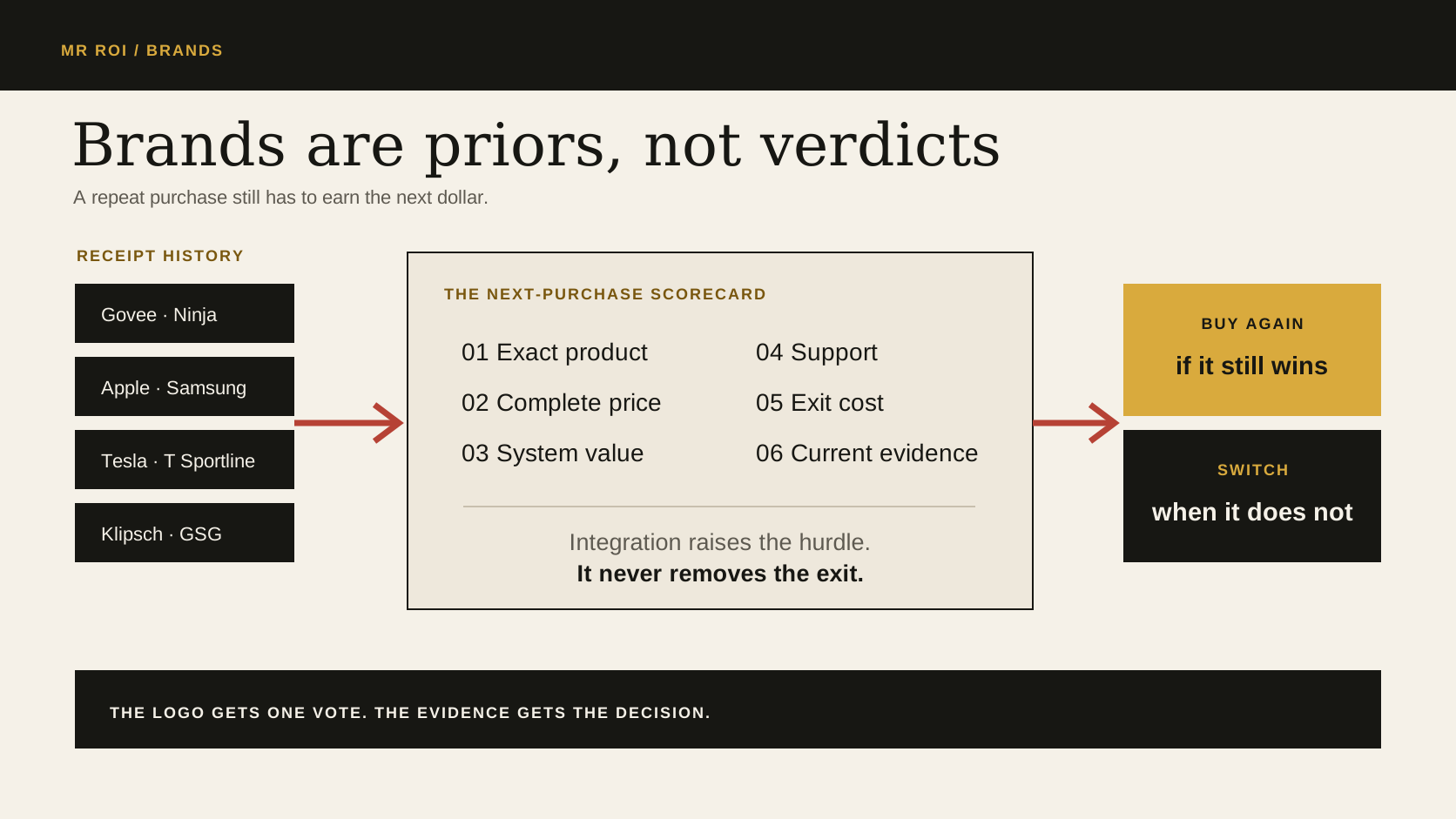
In brief
What I learned
My purchase history shows repeated wins for Govee, Ninja, Apple, Samsung, Anker, Klipsch and JBL. Each earned another purchase by doing a useful job at the right price.
The same Govee floor-lamp ASIN moved from $99.99 to $54.99 in six weeks, illustrating why promotional categories need an exact product target and a real price trigger before a sale label matters.
Apple, Tesla, and Govee integration can create legitimate switching costs, but the Model 3 wheel swap, Samsung purchases after the phone transition, and migration from Klipsch to specialist audio prove that a better product can still win.
I buy from some brands repeatedly. That does not make me loyal to them.
It means they have solved more than one job at a price and quality level that made sense at the time. The next product still has to earn the next purchase.
I used to have a Samsung phone. I now use an iPhone and own enough Apple products that integration makes leaving harder. If a competing product becomes materially better for the money and clears the switching cost, I will leave anyway.
That is the difference between using brand history as evidence and using a logo as identity.
My receipts show repeat buying, not allegiance
I didn't reconstruct my brand preferences from a few memorable purchases. I checked the Amazon order export behind my purchase-intelligence workbook, covering October 2017 through June 2026. That evidence tells me which brands I actually kept buying; it doesn't give any of them permanent loyalty. I still want the next purchase to win on performance, support, compatibility, or price.
For the brand counts below, I used shipped or closed product lines whose names begin with the manufacturer, then calculated pre-tax item price multiplied by quantity. These are order-history signals, not audited net cash accounting. They exclude non-Amazon purchases, may include gifts or later disposition, and do not subtract every discount, return, refund, tax, or credit.
- Brand in the retained Amazon export
- Govee
- Shipped product lines
- 23
- Units
- 27
- Approx. pre-tax item spend
- $1,373.73
- What the pattern says
- Repeated smart-lighting purchases across many formats and rooms
- Brand in the retained Amazon export
- Ninja
- Shipped product lines
- 13
- Units
- 13
- Approx. pre-tax item spend
- $903.38
- What the pattern says
- Multiple appliance jobs won independently over six years
- Brand in the retained Amazon export
- Apple
- Shipped product lines
- 14
- Units
- 14
- Approx. pre-tax item spend
- $1,476.15
- What the pattern says
- Ecosystem utility grew through watches, audio, TV, tracking, and accessories
- Brand in the retained Amazon export
- Samsung
- Shipped product lines
- 9
- Units
- 9
- Approx. pre-tax item spend
- $2,127.91
- What the pattern says
- The old phone ecosystem did not stop Samsung products from winning other categories
- Brand in the retained Amazon export
- Anker
- Shipped product lines
- 16
- Units
- 17
- Approx. pre-tax item spend
- $443.48
- What the pattern says
- Boring accessory consistency repeatedly cleared the value threshold
- Brand in the retained Amazon export
- Klipsch
- Shipped product lines
- 6
- Units
- 9
- Approx. pre-tax item spend
- $1,254.03
- What the pattern says
- Strong value at prior audio goals and sale prices, not a permanent performance ceiling
- Brand in the retained Amazon export
- JBL
- Shipped product lines
- 3
- Units
- 3
- Approx. pre-tax item spend
- $1,049.85
- What the pattern says
- A narrow set of products won specific portable and party-audio jobs
The strongest evidence against blind loyalty is that both Apple and Samsung remain in the record. Switching my phone did not require pretending Samsung had never made anything worth buying. Buying Apple products did not require promising to buy the next Apple product.
Brand is a prior probability. It can make a product more likely to be good, compatible, repairable, or familiar. It cannot finish the evaluation.
For a new category or seller, use The Online Buying System to check the exact product and purchase terms.
Govee keeps winning because the system multiplies the hardware
My Govee history includes strips, television backlights, floor lamps, smart plugs, bulbs, outdoor strings, and other lighting. The repeated value is not just the light output of each device. It is the ability to control them in one app and, where compatible, coordinate them through features such as DreamView.
That creates legitimate ecosystem value:
- one control surface instead of a folder of unrelated apps
- shared scenes and synchronized effects
- less setup time for the next compatible device
- a lower learning cost for the household
It also creates switching cost. Replacing one lamp is easy. Replacing a room of synchronized products is not.
That is why I buy Govee when the exact device performs well and strengthens a system I already use. I do not buy Govee merely because I already own Govee. A weak camera, bad form factor, inflated price, or better interoperable alternative can still lose.
The receipt history also shows why timing matters. I bought one Govee RGBIC floor lamp for $99.99 on October 10, 2024. The same ASIN appeared in a November 22 order at $54.99 per unit, roughly 45 percent lower.
The lesson is not that every Govee lamp will be 45 percent cheaper on the Friday before Thanksgiving. The lesson is that this category can carry large promotional spreads. If the purchase is optional, I establish the target product first and wait for the real price to cross my threshold.
Ninja wins jobs, not a lifetime contract
The retained history includes Ninja blenders, a Foodi grill, personal blending systems, a hot-and-cold brew system, a Blast portable blender, Thirsti hardware, and related consumables. The purchases span 2019 through 2025.
Ninja repeatedly earned another purchase by packaging a useful appliance function at a price I accepted.
My standard is still job-specific:
- Job
- Blender
- What earns the purchase
- Useful container sizes, adequate power, easy cleanup, replacement parts
- What makes me leave
- A cheaper or better-performing system with less friction
- Job
- Grill or multicooker
- What earns the purchase
- Repeatable results and enough use to justify counter space
- What makes me leave
- A feature pile that duplicates equipment I already own
- Job
- Beverage system
- What earns the purchase
- Lower recurring effort or cost for a drink I actually make
- What makes me leave
- Proprietary consumables, clutter, or weak use frequency
- Job
- Vacuum
- What earns the purchase
- Pickup, handling, filtration, hair management, service, and price
- What makes me leave
- Brand relationship without evidence on the exact model
My purchase records document Ninja much more thoroughly than Shark. For Shark, the export contains a replacement-filter order compatible with an APEX UpLight, so I leave it out of the original-appliance purchase totals.
That evidence discipline is part of the brand.
Apple earns an integration premium, not obedience
Apple's own Continuity documentation lists the cross-device functions that create the real moat: AirDrop, Handoff, calls and messages across devices, Continuity Camera, AirPlay, iPhone Mirroring, Apple Watch unlock, and other workflows.
When those functions remove friction every day, integration has financial value. Leaving can require more than buying a different phone. It can mean replacing accessories, moving data, rebuilding workflows, teaching other people, losing features, and accepting temporary inconvenience.
I treat that as a switching cost, not as proof that Apple is automatically best.
The decision equation is:
Switch when the new product's improvement plus savings exceeds hardware replacement, migration, relearning, lost integration, and transition risk.
That hurdle can be high without being infinite.
I came from Samsung. My retained Amazon history still contains a Samsung Q70 television, Galaxy Buds, Galaxy Watch hardware, SSDs, and later Samsung earbuds. The phone decision changed because the complete system decision changed. Samsung products continued to compete where their own product case remained strong.
This is what rational switching looks like. I do not rewrite the old brand as bad to justify the new one.
Tesla wins the vehicle system, while Tesla wheels lost
Tesla is probably the cleanest example of why “brand pick” cannot mean “buy everything the company sells.”
The car wins for me as a complete ownership system: acceleration, software, route planning, charging integration, phone-key behavior, remote controls, and over-the-air updates. Tesla's own support material confirms how much of the ownership experience runs through the app and ongoing software.
Then I removed the factory 20-inch Uberturbines.
The wheels demanded too much pothole avoidance, carried expensive tire exposure, and had already produced a repair plus new rash. I replaced them with 18-inch T Sportline wheels and Goodyear tires, then sold the factory set locally.
That decision did not make me less satisfied with the Tesla. It made the Tesla better for my actual life.
- Layer
- Vehicle platform
- Winner for my current job
- Tesla
- Why
- The integrated ownership system produces weekly value
- Layer
- Daily-driver wheel
- Winner for my current job
- T Sportline TSH 18-inch
- Why
- Exact brake fitment, more sidewall, lower published wheel mass
- Layer
- Daily-driver tire
- Winner for my current job
- Goodyear Eagle F1 All Season
- Why
- Performance-oriented all-season compromise and cheaper replacement cycle
- Layer
- Factory 20-inch package
- Winner for my current job
- PASS for my use
- Why
- Appearance and sharpness did not justify the attention and damage exposure
The product is allowed to beat the parent brand's accessory. That should be normal.
My audio history moved as the target moved
Klipsch and JBL have both earned repeated purchases. My Amazon record includes Klipsch bookshelf speakers, center channels, in-ceiling speakers, and subwoofers, plus JBL PartyBox and portable-audio purchases.
Those brands made sense at their price, scale, and convenience. They did not remain the answer after my target became extreme output, custom enclosure alignment, large-room capability, and enthusiast-grade bass.
That is when Stereo Integrity, GSG flat packs, pro drivers, custom amplification, and used specialist gear entered the decision.
The old purchase can have been correct even when the next purchase comes from somewhere else.
Brand loyalists often treat switching as an admission that the prior choice was wrong. Product systems evolve. Budgets change. Rooms change. Use cases change. The correct product at one rung of the ladder can be the wrong product at the next.
I am most flexible where failure is cheap
My willingness to try an unfamiliar brand depends on the consequence of being wrong.
- Failure consequence
- Low
- Brand posture
- Aggressive value shopping
- Examples
- Cables, adapters, organizers, simple lighting
- Failure consequence
- Moderate
- Brand posture
- Exact-model research plus usable returns
- Examples
- Small appliances, speakers, televisions, tools
- Failure consequence
- High
- Brand posture
- Strong documentation, support, installation, and safety evidence
- Examples
- Tires, high-current electrical gear, structural products, critical storage
- Failure consequence
- Very high
- Brand posture
- Brand is secondary to professional verification and system design
- Examples
- Vehicle modifications, electrical service, medical or safety decisions
Anker has repeatedly won the boring-accessory tier because the products often solve the job with little drama. Harbor Freight and U.S. General can offer exceptional tool and storage value, but I do not turn that into “buy every tool there.” The less tolerable the failure, the more documentation, support, warranty, and exact-model evidence matter.
TCL won my giant-television decision because the exact 98QM7K delivered the scale and performance tradeoff I wanted at $2,085.24 tax-in. OUPES won one power-station deal at $466.01 tax-in. Neither transaction requires a lifelong badge tattoo.
I buy sale patterns, not sale labels
The FTC's deceptive-pricing guidance is one reason I do not treat a crossed-out reference price as evidence. My own order history is another. The same product can have a large real price spread even within weeks.
My buying sequence is:
- Define the job and exact acceptable models before the promotion.
- Record the normal complete cost, not just MSRP.
- Set a price or value trigger that would change WAIT to BUY.
- Watch the periods when that category historically gets aggressive.
- Verify seller, configuration, warranty, return cost, tax, shipping, accessories, and stackable discounts.
- Buy when the complete deal crosses the threshold.
- Stop monitoring after the return and price-adjustment window closes.
The observed sale windows in my own history include Prime-event periods, the November promotion cycle, model transitions, manufacturer clearances, member offers, local used listings, and one-off direct discounts. They are hunting zones, not promises.
- Category
- Smart lighting and small appliances
- When I become more attentive
- Prime-event periods and November promotions
- What still controls the buy
- Same exact model, price history, compatibility, real use
- Category
- Phones and consumer technology
- When I become more attentive
- Product launches and outgoing-model clearance
- What still controls the buy
- Complete ecosystem cost and material improvement
- Category
- Televisions
- When I become more attentive
- Model transition and major holiday promotion windows
- What still controls the buy
- Size, panel performance, return path, delivered price
- Category
- Tools and storage
- When I become more attentive
- Member promotions, clearance, and local availability
- What still controls the buy
- Capacity, duty cycle, warranty, failure consequence
- Category
- Cars, wheels, and tires
- When I become more attentive
- Inventory changes, rebates, local resale, actual replacement need
- What still controls the buy
- Complete installed cost, fitment, safety, ownership economics
- Category
- Specialist audio
- When I become more attentive
- Used listings, direct bundles, model changes
- What still controls the buy
- Measurement, condition, freight, support, resale, system fit
I do not buy a product because Black Friday arrived. I let Black Friday compete for a purchase I had already defined.
The brand scorecard I use now
A repeat purchase starts with six questions.
- Dimension
- Product
- Question
- Is this exact model still competitive?
- Dimension
- Price
- Question
- Is the complete cost good against real history and alternatives?
- Dimension
- System
- Question
- Does it reduce friction with products I already own?
- Dimension
- Support
- Question
- Can I return, repair, replace, or get parts without absurd effort?
- Dimension
- Exit
- Question
- Can I resell or switch without replacing an entire ecosystem?
- Dimension
- Evidence
- Question
- Am I relying on current performance or an old brand impression?
Brand history gets one vote. It can reduce search cost, raise confidence, and justify some integration premium. It never gets veto power over the evidence.
The best brands should welcome that standard. They get the repeat purchase when they continue earning it.
Loyalty should save time, not suppress competition
The brands I keep buying are not a personality test. They are a record of products that repeatedly cleared a job, price, integration, and ownership threshold.
BUY AGAIN when the exact product remains competitive and the brand's history or ecosystem creates real additional value. WAIT when a promotion-heavy category is near a real sale window and the current price has not earned urgency. SWITCH when a better product clears the complete migration cost. PASS when the argument begins and ends with the logo.
Brand loyalty is stupid for almost everyone because the brand does not share the consequence of the purchase. It should earn the next dollar with the next product, just like it earned the first one.
Sources
- Federal Trade Commission: Guides Against Deceptive Pricing
- Apple Support: current Continuity features and device requirements
- Govee: Govee Home app and centralized device control
- Govee: DreamView ecosystem and synchronized lighting
- SharkNinja: current Shark and Ninja product categories
- Tesla: app-based vehicle access, climate, charging, and software controls
- Tesla: over-the-air software update process
- Samsung: SmartThings multi-brand control and automation
- Harbor Freight: current warranty terms and category-specific limitations
Disclosure
Some links may earn Mr ROI a commission at no added cost to you. That does not change the recommendation. This is general information, not personal financial or medical advice. Read the full disclosure.