Stop overpaying at Tesla Superchargers
A road-trip charging workflow for checking dynamic prices, using minimum viable charges, comparing nearby stations, and separating useful planning tools from false economy.

In brief
Start here
- Supercharger pricing can vary enough that checking nearby stations changes the trip's cost without meaningfully changing arrival time.
- Minimum viable charging, route comparison, and destination charging are more useful than maximizing every stop.
- A detour is only a win after its time, energy, reliability, and arrival-state tradeoffs are counted.
Tesla road trips are easy. Cheap Tesla road trips require a little more effort. I recently encountered the same V4 Supercharger at dramatically different prices: roughly $0.20/kWh at one time and $0.43/kWh at another. That is not a rounding error. A 50 kWh charging session would cost:
- $10.00 at $0.20/kWh
- $21.50 at $0.43/kWh
Same charger. Same electricity going into the car. $11.50 difference. If you're already the type of person who compares gas stations over a 20-cent-per-gallon difference, ignoring a 23-cent-per-kWh Supercharger spread makes no sense. The problem is that Tesla makes optimizing around this harder than it should be.
| Option | Best use | Cost check |
|---|---|---|
| Home charging | Normal daily driving | Use the residential rate and schedule off-peak when the tariff rewards it. |
| Included destination charging | Overnight stops you already planned | Confirm access and any parking or lodging requirement. |
| Lower-priced Supercharger | Road trips with a small amount of route flexibility | Compare nearby and onward stations before committing. |
| Peak-priced Supercharger | Time-sensitive travel or sparse routes | Pay when the saved time and reliability are worth more than the spread. |
Tesla Knows the Prices. It Just Won't Optimize for Them.
Tesla's native Trip Planner is excellent at what it was designed to do.
It considers factors such as traffic, elevation, outside temperature, estimated energy consumption, stall availability and your vehicle's current state of charge when selecting charging stops.
What it does not currently offer is a setting like:
Optimize route for lowest charging cost.
There is no native:
- Cheapest Supercharger filter
- Sort by $/kWh
- Maximum acceptable charging-price setting
- "Avoid chargers over $0.35/kWh" option
- Cost-minimized road-trip mode
That means Tesla might conveniently route you to a $0.43/kWh station even if a $0.25/kWh station is reasonably close. The information exists. The optimization doesn't. So you have to do it yourself.
First Rule: Check the Price Before You Plug In
Tesla displays Supercharger pricing and applicable peak/off-peak periods in the vehicle navigation interface and Tesla app. This matters because Tesla determines your charging rate based on when you plug in. Your price does not automatically change during the session if the pricing period changes afterward. For example: 6:59 PM: $0.43/kWh 7:00 PM: $0.24/kWh
If the station follows a scheduled pricing change and you have flexibility, waiting one minute could save almost 45%. The same principle applies on a longer scale. If you're arriving near the beginning or end of a peak window, charging immediately might be the worst financial choice. Eat first. Use the bathroom. Check into the hotel. Shop. Then charge.
The car doesn't care which order you do those things in. Your wallet does.
Compare the Next Supercharger, Not Just the Closest One
Tesla owners tend to follow whatever charger navigation recommends. Instead, when you're approaching a charging stop, check a couple of Superchargers farther down the route. Say Tesla recommends:
Station A: $0.43/kWh
Forty miles down the highway:
Station B: $0.24/kWh
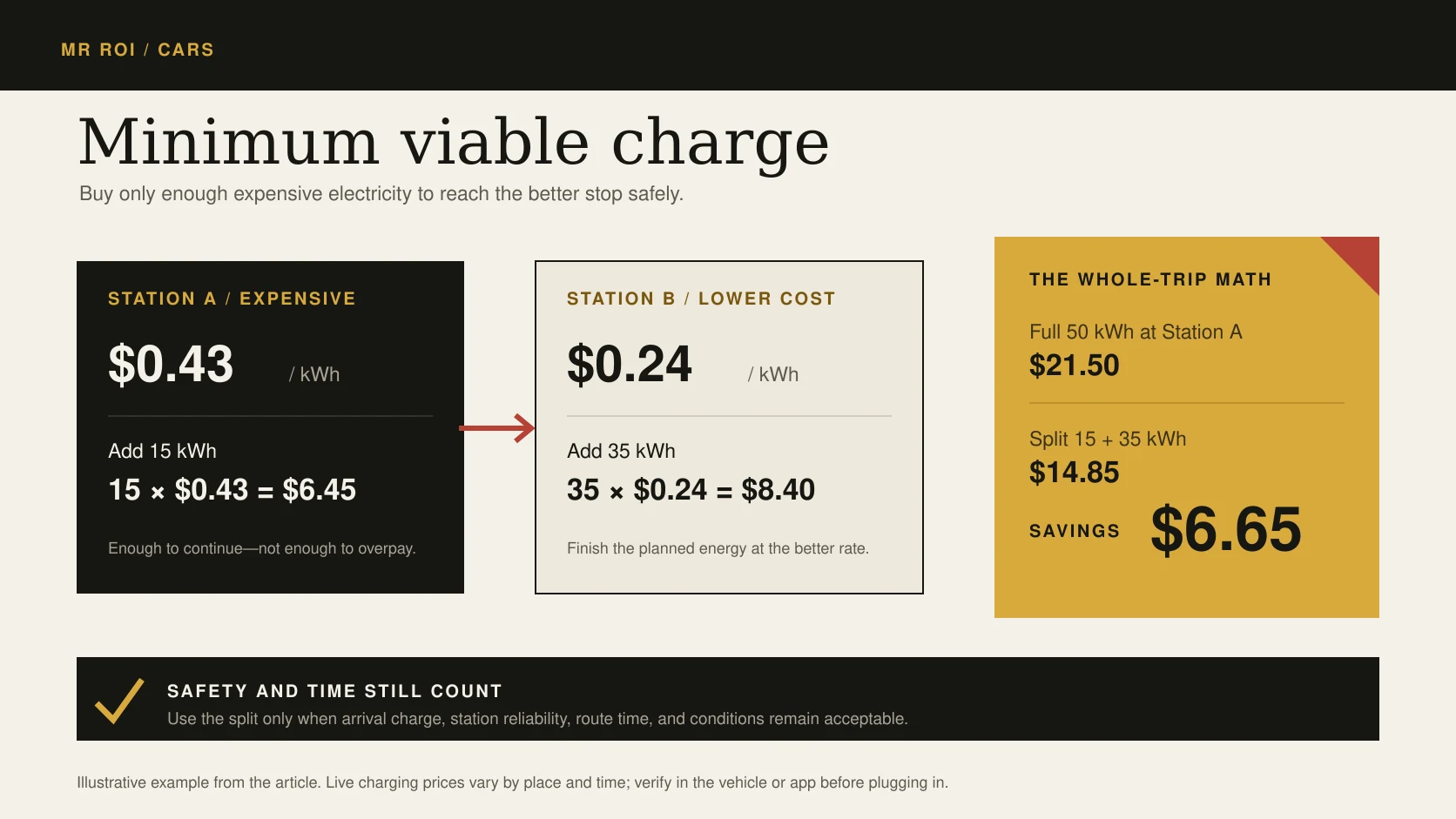
If you have enough battery to reach Station B safely, skipping Station A is obvious. If you don't, you can use what I call a minimum viable charge:
- Adding 50 kWh at the expensive station costs $21.50.
- Adding only 15 kWh there costs $6.45.
- Adding the remaining 35 kWh at $0.24/kWh costs $8.40.
The two-stop total is $14.85, for a $6.65 savings.
You didn't change vehicles, memberships or charging networks. You just stopped buying expensive electricity sooner than necessary.
There is also a secondary benefit. EVs generally accept their highest charging power at lower states of charge. Short low-SOC stops can sometimes reduce both charging cost and charging time.
Small Detours Can Be Worth It
People sometimes reject cheaper charging because it is a few miles away. Do the math first. Suppose:
- Route charger: $0.43/kWh
- Alternative charger: $0.25/kWh
- Difference: $0.18/kWh
- Savings on a 40 kWh session: $7.20
If reaching the cheaper station requires a 10-mile total detour, a Model 3 might use only a few additional kWh.
Your incremental electricity expense could be well under $1. Trading $1 of additional energy and a few minutes of driving for $7 in savings can make sense. Driving 40 minutes out of your way to save $3 probably doesn't. Optimize the entire transaction, not just the displayed price.
Tesla's Pricing Really Is Dynamic
Tesla now explicitly describes its Supercharger pricing as dynamic.
According to Tesla, pricing can vary by location and can respond to factors including site occupancy and forecasted demand. Some locations use predefined peak/off-peak periods, while Tesla says certain sites can use live Supercharger utilization to determine peak versus off-peak pricing.
That explains why the exact same charging site can look cheap one time and expensive another. It also creates an important distinction:
Scheduled pricing is predictable.
If Tesla shows: 11 PM to 4 AM: $0.20/kWh you can plan around it.
Live utilization pricing is less predictable.
If pricing changes based on station utilization, pre-trip research might not tell you exactly what you'll pay hours later. Always check Tesla's live price before committing.
Use planning tools for the jobs they do well
ABRP Is the Best Planning Companion
A Better Routeplanner, or ABRP, is significantly more flexible than Tesla's native planner.
ABRP supports route alternatives, charger preferences, charging-network preferences and detailed EV-specific trip planning. It also displays charger pricing information, and ABRP says charging-network operators can provide real-time pricing and availability data directly to its system.
ABRP 7.0 can now generate up to nine route alternatives, which makes comparing charging strategies significantly easier. I would use ABRP for:
- Pre-trip planning
- Finding alternative chargers
- Comparing possible routes
- Identifying different charging networks
- Seeing whether a cheaper charging strategy is practical
But I would still confirm the Tesla Supercharger's actual price inside Tesla immediately before charging. Tesla controls the billing system. Tesla's displayed rate is the final authority.
PlugShare Solves a Different Problem
PlugShare is useful when you want to ask:
What other chargers exist around here?
It includes station pricing information when available, recent driver check-ins, parking information, amenities, charging speeds and reliability information. PlugShare also lets users filter charging locations and identify free charging opportunities.
That makes it useful for finding:
- Free Level 2 chargers
- Hotel chargers
- Destination chargers
- EVgo
- Electrify America
- ChargePoint
- Municipal charging
- Chargers attached to restaurants or shopping
The downside is that some information is community-maintained or network-supplied, so I wouldn't blindly assume every displayed price is current. Use PlugShare to discover opportunities. Verify before relying on them.
Supercharge.info Isn't Really a Price Tool
Supercharge.info is excellent if you want to nerd out over the Supercharger network itself. It is useful for things like:
- New Supercharger locations
- Construction
- Opening status
- Charger counts
- Network expansion
Pricing is different. Maintainers have historically explained that Tesla pricing changes too frequently and at too granular a level for crowdsourced Supercharger pricing to remain reliably current. So I wouldn't use Supercharge.info for road-trip cost optimization.
Avoid false savings
Don't Pay for Tesla's Supercharging Membership
Tesla offers a Supercharging Membership that can reduce Supercharger pricing. Sounds useful. Except it is meant for non-Tesla EVs. Tesla explicitly states that the membership is designed to let other EVs access the same pricing Tesla owners receive. Tesla vehicles do not need the membership. So there isn't a hidden Tesla subscription that makes Supercharging cheaper for your Model 3.
Other networks may offer their own memberships, which can be worth evaluating if you regularly use them.
Don't Ignore Free Hotel Charging
Overnight charging is one of the most underappreciated EV road-trip benefits. If Hotel A costs $130 and has no charger, while Hotel B costs $140 and includes reliable free charging, Hotel B may actually be cheaper. Add 50 kWh overnight for free instead of paying $0.43/kWh at a Supercharger: 50 × $0.43 = $21.50 Effectively, the $140 hotel just became the cheaper option.
This is classic Mr ROI territory. The sticker price isn't the relevant number. The total economic cost is.
My Road-Trip Charging Workflow
I still use Tesla navigation as the backbone of the trip. Tesla is very good at battery prediction, automatic Supercharger routing, live station awareness and battery preconditioning. I just don't blindly accept every charging stop. Before a meaningful charging session:
- Check Tesla's current $/kWh rate.
- Check whether a cheaper pricing window starts soon.
- Look at the next one or two Superchargers along the route.
- Compare the price spread.
- Use ABRP when evaluating larger route alternatives.
- Use PlugShare to look for cheap or free non-Tesla charging.
- If the current charger is expensive, buy only enough electricity to reach the cheaper option safely.
- Keep Tesla navigation pointed toward the final selected fast charger so the battery can precondition properly.
It takes maybe another minute of thought. On one charge, the savings may only be $5 or $10. Over years of road trips, those little decisions compound.
The Missing Tesla Feature
The irony is that Tesla already has virtually everything required to automate this. The car knows:
- Your battery percentage
- Expected energy consumption
- Charger locations
- Charger availability
- Current pricing
- Peak/off-peak schedules
- Traffic
- Estimated arrival time
- Charging speed
Tesla could theoretically give us three routing buttons:
Fastest
Lowest Cost
Balanced
That would solve most of this. Until then, Tesla handles the physics. I'll handle the economics.
Sources
Disclosure
Some links may earn Mr ROI a commission at no added cost to you. That does not change the recommendation. This is general information, not personal financial or medical advice. Read the full disclosure.