
The Car Audio Subwoofer Ladder: From Factory Bass to a Real Daily-Driver System
A complete path from factory tuning and compact powered bass through stealth, serious sealed, ported, multi-driver, infinite-baffle, and competition systems, grounded in my Model 3 SQL-12 upgrade.
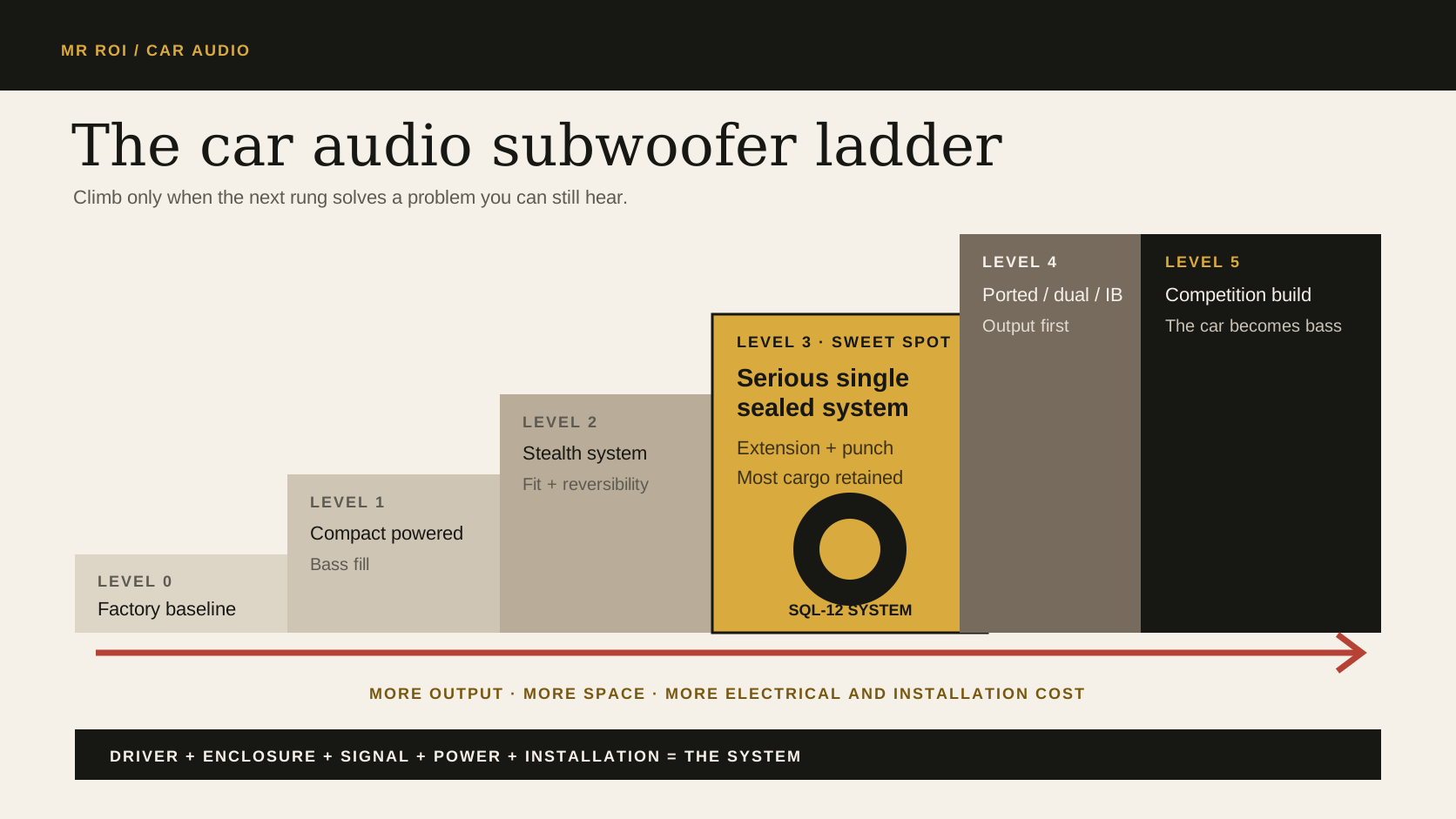
In brief
Start here
- Choose the bass experience first: a little fill, hidden installation, strong daily-driver output or a dedicated competition build. Include installation, cargo space and electrical integration in the price.
- My sealed SQL-12, JL Audio JD1000/1 and LC2i Pro give me the blend of bass and daily usability I wanted from the Tesla.
- I would measure and improve integration before buying another amplifier or a larger box. The Tesla installation guide covers the electrical work that made my system reliable.
I wanted more low-end output from my Tesla without throwing away the factory system I already liked. The upgrade taught me that the driver is only one piece of the job. Power integration, enclosure, tuning, electrical protection, and the daily-driver compromises determine whether the result is actually good.
The real ladder is a series of tradeoffs among output, extension, punch, integration, cargo space, electrical behavior, installation risk, reversibility, and total cost. A $400 woofer can become an excellent system or an expensive trunk ornament depending on everything around it.
This is the car-audio companion to my home-theater Subwoofer Ladder: what each upgrade buys, what it costs to integrate and where I would stop.
Start with the bass job, not the cone size
'More bass' can mean better low-end balance, harder punch, real deep-bass output, or competition-level sound pressure. Those are different projects. I wanted one of them, not all of them.
| Frequency priority | What the listener usually means | What can go wrong |
|---|---|---|
| Roughly 20 to 35 Hz | Deep extension, pressure, low electronic notes | A small system may run out of excursion or rely on boost |
| Roughly 35 to 55 Hz | Weight, kick foundation, broad musical impact | A low-tuned system can be impressive below this band but feel restrained here |
| Roughly 55 to 90 Hz | Chest impact, upper-bass punch, attack | Door-speaker integration and crossover can matter as much as the subwoofer |
| Above roughly 80 Hz | Transition into midbass and front-stage impact | A trunk sub can become localizable or expose weak factory midbass |
My priority was a musical daily-driver system with strong 45-to-90 Hz impact, real low-bass authority, long elevated-volume capability, and no structural cutting. I was not building a 140-plus-dB competition car. I wanted the factory premium system to sound complete and forceful without surrendering the vehicle.
That definition eliminated a lot of theoretically impressive options. A giant ported enclosure could create more output near tuning, but it would consume the trunk and move the project away from the job I had actually assigned it.
Car bass has different constraints from room bass
A vehicle cabin is a small, irregular, highly reflective pressure space. The subwoofer sits close to the listener, boundaries are near, seatbacks and trim filter the path, and road noise changes what remains audible while driving.
The car also arrives with an active factory audio system. The source may already contain equalization, filtering, time alignment, level-dependent behavior, or a factory subwoofer feed. Adding a powerful driver does not guarantee that the new system receives a clean, stable signal.
The decision therefore has five connected layers:
- Acoustic target: extension, punch, maximum level, and listening duration.
- Enclosure: alignment, volume, placement, and cargo tradeoff.
- Signal: factory integration, summing, equalization, crossover, delay, and level control.
- Power: amplifier, final impedance, cable, fusing, voltage, heat, and vehicle sleep behavior.
- Installation: fitment, rattles, serviceability, reversibility, and safety.
Weak systems optimize one layer. Good systems close all five.
The ladder at a glance
These are planning ranges for complete hardware before unusual fabrication or electrical remediation. They are not current quotes, and vehicle-specific labor can move them substantially.
| Level | System type | Planning range | What it buys | What it does not buy |
|---|---|---|---|---|
| 0 | Factory optimization | $0 to $150 | Better settings, rattle control, correct source behavior | New displacement or headroom |
| 1 | Compact powered sub | $250 to $800 | Audible fill, simple packaging, modest installation | Serious deep-bass output at sustained level |
| 2 | Vehicle-specific stealth system | $600 to $1,800 | Preserved cargo space, cleaner fit, predictable integration | Maximum output per dollar or broad upgrade flexibility |
| 3 | Serious single sealed system | $1,200 to $3,500 | Strong daily-driver extension, control, output, and serviceable components | Maximum efficiency or competition output |
| 4 | Output-first ported, dual-driver, or infinite-baffle system | $2,000 to $6,000+ | More efficiency, displacement, or low-frequency headroom | Low complexity, universal cargo use, easy reversibility |
| 5 | Structural or competition build | $5,000 to far beyond | Maximum output and a purpose-built acoustic result | Ordinary daily-driver utility |
The prices overlap because system quality matters more than the rung label. A well-integrated Level 2 can sound better than a poorly designed Level 4. A $1,500 stealth enclosure can contain less raw hardware than a $900 DIY system while buying fit, time, and reversibility.
Levels 0 and 1: optimize first, add fill second
Level 0: make sure the factory system is the real problem
Before buying hardware, I would establish a clean baseline.
- return factory EQ and enhancement settings to a known reference
- test several well-recorded tracks rather than one bass-heavy mix
- identify the volume where bass stops scaling or distortion begins
- listen while parked and while driving
- isolate trim, license-plate, seat, and panel rattles
- confirm whether the complaint is deep bass, upper-bass punch, or front-door midbass
If the system has enough low bass while parked but loses authority on the highway, road-noise masking may be the problem. If bass is strong at low volume and thins as volume rises, the factory signal path may be changing. If the kick lacks attack around 70 Hz, a subwoofer crossed low may never fix weak front midbass.
Before I bought a serious driver, I needed to know whether the factory signal, integration, or placement was the real limitation. Otherwise I could have spent a lot and still ended up with bass that sounded wrong. The boring baseline work protects the fun part.
Level 1: compact powered bass is for fill
A compact powered enclosure can be the correct answer when the factory system is simply thin, cargo space is sacred, installation must be simple, and expectations are controlled.
This rung works best for:
- factory systems with no meaningful subwoofer
- moderate listening levels
- small cabins
- leased vehicles or easily reversed installs
- buyers who want balance rather than a bass demonstration
Its failure mode is expectation inflation. A small driver, small enclosure, compact amplifier, and hidden location cannot provide unlimited low-frequency displacement. Marketing can call it “deep” and “powerful,” but physics still prices cone area, excursion, enclosure alignment, and available power.
BUY Level 1 when the goal is audible low-end fill with minimal intrusion. PASS when the desired result includes sustained deep-bass pressure or chest impact at high volume.
Level 2: stealth systems buy packaging and certainty
Vehicle-specific systems use factory cavities, side panels, spare-tire wells, under-seat space, or carefully shaped enclosures to preserve utility.
Current examples show the value proposition clearly. JL Audio's Model 3 Stealthbox places a 10-inch thin-line driver in a custom sealed enclosure. Alpine's current Model 3 subwoofer-and-amplifier kit uses the factory location, includes vehicle-specific integration, and advertises no cutting for supported configurations.
The premium does not buy the most displacement per dollar. It buys:
- documented fit for an exact vehicle and audio configuration
- retained cargo space and factory appearance
- fewer fabrication decisions
- a clearer support path
- easier resale or removal
- lower risk of an unfinished custom project
The buyer still has to verify model year, factory audio tier, low-voltage architecture, included harnesses, amplifier compatibility, installation requirements, and current warranty.
Stealth is a performance feature when the car must keep doing car things. It is a bad value only when the buyer compares the enclosure with a loose driver and assigns zero value to space, finish, engineering, and time.
Level 3: the serious single sealed system is the daily-driver sweet spot
This is where I landed.
My system uses:
| Component | My configuration | Job |
|---|---|---|
| Vehicle | 2022 Tesla Model 3 Performance with premium audio | Preserve factory controls and front system |
| Driver | Stereo Integrity SQL-12 Series 2, dual 4 ohm, wired to 2 ohms | High-output sound-quality bass in a compact enclosure |
| Enclosure | Modified and braced Tesla-specific Zenclosures box, about 1.0 cubic foot sealed | Preserve most trunk utility and keep the build reversible |
| Amplifier | JL Audio JD1000/1 | Drive the final load with useful headroom |
| Integration | AudioControl LC2i Pro | Convert the factory amplified signal and provide level control |
| Wiring | 4-gauge KnuKonceptz Kolossus OFC | Support the current path with real copper |
Stereo Integrity currently recommends roughly 0.65 to 1.0 cubic foot sealed for the SQL-12 and about 1.7 cubic feet ported with a 27 Hz tuning target. That difference explains the decision. A ported alignment can buy efficiency and output around its design band, but the enclosure would be materially larger.
The sealed system gave me the best blend of deep extension, punch, package size, driver protection, and integration with the factory system. It is capable enough that the next hardware dollar has to prove it improves the result rather than merely making the parts list more impressive.
The SQL-12 itself cost $399.99 when I bought it. That number is almost useless without the enclosure, amplifier, integration, wiring, safe power behavior, labor, and troubleshooting. A driver is not a system.
Level 4: ported, dual, and infinite-baffle systems trade simplicity for output
When Level 3 is not enough, there are several different directions.
Ported enclosure
A correctly designed ported enclosure can produce more output and efficiency around its tuning region than a comparable sealed system. It also requires more volume, adequate port area, subsonic protection where appropriate, and a design matched to the driver and target band.
The JL Audio HO112-W6v3 was one of the most compelling complete options in my research because its enclosure and driver are designed together and it targets serious daily-driver output. A Sundown SA Classic represented a more value-oriented high-output driver path, but it still needed the correct box, amplifier, and integration.
Dual drivers
Two drivers can add displacement and headroom. They also add enclosure volume, amplifier demand, weight, cost, and potential cancellation if placement or polarity is wrong. “Two tens” is not automatically better than one excellent twelve.
Infinite baffle
Infinite-baffle systems can use the trunk or another large separated volume as the rear acoustic space, avoiding a conventional box. The approach can be efficient in enclosure volume and sound excellent. It requires a rigid baffle, strong front-to-rear isolation, suitable drivers, and a vehicle layout that supports the design.
My own boundary was clear: I would not cut structural rear-seat metal to make the upgrade work. Reversibility and vehicle integrity were hard requirements, not soft preferences that disappeared after a louder simulation.
Integration is often the next upgrade, not another subwoofer
My LC2i Pro is an active line-output converter with configurable input loading, high-level input capability, output level control, and AccuBASS. Those tools can solve real factory-integration problems. They do not measure the response, create multi-band correction, or automatically fix every interaction with the factory system.
A true DSP can add the control needed to address:
- input summing when the usable signal spans multiple factory channels
- response correction based on measurements
- crossover slopes and precise filter behavior
- delay and phase alignment through the crossover region
- presets for different seats or listening modes
- controlled subwoofer level without using gain as a volume knob
The HELIX DSP MINI MK2 is one example of a compact six-channel processor with a 96 kHz, 24-bit signal path and software-based tuning. Those specifications are not why I would buy it. I would buy a DSP only if the measurements show that more control can solve an audible problem.
For my current system, the highest-probability next improvement is better integration and measurement, not automatically more amplifier power or a second driver.
The electrical system belongs on the ladder
Traditional car-audio advice often treats power cable and turn-on behavior as installation details. Modern managed vehicles can make them the central design problem.
My Tesla system sounded right before the vehicle behaved wrong. The full failure and corrected architecture are already documented in My Tesla subwoofer install tripped the eFuse. The reusable lesson is broader than Tesla:
- identify the exact vehicle's low-voltage architecture
- verify source voltage and component compatibility
- protect every current path with correctly located fusing
- use cable, terminals, grounds, and relays sized for the real load
- confirm deterministic wake and sleep behavior
- measure parasitic behavior rather than assuming remote-off means disconnected
- test repeated cycles and an overnight park before calling the install complete
High-current wiring, managed low-voltage systems, airbags, trim, and structural metal are not places for copied forum diagrams. A competent installer should be able to explain the source, fuse, ground, state control, inrush behavior, service path, and acceptance test for the exact vehicle.
More amplifier is not an upgrade when the car cannot support it safely and predictably.
Rank the system by complete cost and reversible value
The useful budget is not the advertised woofer price.
Complete system cost = driver + enclosure + amplifier + signal integration + wiring + control + fabrication + labor + tuning + electrical remediation + lost cargo utility - resale value
Then score the system on the dimensions that survive ownership.
| Dimension | Question |
|---|---|
| Output | Is there clean headroom in the bands and volume I actually use? |
| Integration | Does bass connect to the front system instead of sounding attached to the trunk? |
| Utility | How much cargo, access, charging space, or seat function is lost? |
| Reliability | Does it wake, sleep, cool, and operate without warnings or intermittent faults? |
| Reversibility | Can the vehicle be returned to stock without structural repair? |
| Service | Can each component be diagnosed and replaced independently? |
| Ownership cost | What are the real installed cost, future repair exposure, and resale path? |
A vehicle-specific kit may win despite weaker raw output because it scores highly on utility and reversibility. A custom single sealed system may win because it preserves most utility while delivering a decisive performance step. A wall of subwoofers can win when the vehicle's purpose is the wall.
The ladder has no universal top. It has a correct stopping point for the job.
How I would choose today
I would use this sequence:
- Measure or document what the factory system is doing.
- Define the missing frequency band, listening level, and maximum space loss.
- Decide whether the car must remain fully reversible.
- Choose the enclosure alignment and placement before the driver badge.
- Match driver, final impedance, amplifier, and protection as one system.
- Design factory integration and vehicle power behavior before installation.
- Set gain and filters with test signals and measurements.
- Validate rattles, heat, repeated operation, sleep, and overnight behavior.
- Stop when the next rung buys less useful improvement than cost and compromise.
For a supported 2017-to-2023 Model 3 owner, the current Alpine kit is a credible Level 2 reference point at its $599.95 promotional price. It adds bass with factory packaging and minimal modification. Recheck both price and compatibility before purchase.
For someone with my goals, a serious single sealed twelve remains the better destination. It buys far more authority without turning the trunk into the system.
For someone who wants maximum output and accepts lost cargo space, a purpose-designed ported system or multiple drivers can be correct. That buyer should stop pretending the tradeoff is invisible.
Daily-driver ROI stops before competition
My current SQL-12, sealed enclosure, JL amplifier, and LC2i Pro system sits at the high-value daily-driver rung. It transformed the factory premium audio while preserving most of the car. It also taught me that integration and electrical behavior are part of sound quality. An unreliable system is not a quality system.
BUY Level 1 for balanced fill. BUY Level 2 when packaging, support, and reversibility dominate. BUY Level 3 when real extension and sustained output matter but the vehicle must remain useful. MOVE TO Level 4 only when the additional displacement or efficiency is worth the space, electrical, fabrication, and exit cost. PASS on Level 5 unless maximum output is the vehicle's actual purpose.
Move up when you can name the bass you are still missing after tuning the current system.
Sources
- Stereo Integrity: current SQL-12 Series 2 design and configuration information
- Stereo Integrity: recommended SQL-12 sealed and ported enclosure ranges
- JL Audio: vehicle-specific Model 3 Stealthbox specifications
- JL Audio: HO112-W6v3 complete enclosure information
- Alpine: Model 3 premium-audio subwoofer and amplifier upgrade kit
- Sundown Audio: current SA-Classic 12-inch product information
- AudioControl: LC2i Pro inputs, loading, outputs, and AccuBASS
- Audiotec Fischer: HELIX DSP MINI MK2 processing and control platform
- JL Audio: amplifier level-setting procedure
- Tesla: warning and responsibility for non-approved parts and modifications
Disclosure
Some links may earn Mr ROI a commission at no added cost to you. That does not change the recommendation. This is general information, not personal financial or medical advice. Read the full disclosure.